For a portable power station with 2000W output, the most useful distinction is not just rated wattage: battery capacity, carrying weight, and whether the stated output is continuous or only a peak matter just as much. My leading all-rounder is the Anker SOLIX C2000 Gen 2, which pairs 2,400W rated output with a 2,048Wh battery and a comparatively manageable 41.7-pound weight. The OUPES Mega 1 Lite is a lighter 2,000W-class alternative with 1,024Wh capacity and UPS switching, while the EBL Acc2400 suits buyers who want a larger battery and many connection options.

Turn the school run and nap time into listening time
- Thousands of audiobooks, podcasts and originals
- Listen on your phone, tablet or Echo — also offline
- Cancel anytime
There is an important qualification: one entry advertises 2000W peak but provides only 1,000W continuously, so it does not meet the same sustained-load standard as the others. I rank these picks by continuous output, usable capacity, portability, expansion and charging features, while calling out that difference plainly. The tradeoff is straightforward: bigger batteries and higher output support more demanding loads, but they add weight; smaller units are easier to carry, yet run out sooner or cannot sustain the same wattage.
Complete the kit


Key Takeaways
- The Anker SOLIX C2000 Gen 2 leads for buyers who want 2,400W continuous output, a 2,048Wh battery, expansion to 4kWh, and a listed weight of 41.7 pounds.
- The OUPES Mega 1 Lite weighs 26.7 pounds and supplies 2,000W rated output, but its 1,024Wh capacity is half the Anker’s stated capacity.
- The EBL Acc2400 offers 1,843.2Wh, 2,400W output, and many ports, but its listed weight conflicts between 54 and 55 pounds.
- The OUPES Mega 1 can grow to 5,120Wh and charges quickly on combined AC and solar, but the base unit has only 1,024Wh.
- The 576Wh compact station is rated for just 1,000W continuous output; its 2,000W figure is peak output, so it is not a match for sustained 2,000W loads.
| Anker SOLIX C2000 Gen 2 Portable Power Station, 2,048Wh, 2,400W |  | Best Overall | Battery capacity: 2,048Wh | Battery chemistry: LiFePO4 | Peak output: 4,000W | VIEW ON AMAZON | See Our Full Breakdown |
| OUPES Mega 1 Lite Portable Power Station, 1024Wh, 2000W | 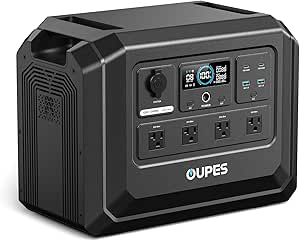 | Best for Portability With True 2000W Output | Capacity: 1,024Wh | Surge capacity: 4,500W | Battery chemistry: LiFePO4 | VIEW ON AMAZON | See Our Full Breakdown |
| EBL Acc2400 Portable Power Station, 1843.2Wh LiFePO4 Battery, 2400W Output |  | Best for Many Devices and Long Sessions | Capacity: 1,843.2Wh | Battery chemistry: LiFePO4 | Output: 2,400W | VIEW ON AMAZON | See Our Full Breakdown |
| OUPES Mega 1 Portable Power Station, 1024Wh, 2000W |  | Best for Expandable Off-Grid Capacity | Capacity: 1,024Wh | Continuous output: 2,000W | Surge output: 4,500W | VIEW ON AMAZON | See Our Full Breakdown |
| Portable Power Station 2000W Peak, 576Wh LiFePO₄ Battery Solar Generator |  | Best Lightweight Option for Lower-Power Loads | Battery capacity: 576Wh | Battery chemistry: LiFePO4 | Continuous output: 1,000W | VIEW ON AMAZON | See Our Full Breakdown |
| portable power station with 2000w output | Battery chemistry | Weight | Warranty | Capacity |
|---|---|---|---|---|
| Anker SOLIX C2000 Gen 2 Portab | LiFePO4 | 41.7 lb | 5 years | — |
| OUPES Mega 1 Lite Portable Pow | LiFePO4 | 26.7 lb | 5 years | 1,024Wh |
| EBL Acc2400 Portable Power Sta | LiFePO4 | About 54–55 lb; supplied figures differ | 2 years | 1,843.2Wh |
| OUPES Mega 1 Portable Power St | LiFePO4 | — | — | 1,024Wh |
| Portable Power Station 2000W P | LiFePO4 | 14.8 lb | 3 years | — |
More Details on Our Top Picks
Anker SOLIX C2000 Gen 2 Portable Power Station, 2,048Wh, 2,400W
I put the Anker SOLIX C2000 Gen 2 first because it combines a 2,400W rated output with a 2,048Wh LiFePO4 battery without reaching the weight of the EBL Acc2400. At 41.7 pounds, it is still a substantial carry, but the difference from the EBL’s listed 54–55 pounds matters for road trips and moving it between storage and a vehicle. Its 4,000W peak output provides headroom for brief surges, though that figure should not be confused with continuous power.
Its strongest distinction is flexibility beyond the base capacity. The station can expand to 4kWh with an additional battery, and the description lists six charging methods, including AC, solar, and car alternator charging. The claimed 58-minute AC-and-solar recharge is attractive for a quick turnaround, but depends on using both input sources; I would not treat it as the expected wall-only recharge time. The five-year warranty is longer than the EBL’s listed two years.
Compared with the OUPES Mega 1 Lite, the Anker gives buyers roughly twice the stated battery capacity and 400W more rated output, at the cost of about 15 pounds. That makes it a better fit for longer backup sessions or multiple appliances, while the Lite is the easier station to move. I would skip the Anker if frequent solo carrying is the priority or if its expansion feature is unnecessary: the base station is already heavy, and reaching 4kWh requires buying a separate battery.
Pros:- 2,048Wh LiFePO4 battery and 2,400W rated output
- Expands to 4kWh with an additional battery
- 41.7-pound weight is lower than the EBL Acc2400’s listed weight
- Five-year warranty and multiple charging methods
Cons:- Expansion battery is required to reach 4kWh
- The 58-minute recharge claim depends on combined AC and solar charging
- Still weighs 41.7 pounds, limiting easy one-handed carrying
Best for: Buyers who want high continuous output, a large base battery, optional expansion, and multiple charging routes for home backup or longer trips.
Not ideal for: People who need a light unit for frequent carrying, or who want 4kWh capacity included without buying an expansion battery.
- Battery capacity:2,048Wh
- Battery chemistry:LiFePO4
- Peak output:4,000W
- Expandable capacity:Up to 4kWh with additional battery
- Weight:41.7 lb
- AC and solar recharge claim:58 minutes
- Warranty:5 years
Our verdict“I rank the Anker first for its combination of 2,400W rated output, substantial base capacity, expansion, and more manageable weight than the EBL.”
OUPES Mega 1 Lite Portable Power Station, 1024Wh, 2000W
The OUPES Mega 1 Lite is my portability pick among the models here that provide a genuine 2,000W rated output. Its 26.7-pound weight is much easier to manage than the Anker or EBL, yet it still offers a 1,024Wh LiFePO4 battery and a 4,500W surge rating. That combination suits a buyer who needs strong output for a focused task or shorter backup period, rather than the extended runtime a larger battery can provide.
Its two 140W USB-C ports, nine total ports, app control, and UPS switchover under 20ms give it a practical role for electronics and smaller backup setups. The listed battery cycle life is over 3,500 cycles to 80% capacity. Those features make it more fully equipped than a basic travel battery, but do not erase its capacity limit: compared with the Anker’s 2,048Wh, the Mega 1 Lite starts with half as much stored energy.
The Mega 1 Lite is also lighter than the EBL Acc2400 by more than 25 pounds based on the listed figures, but the EBL has substantially more capacity and 400W more rated output. Solar charging can help extend off-grid use, though the actual recharge time depends on compatible panels and conditions. I would choose this model when mobility and 2,000W continuous output outweigh long runtime; I would skip it for sustained high loads or backup plans that need a larger reserve.
Pros:- 2,000W rated output with 4,500W surge capacity
- 26.7-pound weight is easier to carry than the larger picks
- Two 140W USB-C ports and nine total output ports
- UPS switchover under 20ms and app control
Cons:- 1,024Wh capacity is half the Anker’s stated capacity
- Solar recharge time varies with panel compatibility and conditions
- 26.7 pounds may still feel bulky for frequent long-distance carrying
Best for: Campers, mobile workers, and home users who need 2,000W rated output in a unit lighter than the larger-capacity stations.
Not ideal for: Buyers seeking long runtimes from a single charge or a large reserve for several high-draw appliances.
- Capacity:1,024Wh
- Surge capacity:4,500W
- Battery chemistry:LiFePO4
- Weight:26.7 lb
- USB-C ports:2 × 140W PD
- UPS switchover:Under 20ms
- Warranty:5 years
Our verdict“I recommend the Mega 1 Lite when carrying ease matters more than the longer runtime available from the Anker or EBL.”
EBL Acc2400 Portable Power Station, 1843.2Wh LiFePO4 Battery, 2400W Output
The EBL Acc2400 is a strong alternative to the Anker for buyers who value a broad port selection and a high-capacity base unit. Its 1,843.2Wh battery and 2,400W output put it close to the Anker’s 2,048Wh and match its rated output. Four AC outlets, USB, DC, a car port, and a wireless charging panel are listed, with support for up to 12 devices. That makes it convenient for a shared campsite or work area where several kinds of gear need power at once.
It also lists 0.1-second emergency backup switching, a display, built-in LED light, and a LiFePO4 battery rated for over 3,500 cycles. Those details give it a useful mix of everyday outputs and backup functions. Compared with the OUPES Mega 1 Lite, the EBL holds substantially more energy and adds 400W of rated output, but it weighs about 54–55 pounds. The provided specifications disagree on the exact figure, so I would plan around a roughly 55-pound carry.
That weight is the main reason I place it below the Anker. The Anker is lighter, offers expansion to 4kWh, and lists a longer five-year warranty; the EBL’s stated warranty is two years. The EBL remains a sensible choice if its port variety and nearly 1.8kWh base capacity better match the setup, and if it will mostly stay in a vehicle or fixed backup location. I would skip it for regular carrying or if a clearly stated weight and longer warranty are priorities.
Pros:- 1,843.2Wh battery with 2,400W output
- Wide range of AC, USB, DC, car, and wireless charging connections
- Supports up to 12 devices and lists 0.1-second backup switching
- LiFePO4 battery rated for over 3,500 cycles
Cons:- Listed weight is inconsistent at 54 versus 55 pounds
- Heavier than the Anker and much heavier than the OUPES Mega 1 Lite
- Two-year warranty is shorter than the Anker and OUPES Lite warranties
Best for: Buyers powering several devices at a shared worksite, campsite, or home backup point who want substantial capacity and varied ports.
Not ideal for: Anyone who must carry the station often, or who prefers consistent weight specifications and a longer listed warranty.
- Capacity:1,843.2Wh
- Battery chemistry:LiFePO4
- Output:2,400W
- AC ports:4
- Maximum supported devices:12
- Emergency backup switching:0.1 seconds
- Weight:About 54–55 lb; supplied figures differ
- Warranty:2 years
Our verdict“I favor the EBL for stationary or vehicle-based setups that benefit from many ports, but the Anker is the more balanced choice for buyers who also need easier handling.”
OUPES Mega 1 Portable Power Station, 1024Wh, 2000W
The OUPES Mega 1 begins with 1,024Wh and a true 2,000W continuous output, then stands apart through a stated expansion path to 5,120Wh using two B2 Extra Batteries. That makes it the most capacity-flexible option in this group for a buyer willing to build a larger setup over time. It does not arrive with that maximum capacity in the base unit, so buyers should compare its starting runtime with the Anker and EBL rather than treating the expansion figure as included.
Charging is another point of distinction: the Mega 1 is listed at 0–80% in 36 minutes on AC, or 26 minutes with AC and solar together. Combined charging can shorten downtime, while UPS transfer under 20ms and Bluetooth app control serve users who want backup monitoring and device control. Its 4,500W surge rating offers brief startup headroom, but the 2,000W continuous rating is the figure I would use when matching it to appliances.
Compared with the Mega 1 Lite, the Mega 1’s notable draw is its stated expansion to a far larger system, rather than a known portability advantage; no weight is supplied here, so I cannot rank it on carrying ease. The Lite has two 140W USB-C ports and a five-year warranty listed, while the Mega 1’s provided details specify two 100W USB-C ports and no warranty figure. I would pick this model for expandable off-grid use, but skip it if you want a larger battery in the box or a clear weight and warranty specification before choosing.
Pros:- 2,000W continuous output and 4,500W surge rating
- Expandable to 5,120Wh with two B2 Extra Batteries
- Fast listed AC and combined AC/solar charging
- UPS transfer under 20ms and Bluetooth app control
Cons:- Base capacity is 1,024Wh; extra batteries are needed for expansion
- Reaching 5,120Wh requires purchasing two additional batteries
- Supplied details do not state weight or warranty
Best for: Off-grid users who want 2,000W continuous output now and a path to substantially more capacity through separate expansion batteries.
Not ideal for: Buyers who want maximum capacity included in the base purchase, or who need a clearly stated weight and warranty specification.
- Capacity:1,024Wh
- Continuous output:2,000W
- Surge output:4,500W
- Battery chemistry:LiFePO4
- Expandable capacity:Up to 5,120Wh with two B2 Extra Batteries
- AC charging:0–80% in 36 minutes
- AC and solar charging:0–80% in 26 minutes
- UPS transfer time:Under 20ms
Our verdict“I rank the Mega 1 for expandable off-grid plans, while the Anker is a safer fit for buyers who want more capacity in the base station.”
Portable Power Station 2000W Peak, 576Wh LiFePO₄ Battery Solar Generator
This compact station earns a place for buyers who put easy transport ahead of sustained 2,000W power. It weighs 14.8 pounds and has a 576Wh LiFePO4 battery, making it much easier to bring on a camping trip than the 26.7-pound OUPES Mega 1 Lite. Its nine listed ports include four AC outlets, two USB-C ports, USB-A, and DC, so it can serve several smaller devices without the bulk of the larger stations.
But the headline needs careful reading: the supplied specifications state 1,000W continuous and 2,000W peak. Peak output is not the same as sustained 2,000W output, so I would not choose it for a load that needs close to 2,000W for an extended period. That puts it in a different category from every other model in this roundup, each of which lists at least 2,000W rated or continuous output. It is a compact companion, not a substitute for the Anker or EBL on demanding appliances.
Its 576Wh capacity also runs out sooner than the OUPES Mega 1 Lite’s 1,024Wh, although the lighter carry may matter more for short trips and lighter loads. The product lists AC, solar, and car charging, with 0–70% times of 1.8 hours by AC and 1.4 hours by solar or car; panels and car cables are sold separately. I would skip it if the search requirement is truly sustained 2,000W output, but it is the clearest fit for buyers who want a small, light station and understand the continuous-power limit.
Pros:- 14.8-pound weight is the lightest in this comparison
- 576Wh LiFePO4 battery with nine listed output ports
- AC, solar, and car charging options
- Three-year warranty
Cons:- Only 1,000W continuous output; 2,000W is peak output
- 576Wh capacity is lower than every other listed model
- Solar panels and car charging cables are sold separately
Best for: Campers and travelers who want a particularly light station for smaller loads and occasional short power needs.
Not ideal for: Anyone who needs 2,000W continuous output or longer operation of high-draw appliances.
- Battery capacity:576Wh
- Battery chemistry:LiFePO4
- Continuous output:1,000W
- Peak output:2,000W
- Weight:14.8 lb
- Ports:9
- AC recharge claim:0–70% in 1.8 hours
- Warranty:3 years
Our verdict“I recommend this compact station only for lighter loads, because its 2,000W peak figure does not meet the sustained-output promise of this roundup.”

How We Picked
I compared the five supplied models against the practical meaning of 2000W output: whether they can sustain a demanding load, how much stored energy sits behind that rating, and how realistic they are to move. Continuous output received more weight than a peak or surge number, because a brief startup allowance does not mean a station can operate a high-wattage appliance steadily. That distinction changes the ranking: the compact 576Wh model is useful for lighter needs, but its 1,000W continuous rating keeps it below the true 2,000W-class options.
I also weighed capacity against portability. A 2,000W rating tells me what a station can power at once, not how long it can do so. The 2,048Wh Anker and 1,843.2Wh EBL are better suited to longer or more demanding sessions than the 1,024Wh OUPES models, while the OUPES Lite’s 26.7-pound weight makes it easier to carry than either larger-capacity option. Expansion matters, but I treat it as an add-on rather than capacity included in the base unit.
Finally, I compared charging details, output ports, backup features, battery chemistry, cycle-life claims, warranty information, and the stated drawbacks. I use the specifications provided for each product and do not assume a particular appliance will run from a wattage rating alone; startup surges, operating draw, and the station’s usable energy all affect the result. The order favors a strong balance of sustained output, capacity, and mobility, then gives narrower use cases their own place.
Factors to Consider When Choosing Portable Power Station With 2000w Output
I would choose a 2000W-class power station by starting with the load and runtime I need, then checking portability and charging. The number on the label is only one part of the decision.Check continuous output before peak output
Continuous output is the rating to match against equipment that must run steadily. Peak or surge output is a brief allowance for a startup draw, not an alternative continuous rating. In this group, the Anker and EBL each list 2,400W output, and both OUPES Mega models list 2,000W rated or continuous output. The compact 576Wh station lists 1,000W continuous and 2,000W peak, so I would not count it as a station for sustained 2,000W loads.
Check the appliance label or manual for both running watts and startup requirements. A motor-driven appliance may draw more when starting than while running. I would leave some headroom rather than selecting a station whose continuous rating only just matches the expected running load.
Match battery capacity to the hours you need
Watt-hours measure stored energy, not the maximum number of watts the station can supply at once. The Anker’s 2,048Wh and the EBL’s 1,843.2Wh provide larger starting reserves than the 1,024Wh OUPES units, while the compact station has 576Wh. Actual runtime depends on the connected device’s draw, conversion losses, and how the station is used, so stated capacity does not translate directly into the same number of hours for every appliance.
For a short task or a few low-draw devices, a smaller battery may be easier to carry. For longer backup or repeated use away from a wall outlet, I would favor more base capacity. Treat expansion as a separate purchase: the Anker’s 4kWh and Mega 1’s 5,120Wh figures require additional batteries.
Be realistic about weight and where the unit will sit
The weight spread here is substantial: 14.8 pounds for the compact station, 26.7 pounds for the OUPES Mega 1 Lite, 41.7 pounds for the Anker, and about 54–55 pounds for the EBL. The Mega 1’s supplied details do not give a weight. A lighter unit is easier to move between a car and campsite, while a heavier, higher-capacity station may make more sense beside a home backup load or in a vehicle.
I would also check the space where the station will be stored and how it will be lifted. The EBL’s two supplied weight figures conflict, so its listed weight should be read as approximate. A station that stays in one place can be selected differently from one that needs frequent carrying.
Compare charging claims by input source
Fast recharge figures depend on the charging setup. The Anker’s 58-minute claim uses AC and solar together, rather than AC alone. The OUPES Mega 1 lists a 26-minute 0–80% combined AC-and-solar charge and 36 minutes on AC. These are product-provided claims, and real results depend on available input power and conditions. For solar charging, panel compatibility and sunlight affect the result.
If you expect to charge from a vehicle, check whether the required cable or charging equipment is included. The compact station’s solar panels and car charging cables are listed as separate items. A quick recharge can be useful between trips, but the battery’s capacity and the power source you can actually access matter just as much.
Choose ports and backup features for your setup
Port counts help only when the types and power ratings suit your devices. The EBL lists four AC outlets and a mix of USB, DC, car, and wireless charging, making it a natural fit for several different devices. The OUPES Mega 1 Lite lists two 140W USB-C ports, while the Mega 1 lists two 100W USB-C ports. Check each output’s rating against the gear you intend to connect rather than relying only on the total port count.
For electronics that need power during an outage, compare transfer-time claims: the EBL lists 0.1-second emergency backup switching, and both OUPES Mega models list UPS switching under 20ms. A backup feature does not by itself establish that a station suits every sensitive device or installation. I would check the manufacturer’s directions and the connected equipment’s requirements before relying on it as an uninterrupted power source.
Frequently Asked Questions
Does a 2000W power station run any appliance rated below 2000W?
Not automatically. The appliance’s running draw must fit within the station’s continuous output, and a device with a motor or compressor may need extra power when it starts. I would check both the appliance’s running and startup requirements, then compare them with the station’s continuous and surge ratings. The compact model in this roundup illustrates why the distinction matters: it lists 2,000W peak but only 1,000W continuous.
Which option has the largest battery included in the base unit?
The Anker SOLIX C2000 Gen 2 has the largest stated base capacity here at 2,048Wh, followed by the EBL Acc2400 at 1,843.2Wh. Both are ahead of the 1,024Wh OUPES Mega 1 and Mega 1 Lite, while the compact station has 576Wh. The Mega 1 can expand to 5,120Wh and the Anker to 4kWh, but each maximum requires additional battery hardware.
Which station is easiest to carry?
The 576Wh compact station is the lightest at 14.8 pounds, but its continuous output is only 1,000W. Among the models with a true 2,000W-or-higher rated output and a supplied weight, the OUPES Mega 1 Lite is the lightest at 26.7 pounds. The Anker weighs 41.7 pounds, and the EBL is listed at about 54–55 pounds; the supplied details do not state the Mega 1’s weight.
Can I use solar panels to recharge these power stations?
The supplied descriptions list solar charging for each model, but the required panel setup, input limits, and recharge time vary. The Anker’s 58-minute claim combines AC and solar, while the OUPES Mega 1 lists a 26-minute 0–80% combined AC-and-solar claim. Solar performance depends on compatible equipment and conditions, and the compact unit’s solar panels are sold separately. I would check the manufacturer’s compatible panel and input specifications before buying accessories.
Which model should I choose for home backup?
For more stored energy in the base unit, I would compare the Anker and EBL first: they list 2,048Wh and 1,843.2Wh respectively, both with 2,400W output. The Anker is lighter, expandable to 4kWh, and has a five-year warranty listed; the EBL offers a wide mix of ports and 0.1-second emergency switching, but is heavier and has a two-year warranty. For backup-sensitive electronics, confirm that the station’s transfer behavior and output suit the equipment, and check the manufacturer’s instructions for the intended setup.
Conclusion
For most buyers seeking a portable power station with genuine 2000W-class output, I would start with the Anker SOLIX C2000 Gen 2: it balances a 2,400W rating, 2,048Wh base battery, expansion, and lower weight than the EBL. Choose the OUPES Mega 1 Lite if portability is the priority and 1,024Wh is enough for your planned use. Pick the EBL Acc2400 for a high-capacity, many-port setup that will mostly stay put, and the OUPES Mega 1 if you want to add batteries toward a larger off-grid system over time. I would select the 576Wh compact model only for lighter loads where a 1,000W continuous limit works; its 2,000W peak rating does not meet a sustained 2,000W requirement.
Fall Picks
fall essentials
As an affiliate, we earn on qualifying purchases.