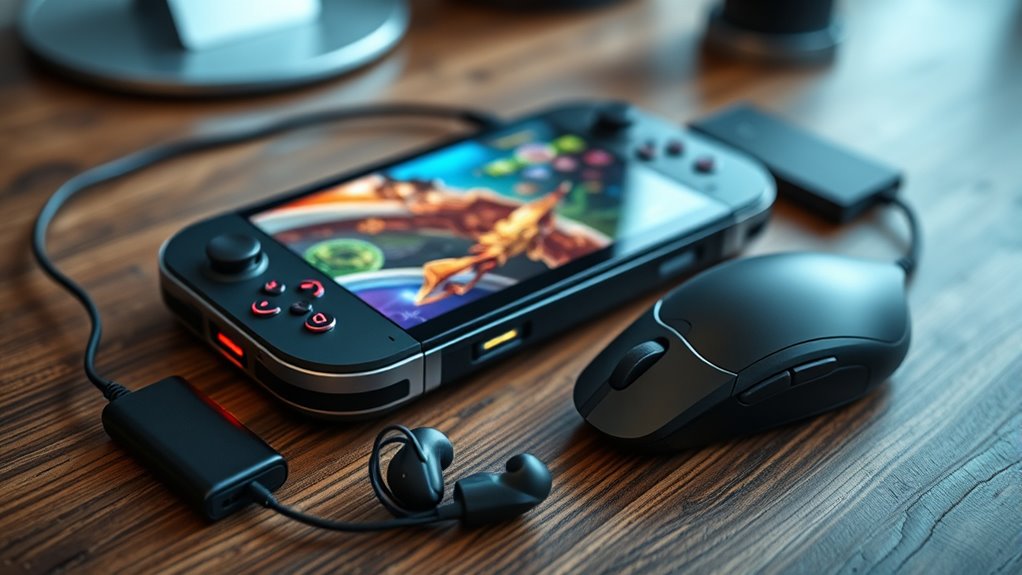

Handheld gaming PC accessories can make desk play more comfortable, add ports for a monitor and peripherals, or simplify charging on the go. I’d choose the JSAUX 6-in-1 Docking Station as the best overall because its dock format suits a broader range of desk setups, while the MEPATEM 6-in-1 Docking Station is a value-minded alternative and the Lenovo Legion Go Charging Connector with Battery is tailored to portable charging. The main tradeoff is between a simple stand, which takes up little space but adds no connectivity, and a dock, which can expand your setup but needs more room and cable management. Device compatibility matters just as much as features, especially for model-specific stands and charging connectors. Read on for how each option fits a different handheld gaming setup.

Turn the school run and nap time into listening time
- Thousands of audiobooks, podcasts and originals
- Listen on your phone, tablet or Echo — also offline
- Cancel anytime
Complete the kit


Key Takeaways
- JSAUX’s 6-in-1 dock earns the overall pick for buyers who want to build a desk setup around a handheld, while a stand alone cannot provide that connectivity.
- MEPATEM’s 6-in-1 dock is the alternative to compare when dock functionality matters but the Razer hub’s Chroma-focused design is not a priority.
- The Lenovo Legion Go Charging Connector with Battery serves a different need from either dock: portable charging for Legion Go owners rather than a permanent desk hub.
- The two desktop stands have different compatibility targets. Check your exact handheld before choosing the broader multi-device stand or the ASUS ROG Xbox Ally and Ally X stand.
- The Razer Handheld Dock Chroma Charging Hub appears twice in the supplied lineup. It is one distinct product, so the roundup should not treat the duplicate listing as a separate recommendation.
| Desktop Stand for ROG Xbox Ally, PlayStation Portal, Steam Deck, ROG Ally, and Switch 2 |  | Best Simple Display Stand | Compatibility: ROG Xbox Ally, ROG Xbox Ally X, PlayStation Portal, Steam Deck, ROG Ally, ROG Ally X, Nintendo Switch 2 | Color: Black | Material: High-quality materials; specific material not stated | VIEW ON AMAZON | See Our Full Breakdown |
| MEPATEM 6-in-1 Gaming Docking Station for Steam Deck and Other USB-C Devices |  | Best Adjustable Multi-Device Dock | Compatible devices: Steam Deck, Steam Deck OLED, ROG Ally, ROG Ally X, Legion Go, iPads, USB-C Android phones | Video output: HDMI 2.0, up to 4K at 60Hz | USB ports: 3 USB-A ports | VIEW ON AMAZON | See Our Full Breakdown |
| JSAUX 6-in-1 Docking Station for Steam Deck, ROG Ally X, and Legion Go |  | Best for High-Refresh External Displays | Compatible devices: Steam Deck LCD/OLED, ROG Ally/Ally X, Legion Go/Go S/2, MSI Claw/8 AI+, OneXPlayer | HDMI: 1 HDMI 2.1 port, up to 4K at 120Hz | Total ports: 6 | VIEW ON AMAZON | See Our Full Breakdown |
| Lenovo Legion Go Charging Connector with Battery |  | Best Legion Go Controller Battery Add-On | Compatibility: Lenovo Legion Go controllers | Battery capacity: 2850mAh | Charging connection: USB-C | VIEW ON AMAZON | See Our Full Breakdown |
| Razer Handheld Dock Chroma Charging Hub |  | Best Renewed Multi-Port Hub | Condition: Renewed | Total ports: 6 | USB-A ports: 3 | VIEW ON AMAZON | See Our Full Breakdown |
| Desktop Stand for ASUS ROG Xbox Ally and Ally X |  | Best for a Dedicated Charging Cradle | Compatibility: ASUS ROG Xbox Ally and Ally X | Stand type: Desktop stand | Charging feature: Charging cradle | VIEW ON AMAZON | See Our Full Breakdown |
| Razer Handheld Dock Chroma Charging Hub |  | Best for a Portable Full-Connectivity Setup | Hardware interface: USB | Total ports: 6 | USB ports: 3 | VIEW ON AMAZON | See Our Full Breakdown |
More Details on Our Top Picks
Desktop Stand for ROG Xbox Ally, PlayStation Portal, Steam Deck, ROG Ally, and Switch 2
This stand suits players who want a stable place to set down a handheld between sessions, without adding a full dock. Its anti-slip silicone pad helps keep compatible devices in position, and the rear opening is designed to accommodate a PlayStation Portal charger. Compared with the MEPATEM 6-in-1 Gaming Docking Station, it takes up a simpler role: it holds a device but does not add video output, USB ports, or network connectivity. Broad compatibility across Steam Deck, ROG Ally models, Switch 2, and PlayStation Portal makes it flexible if your handheld changes. The tradeoff is that the charging detail is specific to PlayStation Portal, while the stated material is vague. Choose it for tidy storage and display; skip it if you need a desk dock for playing on a monitor.
Pros:- Anti-slip pad helps stabilize compatible devices
- Rear opening accommodates a PlayStation Portal charger
- Supports several handheld families, including Steam Deck, ROG Ally, and Switch 2
Cons:- Does not provide display output or connectivity ports
- Charging accommodation is specifically described for PlayStation Portal
- Material type is not specified
Best for: Handheld owners who want a stable desktop resting spot, especially PlayStation Portal users who need room for its charger
Not ideal for: Players who need HDMI output, USB expansion, Ethernet, or a charging setup specified for handhelds other than PlayStation Portal
- Compatibility:ROG Xbox Ally, ROG Xbox Ally X, PlayStation Portal, Steam Deck, ROG Ally, ROG Ally X, Nintendo Switch 2
- Color:Black
- Material:High-quality materials; specific material not stated
- Stability feature:Anti-slip bottom pad
- Charger accommodation:Rear opening for PlayStation Portal charger
- Product type:Desktop stand
Our verdict“Pick this stand for simple, stable desktop storage across several handhelds; choose a dock if you need ports or an external display.”
MEPATEM 6-in-1 Gaming Docking Station for Steam Deck and Other USB-C Devices
The MEPATEM dock is a practical fit for players who move between handheld gaming and a monitor setup. Its adjustable viewing angle and weighted aluminum base support desk play, while HDMI 2.0 can send video to a display at up to 4K at 60Hz. Three USB-A ports, power delivery, and Gigabit Ethernet also cover common desk connections. Compared with the JSAUX 6-in-1 Docking Station, MEPATEM emphasizes angle adjustment and wide USB-C device compatibility; JSAUX offers HDMI 2.1 and up to 4K at 120Hz for compatible devices. MEPATEM’s stated case fit is a real constraint: protective cases with kickstands are unsupported, and the case limitation is listed as less than 4 mm. It makes sense for a mixed-device desk, but not for thick-cased handhelds or buyers seeking higher refresh-rate output.
Pros:- Adjustable stand and weighted aluminum base support desk viewing
- HDMI 2.0 supports up to 4K at 60Hz
- Three USB-A ports, power delivery, and Gigabit Ethernet expand desk connectivity
- Works with several handhelds, iPads, and USB-C Android phones
Cons:- Does not support protective cases with kickstands
- Case fit is limited to less than 4 mm
- HDMI output tops out at 60Hz, below the JSAUX dock’s stated 120Hz capability
Best for: Steam Deck, ROG Ally, and USB-C tablet owners who want an adjustable desk dock for a 4K 60Hz monitor
Not ideal for: Handheld owners using protective cases with kickstands or cases thicker than the stated less-than-4-mm fit limit
- Compatible devices:Steam Deck, Steam Deck OLED, ROG Ally, ROG Ally X, Legion Go, iPads, USB-C Android phones
- Video output:HDMI 2.0, up to 4K at 60Hz
- USB ports:3 USB-A ports
- Total ports:6
- USB interface:USB 3.0
- Power delivery:100W
- Dimensions:2.6 × 4.5 × 1.3 in
- Material and color:Aluminum alloy, black
- Warranty:2 years
Our verdict“Choose MEPATEM for adjustable positioning and broad USB-C device support, provided your handheld case fits and 4K 60Hz output is enough.”
JSAUX 6-in-1 Docking Station for Steam Deck, ROG Ally X, and Legion Go
Among these docks, JSAUX is the pick for buyers whose display setup can use its higher video-output ceiling. HDMI 2.1 supports up to 4K at 120Hz, alongside 100W USB-C PD, three USB-A 3.0 ports, and Gigabit Ethernet. That makes it a stronger match than the MEPATEM 6-in-1 for a compatible handheld connected to a high-refresh display, though the display, device, and cable must also support the target mode. Its 170 g weight and compact footprint make it easy to leave on a desk or pack away. Compatibility is the key catch: it supports listed Steam Deck, ROG Ally, Legion Go, MSI Claw, and OneXPlayer models, but explicitly excludes ROG Xbox Ally and Xbox Ally X. It also recommends a 100W charger for ROG Ally Turbo Mode.
Pros:- HDMI 2.1 output supports up to 4K at 120Hz
- Up to 100W USB-C PD charging
- Three USB-A 3.0 ports and Gigabit Ethernet
- Compact 170 g design with broad listed handheld compatibility
Cons:- Not compatible with ROG Xbox Ally or Xbox Ally X
- A 100W charger is recommended for ROG Ally Turbo Mode
- The 120Hz output ceiling only helps when the handheld and display setup support it
Best for: Owners of supported Steam Deck, ROG Ally, Legion Go, MSI Claw, or OneXPlayer models who want high-refresh external display output
Not ideal for: ROG Xbox Ally or Ally X owners, and anyone whose display setup cannot use HDMI 2.1 or 4K at 120Hz
- Compatible devices:Steam Deck LCD/OLED, ROG Ally/Ally X, Legion Go/Go S/2, MSI Claw/8 AI+, OneXPlayer
- HDMI:1 HDMI 2.1 port, up to 4K at 120Hz
- Total ports:6
- USB ports:4 total, including 3 USB-A 3.0 ports
- Charging:Up to 100W USB-C PD
- Ethernet:Gigabit Ethernet
- Dimensions:1.26 × 4.29 × 6.02 in
- Weight:170 g
Our verdict“Pick JSAUX for high-refresh monitor play with a listed compatible handheld, and check the model carefully if you own an Xbox Ally.”
Lenovo Legion Go Charging Connector with Battery
This accessory addresses a specific Legion Go problem: using the detached controllers together can call for a grip, and this connector joins them into one while adding a 2850mAh rechargeable battery. That makes it distinct from the Razer Handheld Dock Chroma, which expands ports for a desk or display setup rather than extending controller use. The built-in battery is designed to double controller life, and USB-C charging gives the connector a familiar charging route. Its usefulness depends entirely on owning Legion Go controllers, however; it does not include them and has no stated support for other handhelds. Compared with a general-purpose stand or dock, this is a narrow accessory with a focused payoff. Choose it if you often play with detached controllers and want a unified grip; skip it if you use another handheld or keep the controllers attached.
Pros:- Built-in battery is designed to double controller life
- Joins Legion Go controllers into an ergonomic grip
- USB-C charging connection
- Pogo-pin power connection is described as durable
Cons:- Compatible only with Lenovo Legion Go controllers
- Controllers are not included
- Adds little value for players who rarely use detached controllers
Best for: Legion Go owners who often detach both controllers and want a joined grip with added battery capacity
Not ideal for: Players without Legion Go controllers or those seeking a general-purpose handheld stand, charging dock, or port hub
- Compatibility:Lenovo Legion Go controllers
- Battery capacity:2850mAh
- Charging connection:USB-C
- Included controllers:No
- Controller connection:Pogo-pin power connection
- Product function:Joins controllers into an ergonomic grip and adds a rechargeable battery
Our verdict“Choose this connector if detached Legion Go controller sessions need a joined grip and more battery life.”
Razer Handheld Dock Chroma Charging Hub
Razer’s six-port hub is aimed at handheld owners who want to connect a display and wired accessories from one dock. It combines HDMI, Gigabit Ethernet, three USB-A ports, and one USB-C port, with power support up to 100W. That makes it more suited to a connected desk setup than the Desktop Stand for ROG Xbox Ally, PlayStation Portal, Steam Deck, ROG Ally, and Switch 2, which holds a device but adds no ports. Its stated device list includes ROG Ally, Steam Deck, Switch, and iPhone 16. The main tradeoff is condition: this listing is Renewed and carries a 90-day limited warranty, while MEPATEM specifies a two-year warranty. The product data does not state a video resolution or refresh-rate limit, so buyers comparing monitor output should verify that detail before choosing it.
Pros:- Six-port layout includes HDMI, Gigabit Ethernet, and four USB ports
- Supports up to 100W of power
- Compatible device list includes ROG Ally, Steam Deck, Switch, and iPhone 16
Cons:- This listing is in Renewed condition
- 90-day limited warranty is shorter than the two-year warranty listed for MEPATEM
- Video resolution and refresh-rate details are not provided
Best for: Handheld owners with a compatible device who want HDMI, Ethernet, and USB connections in one renewed hub
Not ideal for: Buyers who prefer a new unit, want a longer stated warranty, or need confirmed HDMI resolution and refresh-rate specifications
- Condition:Renewed
- Total ports:6
- USB-A ports:3
- USB-C ports:1
- Video output:1 HDMI port; resolution and refresh rate not specified
- Ethernet:Gigabit Ethernet
- Power:Up to 100W
- Compatible devices:ROG Ally, Steam Deck, Switch, iPhone 16
- Warranty:90-day limited warranty
Our verdict“Pick the Razer hub for its mix of display, network, and USB connections if renewed condition and limited warranty suit you.”
Desktop Stand for ASUS ROG Xbox Ally and Ally X
This stand suits owners who want a fixed place to dock an ASUS ROG Xbox Ally or Ally X and keep its charging cable routed from behind. The rear opening makes a charging setup neater than a basic display stand, while non-slip base pads help limit movement when placing or lifting the handheld. Compared with the Razer Handheld Dock Chroma Charging Hub, this is a simpler, device-specific stand rather than a multiport hub for displays, networking, and peripherals. That focus also means fewer setup choices and less connectivity to manage. The product description also mentions PlayStation Portal compatibility, which conflicts with its stated ASUS compatibility; buyers should confirm the fit before ordering. It makes the most sense for an ASUS handheld owner who values tidy charging over added ports.
Pros:- Designed for ASUS ROG Xbox Ally and Ally X
- Charging cradle includes a rear opening for charger access
- Non-slip pads help keep the stand steady
- Simple desktop setup focused on storage and charging
Cons:- No HDMI, Ethernet, or USB expansion is listed
- Description’s PlayStation Portal compatibility claim conflicts with its ASUS-specific fit
Best for: ROG Xbox Ally and Ally X owners who want a stable desktop charging spot with rear cable access
Not ideal for: Players who need HDMI, Ethernet, or extra USB ports, or buyers who need confirmed PlayStation Portal fit
- Compatibility:ASUS ROG Xbox Ally and Ally X
- Stand type:Desktop stand
- Charging feature:Charging cradle
- Cable access:Rear charger opening
- Base:Non-slip pads
- Construction:Durable materials
Our verdict“Choose this stand for a dedicated, cable-neat charging spot for an ROG Xbox Ally or Ally X, provided the compatibility details match your device.”
Razer Handheld Dock Chroma Charging Hub
The Razer Handheld Dock Chroma Charging Hub is the most connectivity-focused choice here: its six ports pair HDMI and gigabit Ethernet with three USB ports, turning a compatible handheld into a small desk setup. 100 W passthrough charging can keep power flowing while accessories are connected, and the adjustable stand offers 45° and 75° viewing angles. Compared with the MEPATEM 6-in-1 Gaming Docking Station, Razer adds a collapsible aluminum design and customizable Chroma lighting, making portability and appearance a bigger part of the package. That versatility comes with a 500 g weight, and the listed device compatibility does not guarantee every feature works identically across handhelds, phones, and tablets. Choose it when you want display, network, and USB connections in one portable hub; skip it if a simple charging cradle is enough.
Pros:- Six ports include HDMI, three USB ports, and 1 Gbps Ethernet
- 100 W passthrough power delivery supports charging while docked
- Collapsible aluminum design and adjustable stand suit portable setups
- Customizable Chroma RGB lighting
Cons:- At 500 g, it adds noticeable weight to a travel kit
- More connectivity and features than needed for buyers who only want a charging stand
- Listed device compatibility does not specify feature behavior for each device
Best for: Handheld PC owners who move between desks and want HDMI, Ethernet, USB expansion, and an adjustable stand in one dock
Not ideal for: Players seeking a lightweight charging stand or a dock with confirmed identical functionality across all listed phones and handhelds
- Hardware interface:USB
- Total ports:6
- USB ports:3
- Video output:1 HDMI port
- Ethernet:1 Gbps
- Power delivery:100 W passthrough
- Viewing angles:45° and 75°
- Weight:500 g
- Listed compatible devices:Legion Go, Nintendo Switch, Nintendo Switch OLED, ROG Ally, Samsung Galaxy S24, Samsung Galaxy S25, Steam Deck, iPhone 15, iPhone 16
Our verdict“Pick the Razer hub if you want a portable dock for display, networking, USB accessories, and charging in one unit.”

How We Picked
I ranked these accessories by how directly they solve common handheld gaming PC needs: stable desk placement, useful connectivity, charging support, portability, and fit with named devices. I gave the broadest desk utility to a dock that can support a more complete setup, while standalone stands rank lower for buyers who also need display or peripheral connections. A dedicated battery connector has a narrower role, but can make more sense for portable play than a desk-focused hub.
Compatibility and tradeoffs shaped each role. A model-specific accessory can be the better fit when its target device matches, but offers less flexibility across a mixed-device household. The Razer dock’s lighting-oriented identity may appeal to buyers building a coordinated setup, while simpler stands prioritize support with fewer added functions. The supplied list repeats that Razer product, so I count it once rather than presenting duplicate entries as distinct choices.
Factors to Consider When Choosing Handheld Gaming Pc Accessories
Before choosing an accessory, decide what problem you want it to solve in your actual setup. A stand, dock, and battery connector address different points in the play session, and choosing by feature count alone can leave you with the wrong fit.
Match the accessory to your play location
Start by deciding whether the accessory will live on a desk or travel with the handheld. A stand or dock can improve a fixed setup, but a larger base and extra cables may become clutter in a bag. A battery-equipped connector points toward portable play, where access to an outlet is less reliable. Think about where you usually stop playing and charge, not just where you begin. If you split time between a desk and travel, check whether carrying the accessory is practical before buying. A dedicated home accessory and a small travel charger can be a better split than one bulky item for both jobs.
Check the exact device fit
Accessory names can cover one device, a few named models, or a wider set of USB-C devices, and those claims are not interchangeable. Check the precise handheld model and any revision, particularly with shaped stands or connectors that attach directly to the device. A fit that works for one ROG Ally model may not work for another simply because the names are similar. Also check whether a case changes the way the device rests or connects. For docks, confirm that the handheld supports the video and data features you expect from its USB-C port. This small compatibility check can prevent buying an accessory whose headline features your device cannot use.
Decide which connections you will actually use
A dock’s port count matters less than whether it includes the connections your setup needs. List the monitor, controller, storage, and other peripherals you plan to attach, then check the dock’s port types and supported display output. Avoid assuming that every USB-C dock provides the same video, data, or charging behavior. A stand may be enough if you only want a raised screen and already connect peripherals another way. Extra ports add flexibility, but they also add cables and take up desk space. Choose for your current setup and likely next addition, rather than paying attention to the largest number on the box.
Treat charging as a separate requirement
Charging support can mean very different things across a dock and a battery connector. Confirm what power source each accessory needs and whether charging happens alongside display output or other connections. A dock that accepts a charger may help keep a desk setup powered, but it still depends on that external power source. A battery attachment can reduce dependence on an outlet, while adding weight and a device-specific connection. Check the required power adapter and cable separately; they may affect what else you need to buy or carry. Decide whether you want power at a desk or extra runtime away from one before comparing these designs.
Balance desk stability with portability
A stable base can make tabletop play more comfortable, but a stand’s angle and footprint should suit your desk and viewing position. If you use an external controller, check that the handheld can sit securely without blocking access to its ports. Compact stands are easier to store, although they may offer less flexibility in positioning. Docks can steady a device while also organizing connections, but that convenience can come with more bulk. For portable use, consider the packed size and whether the accessory needs extra cables or a power adapter. The best form is the one you will keep set up or actually carry.
Pay for features that change your routine
Premium styling or lighting can make a setup feel coordinated, but it does not replace compatibility, stable placement, or useful connections. If visual design matters to you, consider whether the Razer Chroma hub’s lighting-focused appeal fits the rest of your desk. For a first accessory, a straightforward stand may be easier to use than a dock if you do not need extra connections yet. A dock becomes a more compelling purchase when it replaces several adapters or makes connecting a monitor and peripherals simpler. A battery connector has a clearer case when portable runtime is the recurring problem. Spending more makes sense when the added feature solves a problem you encounter regularly.
Frequently Asked Questions
Should I get a stand or a docking station for my handheld gaming PC?
Choose a stand if you mainly want a stable viewing angle and already have a separate way to connect peripherals. Choose a dock if you plan to use a monitor, wired accessories, or several connections from one desk setup. A dock needs more space and usually brings more cables, so its extra functions are useful only if you will use them. Check whether your handheld supports the dock’s video output and charging features. If you are unsure, list the devices you want to connect before deciding.
Will a USB-C dock work with any handheld gaming PC?
USB-C by itself does not guarantee that every dock feature will work. The handheld must support the relevant video output, data functions, and power behavior for the connections you want. Check the dock’s compatibility information against the exact model of your handheld, rather than relying on the connector shape alone. A dock may still provide some functions while lacking another, such as display output. Confirm the specific features before building a setup around it.
Is a battery connector a better choice than a dock for Legion Go owners?
It depends on where your charging problem occurs. The Lenovo Legion Go Charging Connector with Battery is aimed at portable power, while a dock is better suited to connecting a handheld to desk peripherals. The battery accessory may add bulk and only fits its intended device, so it is a poor match if you want one accessory for several handhelds. A dock still depends on an external power source for charging. Choose based on whether extra runtime away from an outlet or desk connectivity matters more to you.
Can I use a handheld stand with a protective case?
That depends on the stand’s cradle shape, the case’s thickness, and whether the case changes access to the ports. A broad, open stand may accommodate cases more readily than a close-fitting model-specific design, but product names alone do not confirm a fit. Check the manufacturer’s compatibility details and compare the stand’s contact points with your device and case. Also consider whether the case makes the handheld less stable on a narrow base. If case compatibility is unclear, a stand with an open support design is the more flexible direction.
Why is the Razer Handheld Dock listed twice, and should I treat them as different options?
The supplied lineup repeats the same Razer Handheld Dock Chroma Charging Hub name, with no separate model detail to distinguish the entries. I count it as one product rather than assigning it two roles or presenting it as two competing choices. If you have seen two listings elsewhere, compare their model identifiers and included accessories to check whether one is a different revision or bundle. The duplicate here does not provide evidence of a second distinct accessory. Base your choice on the actual model and its fit with your setup.
Conclusion
For most desk setups, I’d start with the JSAUX 6-in-1 Docking Station as the best overall pick, especially if you want a dock to connect a handheld and peripherals. The MEPATEM 6-in-1 Docking Station is the best value-minded choice for buyers focused on dock functionality, while the Razer Handheld Dock Chroma Charging Hub is the premium-style option for a desk where its Chroma design appeals. Beginners who only need a secure place to set down a device can start with the Desktop Stand for ROG Xbox Ally, PlayStation Portal, Steam Deck, ROG Ally, and Switch 2, after confirming fit. For portable Legion Go charging, choose the Lenovo Legion Go Charging Connector with Battery; for a stand tailored to ASUS ROG Xbox Ally or Ally X, choose the matching model-specific stand. The Razer entry is duplicated in the supplied list, so I count it as one recommendation.