
TL;DR

Turn the school run and nap time into listening time
- Thousands of audiobooks, podcasts and originals
- Listen on your phone, tablet or Echo — also offline
- Cancel anytime
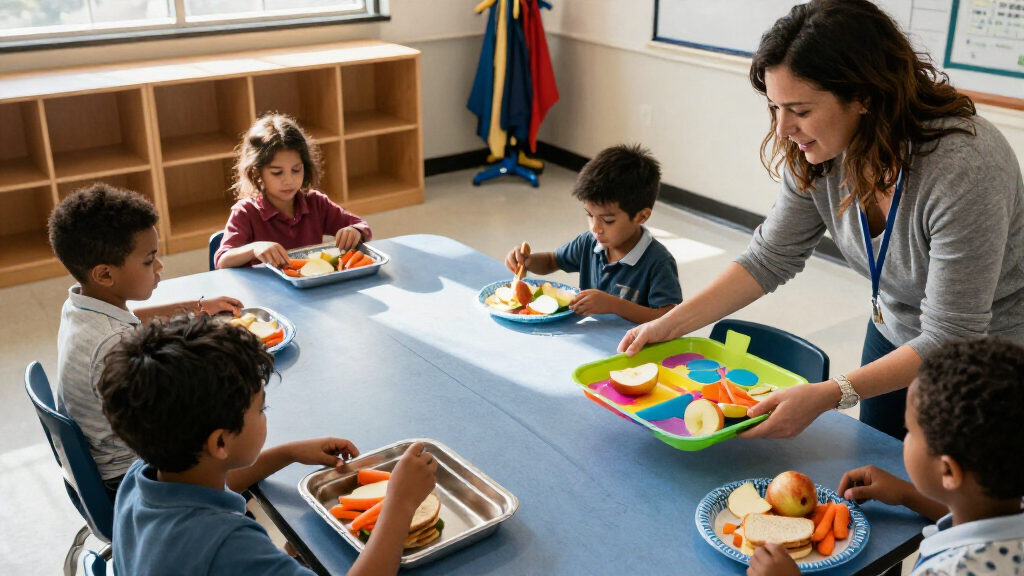
A commentary published by The 74 argues that American schools give students too little nutrition and food-system education, and that food can be used to teach subjects from math to history. The author describes classroom projects run with Pilot Light, while the article’s claims about attendance and the effects of its approach are not accompanied by detailed study data.
The 74 published an opinion essay arguing that American schools should teach more about food, connecting it to academic subjects, health and civic life. The author, a Chicago chef and co-founder of Pilot Light, says food-based lessons can help students understand where food comes from and how food systems affect people and communities.
The essay says the average U.S. student receives fewer than eight hours of nutrition education a year and that about half of schools have district- or state-level food education requirements. It also cites Centers for Disease Control and Prevention data stating that roughly one in five children and teenagers are obese, compared with a rate more than four times lower in the early 1970s. The article frames these figures as reasons to treat food knowledge as an educational concern, not only a health issue.
The author describes Pilot Light, a nonprofit that helps teachers use food to teach subjects already in the curriculum. Students might scale a cookie recipe to work with percentages, use produce from a school garden to practice literary devices, or trace rice through agricultural history and cultures in an AP World History lesson. The essay says food gives students a familiar starting point for questions about production, labor, environmental effects and who profits.
The examples also include student action beyond classwork. The essay recounts Chicago students holding a City Hall press conference to advocate against Styrofoam, and third graders who designed a predator-resistant chicken coop after a predator killed chickens they had been raising. The author presents these efforts as practical lessons in problem-solving and civic participation, rather than as proof that food education alone can resolve broader health or environmental problems.
Food Lessons Reach Beyond Nutrition
The argument matters because it links what students eat and learn about food with skills schools already aim to develop: critical thinking, literacy, science and civic engagement. Lessons about ingredients, farming and packaging can give abstract subjects a concrete setting, while encouraging students to examine systems that shape daily life.
The essay also challenges the idea that food instruction should be limited to advice about individual choices. The author argues that students need opportunities to ask how food is produced, how it reaches them and how costs and benefits are distributed. That wider approach could help children interpret claims about health and sustainability, though the essay does not establish that the program’s classroom model is effective across different schools or communities.
Products Worth Considering

eufy Security Essential Alarm System, 7-Piece

Philips Hue Essential Starter Kit with Bridge and 4 E26 Smart Bulbs

Philips Hue Starter Kit with Bridge Pro and 4 Retrofit LED Recessed Downlights
As an affiliate, we earn on qualifying purchases.
Pilot Light’s Classroom Approach
The author says they have worked as a chef in Chicago for 27 years and helped co-found Pilot Light 16 years ago. The nonprofit’s approach, as described in the essay, is to help teachers incorporate food into subjects rather than treat it as a separate unit or a nutrition poster. Examples range from compost in biology to rice and agricultural traditions in history.
The article says students have been more likely to attend on Pilot Light days over the organization’s 15 years, but it supplies no attendance figures, comparison group or research methods. That limits what can be concluded from the claim. The piece is an opinion essay drawing on the author’s experience, not an independent evaluation of the program or a report announcing a new policy.
“Taking care of your own body turns out to be a requisite for taking care of the body politic.”
— The essay’s author
Evidence and Access Remain Unclear
The source does not identify a specific new school policy, funding decision or national initiative. It also does not provide the publication date, detailed methods behind its figures on nutrition instruction and school requirements, or research supporting the claim that attendance rises on Pilot Light days. The CDC statistic is cited in the essay, but the source does not give a direct link or specify the data year.
It is also unclear how widely Pilot Light’s lessons are used, how they are adapted for schools with different resources, or whether the reported student projects led to lasting changes. The examples illustrate the author’s case but do not establish outcomes for food education programs generally.
A Call for School-Level Debate
The essay’s immediate next step is a public discussion about whether food education should have a larger place in schools. It urges families, teachers and school leaders to treat the subject as part of preparing students to understand the world they inherit. No specific legislative proposal, school adoption plan or implementation date is announced in the source.
Any wider expansion would require decisions about curriculum time, teacher support and how schools address food without reducing complex issues to simplistic instructions. The source leaves those questions open; it makes the case for asking them rather than setting out a policy blueprint.
Key Questions
What is the essay arguing?
It argues that schools should teach more about food and use it to connect academic subjects, health and civic life.
Who is behind the classroom examples?
The examples come from the essay’s author, a Chicago chef and co-founder of Pilot Light, a nonprofit that helps teachers incorporate food into existing lessons.
Does the essay announce a new school policy?
No. It is an opinion essay advocating for more food education; it does not announce a government or school-system policy change.
What evidence does the source provide about the program?
It offers classroom examples and says students were more likely to attend on Pilot Light days, but gives no attendance data or evaluation methods to quantify that claim.
What remains uncertain?
The source does not establish how widely the approach is used, its effects across schools, or what funding and curriculum changes would be needed to expand it.
Source: the74million.org