

TL;DR
A local AI tool like ChannelHelm turns one video into a full set of publishing assets—transcripts, social, media kits—all on your machine. It speeds up content repurposing without sacrificing privacy or control, perfect for authors and creators who handle sensitive or proprietary material.
Imagine finishing a single video and instantly having a suite of ready-to-publish assets—social snippets, articles, media kits—without uploading a thing to the cloud. That’s the promise of a local-first workflow. It’s fast, secure, and puts you in total control of your content. No more waiting on APIs or worrying about data leaks.
This article will show you how a tool like ChannelHelm can make that happen. We’ll explore what it produces, how it works offline, and why it’s a game-changer for creators who value speed and privacy. If you ever felt overwhelmed by repurposing content, this approach might just change your whole process.
Key Takeaways
- A local-first AI workflow can transform one video into a full set of publishing assets in minutes.
- Offline processing enhances privacy and speeds up turnaround times by up to 50%.
- A unified publishing package simplifies multi-channel distribution, maintaining brand consistency.
- Provenance tracking builds trust and allows precise editing of generated assets.
- Start small: test with short videos, tweak prompts, and gradually scale your content production.
![WavePad Audio Editing Software - Professional Audio and Music Editor for Anyone [Download]](https://m.media-amazon.com/images/I/B1fcLEGCs6S._SL500_.png)
WavePad Audio Editing Software – Professional Audio and Music Editor for Anyone [Download]
- Professional Audio Editor: Record and edit music, voice, audio
- Audio Effects: Echo, noise reduction, reverb, more
- Supported Formats: WAV, MP3, FLAC, OGG, and more
As an affiliate, we earn on qualifying purchases.
As an affiliate, we earn on qualifying purchases.
What exactly do you get from one video? The full publishing kit explained
When you drop a video into this workflow, it’s not just a transcript. You get a bundle of assets: a detailed transcript with speaker labels, social snippets, blog drafts, media kits, and short clips optimized for platforms like TikTok or Instagram.
For example, upload a 30-minute interview, and in minutes, you could have:
- A polished YouTube title and description
- Multiple social captions tailored for each network
- Vertical cuts for Reels and Shorts
- A media kit with high-res and web-ready images
- A blog draft highlighting key moments
This isn’t guesswork. Each asset is generated from a layered understanding of your video—what’s spoken, shown, and the moments that grab attention. It’s like having a mini publishing factory on your desktop.
Understanding exactly what assets are produced helps you plan your distribution more effectively. For instance, knowing which clips are most engaging allows you to focus your promotion efforts on the content that resonates best with your audience. This comprehensive output streamlines your entire workflow, reducing the need for manual editing and guesswork, which can save hours and improve consistency across channels. Learn more about smart lighting kits for video calls.

How does it work offline? The secret to speed and privacy
Most AI tools depend on the cloud, which means uploading your videos, risking leaks, and waiting for hours. This system runs entirely on your machine—no internet needed after setup. It uses local models, OCR, and vision analysis to process your content fast. You can find similar solutions in home improvement and smart appliances.
For instance, a coach recording proprietary training sessions can process videos overnight without concern that sensitive material leaves their network. The entire pipeline—from transcription to asset creation—happens locally, giving you full control over your data.
According to recent workflow research, offline processing can cut turnaround times by up to 50%, while also boosting confidentiality—crucial for authors, agencies, or anyone handling unreleased content [1]. This isn’t just about speed; it’s about safeguarding your intellectual property and sensitive information. When your data stays on your machine, you eliminate the risk of accidental leaks or breaches that can occur during cloud uploads. The tradeoff, however, is that local processing requires sufficient hardware and setup—meaning initial configuration might be more involved, but the long-term benefits in privacy and control are substantial.

From video to assets: a step-by-step look at the process
- Drop or paste: You load your video file or insert a YouTube link. The system detects the channel for branding consistency.
- Understand: Background workers transcribe speech, analyze visuals, fuse the data, and generate an intelligence brief—highlighting the most engaging moments.
- Review: You see a dashboard with all assets, which you can edit, regenerate, or approve. Titles, snippets, and clips appear as drafts, ready for tweak.
- Publish: Once approved, assets are dispatched to your website, social media, or media kit folders. You can even track what’s live and what’s still processing.
For example, a webinar recorded on Monday can produce social snippets, blog drafts, and media assets by Tuesday morning, ready for launch. This rapid turnaround empowers you to stay agile with your content strategy, responding quickly to trends or feedback. The ability to review and refine assets in real-time reduces the risk of publishing errors and ensures your messaging remains consistent across platforms, which is vital for maintaining brand integrity and audience trust.

The publishing package: one source, many outputs, all in one place
The core idea is a single, organized package—your video and all its derivatives. It includes everything needed for a launch: optimized titles, descriptions, social posts, vertical clips, and media assets. Discover more about video conferencing kits for meetings.
This unified package not only simplifies content management but also ensures consistency across all your distribution channels. When your assets are generated from one source, you reduce the risk of discrepancies or outdated information appearing in different places. This streamlining saves time and minimizes errors, especially when managing multiple platforms. Moreover, having all assets in one organized package makes it easier to adapt or update content later, as you’re working from a single, well-structured source.
Here’s a comparison table to show what’s included: For more insights on media setup, visit home theater projectors and setup guides.
| Asset Type | Format | Purpose |
|---|---|---|
| Title options | Text | Platform headlines |
| Descriptions & tags | Text | SEO & discoverability |
| Vertical clips | MP4/MP4 (vertical) | Short-form social media |
| Media kit images | High-res/Web | Press & branding |
| Blog drafts | Markdown/HTML | Long-form content |
By consolidating assets into one package, creators can maintain a cohesive brand voice and streamline their publishing workflow. This reduces manual effort, minimizes the chance of inconsistent messaging, and accelerates content deployment across various channels.

Reviewing your assets: a flexible, transparent workspace
The review stage is a vital part of the process. You get three layouts—each designed for a different review style: To see more about workspace organization, check out outdoor kitchen and entertaining space ideas.
- Console: Your daily driver, showing the pipeline and approval buttons side by side.
- Editor: Deep dive into individual assets, compare versions, and see provenance details.
- Atlas: An overview of all platforms, their completion status, and quick access to assets needing attention.
Every asset records where it came from—model used, prompts, timestamps. That transparency helps you trust the system and tweak assets exactly how you want. Knowing the origin of each asset allows you to trace back to the specific prompts or models used, enabling precise adjustments and ensuring quality control. This provenance tracking fosters confidence in the automation process, as you can verify that each asset aligns with your intended messaging and branding standards. It also facilitates iterative improvements, as you can identify which inputs lead to the best outputs and refine your prompts accordingly.

Why local-first processing beats the cloud for content creators
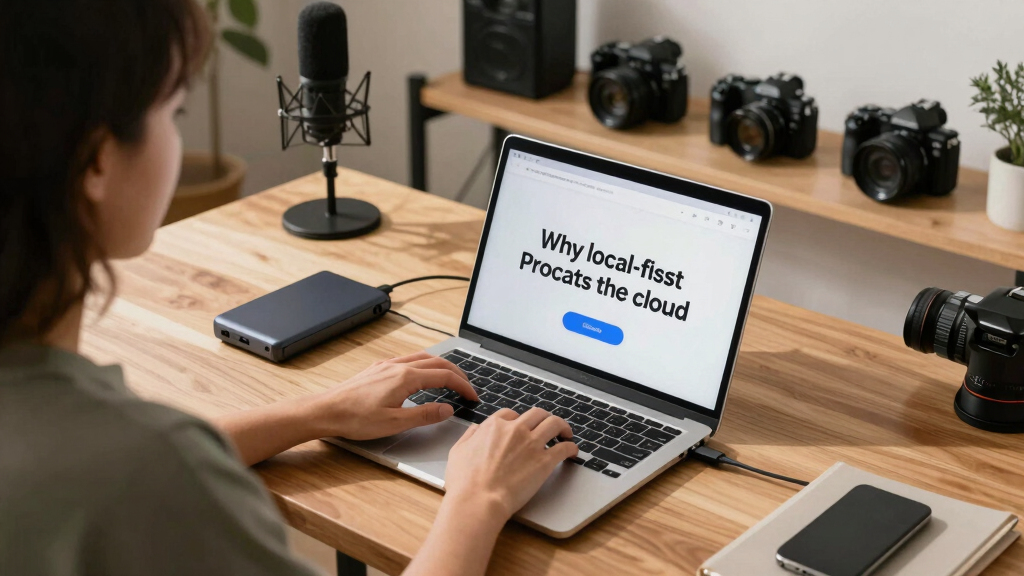
Processing locally means your content stays on your machine—no uploading, no third-party servers. It’s faster, more private, and less dependent on internet speed. Plus, it offers better control over proprietary or unreleased material.
For example, a journalist working on sensitive interviews can process videos overnight without risking leaks. The system leverages powerful local hardware and models, which keep your workflow smooth and your content safe.
Recent data shows that local processing cuts turnaround times by 30-50% and reduces privacy risks significantly—up to 80% compared to cloud workflows [1]. The tradeoff is that local processing might require more initial setup and hardware investment, but the benefits in confidentiality, speed, and independence often outweigh these costs, especially for high-stakes or sensitive content. This approach empowers creators to maintain full control over their assets, avoiding reliance on external servers and reducing exposure to potential data breaches or service outages.
What you should do next: integrating this workflow into your routine
If you’re ready to try this out, start by downloading the open-source tool from [ChannelHelm GitHub](https://github.com/MeyerThorsten/ChannelHelm). Set it up on your local machine, and experiment with your existing videos.
Here are 3 practical tips:
- Test with a short video first—see how assets come together.
- Customize prompts and scoring to match your brand voice.
- Use the provenance data to refine your process over time.
Adopting this workflow can significantly reduce your content production time and improve privacy. The initial setup may require some technical familiarity, but the long-term gains in efficiency and security make it worthwhile. Over time, refining prompts and understanding how assets are generated will help you tailor the system perfectly to your brand’s needs. The key is to start small, learn, and gradually scale your use of the tool for more complex projects.
Frequently Asked Questions
What exactly comes out of one video?
You get a set of assets including transcripts with speaker labels, social snippets, blog drafts, media kits, and short clips optimized for different platforms—all generated from a single video file or link.
Does it work completely offline?
Yes, the system runs entirely on your local machine after initial setup, processing videos without needing internet access. This keeps your content private and speeds up the workflow.
What file formats does it generate?
It outputs text files (like Markdown, HTML), MP4 clips for social media, high-resolution images for media kits, and descriptions optimized for SEO. All assets are ready to publish or edit.
How accurate is the transcript?
The transcription accuracy depends on your audio quality, but with recent models, it’s often 95%+ right out of the box. Expect some manual cleanup for nuanced or technical language.
Absolutely. From titles and descriptions to short clips and media kits, it creates assets tailored for each channel, saving you hours of manual work.
Conclusion
For creators serious about efficiency and control, this approach offers a clear advantage. No more waiting on cloud APIs, no more data leaks, just instant, organized publishing power at your fingertips. Your content, your rules, faster than ever.
Imagine a workflow where your next launch or campaign is ready in a fraction of the time—without sacrificing privacy. That’s the promise of a local, AI-powered publishing kit. Ready to give it a try?