
Door alarms for Alzheimer’s patients exist for one reason: to tell you the instant someone you love opens a door they shouldn’t. After comparing 15 popular options, the YisTech Wireless Caregiver Door Alarm System with 3 Sensors and 2 Receivers earns my top spot because it covers multiple exits at once and puts a receiver in two rooms, so the alert reaches you whether you’re in the kitchen or asleep down the hall. The Caregiver Pager Door Alarm System is a smart value pick for smaller homes, while the YisTech WiFi Smart Door Sensor Alarm System suits caregivers who work or sleep away from home and need phone alerts. The main tradeoff in this category is between simple plug-and-play chimes that always work and WiFi systems that alert your phone but depend on your internet connection. Keep reading for the full breakdown, including which alarms handle nighttime wandering best and which ones you should skip entirely.

Turn the school run and nap time into listening time
- Thousands of audiobooks, podcasts and originals
- Listen on your phone, tablet or Echo — also offline
- Cancel anytime
Complete the kit


Key Takeaways
- Receiver count matters more than sensor count for wandering alerts — the YisTech 3-sensor/2-receiver kit ranks first because a single receiver leaves you deaf to alerts whenever you’re in the wrong room.
- Every standalone vibration or magnetic alarm under $20 in this roundup, including the Securityman handle alarms and the 5-pack window/door alarms, is too loud and too dumb for caregiver use — they startle the patient instead of alerting the caregiver.
- WiFi app-based systems (YisTech WiFi, SanJie WiFi, PILSAMAS) only make sense when the caregiver is regularly away from home; they add setup friction and internet dependence that dedicated caregivers don’t need.
- Melody variety and long range are mostly marketing specs here — what actually matters at 3 a.m. is a chime loud and distinct enough to wake you, and receivers you can plug in near your bedroom.
- Homes with multiple exterior doors need at least three sensors; two-sensor kits consistently leave one exit uncovered, which is the single most common coverage gap in this category.
| YisTech Wireless Caregiver Door Alarm System with 3 Sensors and 2 Receivers |  | Best Overall | Sensors: 3 | Receivers: 2 | Maximum range: 260 feet | VIEW ON AMAZON | See Our Full Breakdown |
| Caregiver Pager Door Alarm System – Two Sensors and One Receiver |  | Best Value | Detection range: 260 ft | Sensors included: 2 | Receivers included: 1 | VIEW ON AMAZON | See Our Full Breakdown |
| Wireless Door Chime System, 2 Sensors and 1 Receiver |  | Best for Large Homes | Sensors: 2 | Receivers: 1 | Chimes: 58 melodies | VIEW ON AMAZON | See Our Full Breakdown |
| YisTech WiFi Smart Door Sensor Alarm System with Phone App |  | Best for Remote Monitoring | Connectivity: WiFi | Control method: Smartphone app | Sensors: 4 | VIEW ON AMAZON | See Our Full Breakdown |
| Wireless Door Chime and Alarm System with 58 Melodies and 500FT Range |  | Best for Simple Single-Door Coverage | Melodies: 58 | Volume levels: 5 (0–110 dB) | Range: 500 ft | VIEW ON AMAZON | See Our Full Breakdown |
| SanJie Wi-Fi Door Chime and Alarm Sensor with App Notifications |  | Best for Remote Monitoring | Connectivity: 2.4 GHz Wi-Fi only (5 GHz not supported) | Alert modes: Instant and delayed | Alarm volume: Up to 110 dB | VIEW ON AMAZON | See Our Full Breakdown |
| YisTech Wireless Caregiver Door Alarm, Three Sensors and One Receiver |  | Best Multi-Door Coverage | Set includes: 3 sensors and 1 receiver | Maximum range: 260 feet | Ringtones: 58 melodies | VIEW ON AMAZON | See Our Full Breakdown |
| SanJie Wireless Door Chime and Alarm for Home and Business |  | Best Plug-In Reliability | Power source: AC (120V outlet) | Sensor batteries: 2 x 12V included | Maximum volume: 110 dB | VIEW ON AMAZON | See Our Full Breakdown |
| Securityman Door Handle Alarm (2 Pack) – 130dB Vibration Triggered Portable Security Alarm | 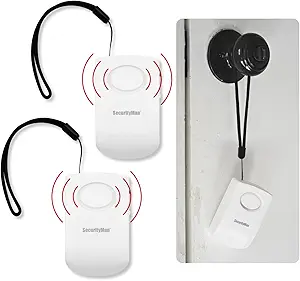 | Best Portable Travel Option | Alarm volume: 130 dB | Trigger type: Vibration | Alarm modes: 30-second and continuous | VIEW ON AMAZON | See Our Full Breakdown |
| Philips Personal Security Window and Door Alarm, 2 Pack, Wireless Chime |  | Best Budget Starter Pick | Alarm volume: 120 dB siren, plus chime mode | Sensor type: Magnetic contact sensor | Power: 4 x LR44 button batteries (included), 6V DC | VIEW ON AMAZON | See Our Full Breakdown |
| 5-Pack Window and Door Alarms, White |  | Best Multi-Room Coverage | Quantity: 5 alarms | Alarm volume: 90 or 120 dB | Power source: 2 AAA batteries per alarm (not included) | VIEW ON AMAZON | See Our Full Breakdown |
| Satisure Wireless Door Chime with Sensor Alarm |  | Best Long-Range Chime | Wireless range: 600 ft | Melodies: 58 selectable with memory | Volume levels: 5 (0–110 dB) | VIEW ON AMAZON | See Our Full Breakdown |
| UltraPro Personal Security Window and Door Alarm, 2-Pack |  | Best Budget Starter Pick | Pack size: 2 alarms | Alert modes: 120 dB siren or chime | Power: Four LR44 batteries per alarm, included | VIEW ON AMAZON | See Our Full Breakdown |
| WiFi Door Sensor Alarm System with Phone App, 2 Sensors and 1 Gateway |  | Best for Shared Caregiving | Included: 2 sensors and 1 gateway | Connectivity: WiFi with smartphone app | Ringtones: 32 | VIEW ON AMAZON | See Our Full Breakdown |
| PILSAMAS Wi-Fi Smart Door and Window Alarms for Seniors |  | Best Smart Monitoring | Wi-Fi: 2.4 GHz only (no 5 GHz) | Receiver range: Up to 328 ft | Melodies: 18 | VIEW ON AMAZON | See Our Full Breakdown |
More Details on Our Top Picks
YisTech Wireless Caregiver Door Alarm System with 3 Sensors and 2 Receivers
Of all the plug-and-play options in this roundup, this YisTech system stands out for covering the most bases at once: three sensors for multiple exit points, and crucially, two receivers so two caregivers in different rooms can be alerted simultaneously. That second receiver is what separates it from the nearly identical Caregiver Pager system (B09PG5FYNR), which includes only one. If one parent is sleeping upstairs while the other cooks in the basement kitchen, a single receiver leaves a blind spot. The 260-foot range handles most single-family homes, though the Wireless Door Chime (B07HSQWY9Z) reaches 500 feet for larger properties. Volume can be dialed all the way down to silent with just the LED flashing, which is thoughtful for nighttime when a blaring chime could distress a confused patient.
Pros:- Two receivers let caregivers in separate rooms get simultaneous alerts
- Three sensors cover front door, back door, and a window in one kit
- Volume can be silenced to LED-only alerts at night
- Each receiver pairs with up to 20 sensors for future expansion
Cons:- Both receivers need wall outlets, limiting where you can place them
- 110 dB top volume is jarring and may frighten an already-anxious patient
Best for: Families with two caregivers who need alerts in different rooms at the same time
Not ideal for: Very large homes or multi-building setups — the 260-foot range trails the 500-foot competitors here
- Sensors:3
- Receivers:2
- Maximum range:260 feet
- Ringtones:58
- Volume levels:5, up to 110 dB
- Mounting:Adhesive door/window mount
- Expandability:20 sensors per receiver; 20 receivers per sensor
- Batteries:3 included 12V batteries
Our verdict“The most complete caregiver package for typical homes — buy it if you have two people monitoring and multiple exits to cover.”
Caregiver Pager Door Alarm System – Two Sensors and One Receiver
Compared with the YisTech Best Overall pick, this system trades one sensor and one receiver for a lower cost of entry, making it the smart choice for smaller homes or a first-time buyer who isn’t sure a door alarm will work for their situation. What it does better than most budget alternatives here is sheer expandability: up to 50 sensors on a single receiver — more than any other option in this roundup. That means you can start with two doors today and add bedroom windows or a backyard gate later without replacing anything. The volume range from 0 to 110 dB is genuinely useful: 0 dB with the LED indicator means you get silent visual alerts during naps, while full volume works when you’re doing laundry. The honest tradeoff is that unspecified sensor battery life means you’ll want spares on hand.
Pros:- Supports up to 50 sensors per receiver, the most expandable in this lineup
- 0 dB mute mode with LED-only visual alerts
- Plug-and-play setup with adhesive mounting, no tools needed
- LED indicator makes it workable for hearing-impaired caregivers
Cons:- Single receiver creates blind spots in larger households
- Sensor battery life is unspecified, so replacements may come sooner than expected
Best for: Budget-conscious families starting small who may expand coverage over time
Not ideal for: Two-caregiver households — with only one receiver, someone will miss alerts when apart
- Detection range:260 ft
- Sensors included:2
- Receivers included:1
- Ringtones:58
- Volume levels:5 (0–110 dB)
- Max sensors per receiver:50
- Power source:Plug-in receiver, battery-powered sensors
Our verdict“The best starting point if you want to test whether a door alarm fits your caregiving routine before committing to a bigger system.”
Wireless Door Chime System, 2 Sensors and 1 Receiver
Where most systems here top out at 260 feet, this chime’s 500-foot range makes it the right call when the caregiver is far from the door — think detached garages, basements, or long ranch-style hallways. It matches the Wireless Door Chime and Alarm System (B07HSLB3BL) on paper with the same range and 58 melodies, so what separates them comes down to configuration: this one packs two sensors and one receiver, suiting a two-entry-point home with one monitoring station, while the Satisure-style single-sensor alternatives suit smaller needs. The pre-paired design means setup is genuinely minutes-long, which matters for exhausted caregivers. One quirk worth knowing: the LED indicator keeps flashing even in mute mode, so a napping caregiver in the same room may notice the light. Mounting with tape or screws gives options the YisTech’s adhesive-only approach doesn’t.
Pros:- 500-foot range doubles the coverage of the YisTech and Caregiver Pager systems
- Two mounting options (3M tape or screws) for uneven or painted surfaces
- Pre-paired components work straight out of the box
- LED visual alerts continue even when chime is muted
Cons:- Only one receiver, so a second caregiver won’t hear alerts in another room
- Screw mounting requires drilling that renters may not permit
Best for: Caregivers in large or long homes where the receiver sits far from monitored doors
Not ideal for: Small apartments — the extended range is wasted capability, and a cheaper 260-foot system covers the same job
- Sensors:2
- Receivers:1
- Chimes:58 melodies
- Volume levels:5, up to 110 dB
- Range:Up to 500 ft
- Installation:3M double-sided tape or screws
- Expandable:Yes
Our verdict“Pick this when distance between the door and the caregiver is your biggest problem, not sensor count.”
YisTech WiFi Smart Door Sensor Alarm System with Phone App
Every other system in this roundup shares one limitation: you have to be inside the house to hear the chime. This WiFi model solves that by pushing alerts to your phone from anywhere, which changes the caregiving equation entirely — an adult child can know the moment Dad opens the front door even from work across town. Compared with the standard YisTech system (B0BHNS2M33), you trade the second receiver and outlet flexibility for four sensors plus a gateway, and gain app-based notifications the non-WiFi version simply can’t offer. It’s the only choice that makes sense when the primary caregiver isn’t physically present overnight. The tradeoffs are real, though: it’s dead without a working internet connection, the app setup has a learning curve that less tech-savvy caregivers may find frustrating, and battery-powered sensors add another maintenance item to remember.
Pros:- Phone app alerts work from anywhere, not just within earshot of a receiver
- Four sensors in the box cover more entry points than any non-WiFi kit here
- Gateway sounds a local 110 dB alarm alongside remote notifications
- Expandable with additional sensors as needs grow
Cons:- Fails to alert remotely if WiFi drops — a real risk during power or internet outages
- App-based setup is harder than the plug-and-play chimes from YisTech and Caregiver Pager
- Battery-powered sensors require ongoing maintenance checks
Best for: Adult children or remote caregivers who monitor a parent living alone or with limited in-home supervision
Not ideal for: Technophobes and homes with unreliable internet — the entire alert system depends on WiFi and app setup
- Connectivity:WiFi
- Control method:Smartphone app
- Sensors:4
- Gateway:1
- Ringtones:58
- Maximum alarm volume:110 dB
- Sensor type:Contact sensor
- Power source:Battery powered sensors
Our verdict“The only pick here for caregivers who can’t be in the house — accept the WiFi dependency in exchange for anywhere-alerts.”
Wireless Door Chime and Alarm System with 58 Melodies and 500FT Range
This is the streamlined version of the two-sensor Wireless Door Chime (B07HSQWY9Z): same 500-foot range, same 58 melodies and five volume levels, but a leaner kit geared toward one primary exit. That focus is a feature, not a weakness — many Alzheimer’s households really only need to monitor one door, typically the front or patio exit, and paying for extra sensors on interior or rarely used entry points is wasted money. The volume range down to 0 dB with a still-active LED indicator is the standout detail for dementia care specifically, since a sudden loud chime can agitate a confused patient, while silent visual alerts protect nighttime wandering detection. Like its sibling, mounting relies on adhesive or screws, so textured or metal door frames may need extra attention to stay secure over months of daily door slams.
Pros:- Full 500-foot range despite the smaller kit
- 0 dB silent mode keeps LED alerts working without startling the patient
- Pre-paired plug-and-play setup takes minutes
- Expandable if a second door becomes a concern later
Cons:- Minimal sensor count out of the box for multi-exit homes
- No published battery life, so expect to keep spare batteries stocked
Best for: Households where one door is the main wandering risk and budget matters
Not ideal for: Homes with multiple accessible exits — you’d need to buy add-on sensors immediately, erasing the simplicity advantage
- Melodies:58
- Volume levels:5 (0–110 dB)
- Range:500 ft
- Installation:3M double-sided tape or screws
- Connectivity:Wireless, pre-paired
- Features:LED indicator, expandable sensors
Our verdict“Buy it if one door is your worry and you want the long range of bigger kits without paying for sensors you won’t use.”
SanJie Wi-Fi Door Chime and Alarm Sensor with App Notifications
Caregivers who sleep in another room or step out to run errands need alerts that travel with them, and this is where the SanJie Wi-Fi sensor pulls ahead of purely local systems like the YisTech Three-Sensor kit. The free app push notifications mean a door opening at 3 a.m. reaches your phone anywhere with an internet connection, not just the receiver plugged in down the hall. The delayed alert mode is a thoughtful touch for dementia care — it can act as a reminder when a door is left ajar rather than an instant siren. Tradeoffs are real, though: it’s limited to 2.4 GHz Wi-Fi, phone calls and texts sit behind a paid subscription, and the single AAA battery sensor isn’t recommended for metal doors, which rules out some exterior doors.
Pros:- Sends free app push notifications in addition to the local chime
- Instant and delayed alert modes fit both wandering alerts and door-left-open reminders
- Adhesive mounting with no tools or wiring
- Up to 2 years of battery life on one AAA battery
Cons:- Phone call and text alerts require a paid subscription
- 2.4 GHz Wi-Fi only; incompatible with 5 GHz networks
- Not recommended for metal doors
Best for: Caregivers who leave the house or sleep far from the patient’s door and need phone-based alerts
Not ideal for: Homes with only 5 GHz Wi-Fi or metal exterior doors, and anyone unwilling to pay for call or text alerts
- Connectivity:2.4 GHz Wi-Fi only (5 GHz not supported)
- Alert modes:Instant and delayed
- Alarm volume:Up to 110 dB
- Chimes:20 chimes, 5 volume levels
- Phone alerts:Free app push notifications; calls/texts require paid subscription
- Battery:1 included AAA battery, up to 2 years
- Mounting:Door or window mount with 3M adhesive tape
- Sensor type:Contact sensor
Our verdict“This pick makes the most sense for caregivers who can’t always be within earshot of a receiver and want door events on their phone.”
YisTech Wireless Caregiver Door Alarm, Three Sensors and One Receiver
Wandering doesn’t confine itself to one exit, and the three included sensors here let you cover a front door, patio slider, and a bedroom door simultaneously through a single receiver — something the single-sensor SanJie Wi-Fi model simply can’t match without buying additional units. The 260-foot claimed range suits larger homes where the receiver lives in a distant bedroom, and the LED indicator gives a visual cue that’s genuinely useful for hard-of-hearing caregivers. Compared with the plug-in SanJie AC-powered chime, this receiver runs on batteries, so it works during power outages — but that means feeding it three 12V batteries, and the confused voltage listing in the specs suggests some sloppy documentation. Expansion is generous at up to 20 sensors per receiver if coverage needs grow.
Pros:- Three sensors cover multiple doors and windows out of the box
- 260-foot claimed range suits larger homes
- LED indicator adds a visual alert for hearing-impaired caregivers
- Expandable up to 20 sensors per receiver
Cons:- Battery-powered receiver requires three 12V batteries
- Confusing voltage specification in the product listing
- No remote or app-based alerts
Best for: Families monitoring multiple exits at once in a larger single-story or two-story home
Not ideal for: Caregivers who need alerts on their phone while away, since this system has no app connectivity
- Set includes:3 sensors and 1 receiver
- Maximum range:260 feet
- Ringtones:58 melodies
- Volume:5 levels, up to 110 dB
- Power source:Battery powered (3 x 12V alkaline)
- Sensor type:Contact sensor
- Expandability:Up to 20 sensors per receiver; 20 receivers per transmitter
- Mounting:Adhesive door mount
Our verdict“Choose this if your priority is blanketing several exits with one receiver rather than getting smartphone notifications.”
SanJie Wireless Door Chime and Alarm for Home and Business
Unlike the battery-hungry YisTech kit, this receiver plugs straight into an outlet, which means no midnight battery failures on the unit that actually makes the noise — a genuine advantage for a caregiver who can’t afford a silent miss. The sensor arrives pre-paired, so setup amounts to sticking it on the door frame and plugging in, making this the low-friction option among the receiver-based systems here. The tradeoff is placement: your receiver must live near an outlet, and the listing muddies its range claim with both 500 feet and 150 meters stated — treat real-world performance, especially through walls, as shorter. With 26 tones and unlimited expandable sensors, it doubles reasonably as a small-business entry chime, though it lacks the app alerts of the Wi-Fi SanJie model.
Pros:- AC-powered receiver eliminates dead-battery failures at the alert source
- Pre-paired sensor and adhesive mounting make setup nearly effortless
- Long stated range of up to 500 feet
- Unlimited expandable sensors
Cons:- Receiver must occupy a standard wall outlet, limiting placement
- Inconsistent range figures (500 feet vs 150 meters) in the listing
- No phone or remote notifications
Best for: Caregivers who want a set-and-forget receiver that never needs batteries and expands to cover more doors later
Not ideal for: Anyone needing alerts away from home, or rooms without a convenient outlet for the receiver
- Power source:AC (120V outlet)
- Sensor batteries:2 x 12V included
- Maximum volume:110 dB
- Tones:26 tones, 5 volume levels
- Maximum range:Up to 150 meters (500 feet)
- Sensor type:Contact sensor
- Expandability:Unlimited sensors
- Mounting:Adhesive, pre-paired
Our verdict“This is the pick for caregivers who value a plug-in receiver that never goes silent over app connectivity.”
Securityman Door Handle Alarm (2 Pack) – 130dB Vibration Triggered Portable Security Alarm
Every other product here is a mounted system; this one hangs from a doorknob and goes wherever the patient goes — hotel rooms, relatives’ homes, respite stays. That portability is its whole reason for being, and at 130 dB it’s the loudest alarm in this lineup, louder than the 110 dB ceiling shared by the YisTech and SanJie receivers. But the vibration trigger cuts both ways: unlike magnetic contact sensors like the Philips two-pack, which fire only when the door actually opens, this can go off from a knock, a slammed cabinet nearby, or a heavy tread unless sensitivity is dialed in carefully. For dementia care specifically, a sudden 130 dB blast may also startle or distress the patient, so it suits wander-alert use better than gentle notification.
Pros:- Loudest alarm in this roundup at 130 dB
- Hangs on the doorknob with zero wiring or mounting hardware
- Works on metal, French, standard, and plastic doorknobs
- Two alarm modes (30-second and continuous) add flexibility
Cons:- Vibration trigger is prone to false alarms unless sensitivity is tuned
- 9V batteries need regular replacement
- Startling siren sound may upset a dementia patient
Best for: Traveling families and caregivers who need door coverage in hotels or temporary accommodations
Not ideal for: Everyday home dementia care where a startling siren or false vibration triggers would be disruptive
- Alarm volume:130 dB
- Trigger type:Vibration
- Alarm modes:30-second and continuous
- Compatibility:Metal, French, standard, and plastic doorknobs
- Package contents:2 alarms, 2 x 9V batteries, mounting screw, user’s guide
- Power:9V battery per unit
Our verdict“Buy this as a travel and backup alarm rather than a primary caregiver alert system at home.”
Philips Personal Security Window and Door Alarm, 2 Pack, Wireless Chime
For a first foray into door monitoring, this Philips two-pack keeps things simple: a slide switch selects OFF, chime, or alarm, the LR44 batteries come pre-installed, and the double-sided tape means functioning protection in minutes. The gentle chime mode is arguably its best feature for Alzheimer’s care — unlike the Securityman handle alarm’s 130 dB blast, a soft chime alerts the caregiver without terrifying the patient. Compared with the YisTech kit, there’s no remote receiver, so you must be within earshot of the door itself — fine for small apartments, limiting for larger homes. Two quirks warrant attention: the packaging description confusingly mentions both a two-pack and a four-unit set, and adhesive-only mounting can loosen on painted or textured frames over time.
Pros:- Chime mode provides gentle alerts that won’t startle the patient
- Batteries pre-installed with a low-battery indicator
- Simple OFF/chime/alarm switch anyone can operate
- Wireless installation with included double-sided tape
Cons:- No separate receiver — alerts only work if you’re within earshot
- Conflicting two-pack vs four-unit packaging description
- Tape mounting can lose adhesion on textured or painted surfaces
Best for: Apartment dwellers and first-time buyers wanting an inexpensive, gentle-alert system for one or two doors
Not ideal for: Larger homes where the caregiver is often out of earshot of the alarmed door
- Alarm volume:120 dB siren, plus chime mode
- Sensor type:Magnetic contact sensor
- Power:4 x LR44 button batteries (included), 6V DC
- Control method:Touch slide switch (OFF/chime/alarm)
- Mounting:Wall mount with double-sided tape
- Quantity:2-pack
- Color:White
Our verdict“This is the low-commitment entry point for caregivers who want a soft chime on a door or two before investing in a full receiver system.”
5-Pack Window and Door Alarms, White
Caregiving for someone with Alzheimer’s rarely means watching one door, and this five-pack is the most affordable way to blanket every exit plus off-limits areas like medicine cabinets and basement doors. The adjustable 90 or 120 dB siren gives you a polite daytime setting and a startling night mode — something the fixed-volume UltraPro 2-Pack can’t match. Unlike the Satisure chime, there’s no receiver to plug in, so alarms work even in rooms without outlets, and each unit sounds right at the door itself, which is disorienting enough to pause a confused wanderer. The tradeoff is coverage: there’s no remote receiver or phone alert, so you must be within earshot. Batteries aren’t included either, so budget for ten AAAs on day one.
Pros:- Five alarms cover every exit and unsafe area in one purchase
- Two volume settings for day versus night
- Wireless self-adhesive installation with no receiver or outlet needed
- Flashing red LED warns of low batteries
Cons:- No remote receiver or smartphone alerts — you must be within earshot
- Batteries not included, and five units need ten AAAs total
Best for: Caregivers who need to secure multiple doors, windows, and cabinets across a home on a budget
Not ideal for: Anyone who sleeps far from the exits or wants phone alerts — the siren only helps if you can hear it
- Quantity:5 alarms
- Alarm volume:90 or 120 dB
- Power source:2 AAA batteries per alarm (not included)
- Installation:Self-adhesive, wire-free
- Controls:On/Off switch and Set button
- Low battery alert:Flashing red LED
- Dimensions:4.18 x 1.2 x 0.6 inches
Our verdict“Buy this if you need loud, local alarms on many doors at once and don’t need remote monitoring.”
Satisure Wireless Door Chime with Sensor Alarm
When the bedroom you sleep in is on the far side of the house from the doors you’re guarding, a plug-in receiver beats a door-mounted siren every time. This Satisure system stands out for its 600-foot range that penetrates walls, roughly double the reach of the PILSAMAS receiver, so a caregiver upstairs or in a backyard room still hears the alert. The 58 melodies with per-door assignment mean you instantly know whether the front door or the back slider opened — invaluable when responding fast matters. The silent LED flash mode is a thoughtful touch for napping hours or hearing-impaired caregivers. Tradeoffs: the receiver needs a dedicated outlet, the sensor relies on adhesive that may fail on textured trim, and there are no phone alerts like the WiFi sensor systems offer.
Pros:- 600-foot range reliably crosses walls and floors
- Assign a distinct ringtone to each door for instant identification
- Silent LED flash mode for quiet hours or hearing-impaired users
- Two-minute plug-and-play installation
Cons:- Receiver occupies a power outlet and won’t work during an outage
- Adhesive sensor mounting may not hold on rough or painted trim
Best for: Caregivers in larger homes who sleep far from the monitored doors and want to know which door opened
Not ideal for: Anyone wanting smartphone alerts while away from home — this system only alerts locally
- Wireless range:600 ft
- Melodies:58 selectable with memory
- Volume levels:5 (0–110 dB)
- Expandability:Up to 58 sensors or receivers
- Installation:Plug & play with adhesive tape
- Special features:LED flash mode, unique ringtone assignment
Our verdict“This is the pick for whole-house chime coverage with clear per-door identification, as long as you don’t need remote alerts.”
UltraPro Personal Security Window and Door Alarm, 2-Pack
For a first door alarm — say, a parent newly diagnosed and still living at home — this two-pack works out of the box, batteries and all, which the 5-Pack above can’t claim. The choice between a 120 dB siren and a gentle chime is what makes it caregiver-friendly: chime during the day so the door isn’t stressful, siren at night when wandering is most dangerous. Its versatility also beats pricier options here — the slim sensors fit cabinets, drawers, and medicine chests, not just doors, useful as dementia progresses and hazardous items need locking down. Compared with the WiFi gateway systems, though, it’s purely local: no remote alerts, no activity logs, no expandability beyond the two units, and LR44 button cells are fiddlier to replace than the AAAs others use.
Pros:- Batteries included plus a low-battery LED indicator
- Switchable siren and chime modes for day and night
- Fits doors, windows, cabinets, and drawers
- Tool-free adhesive installation with a 90-day warranty
Cons:- Only two units with no way to add more sensors or a receiver
- LR44 button batteries are less convenient to replace than AAA cells
Best for: Families at the start of a dementia journey who want a simple, inexpensive trial alarm on two entry points
Not ideal for: Anyone needing remote monitoring, multiple doors, or a receiver in a distant bedroom
- Pack size:2 alarms
- Alert modes:120 dB siren or chime
- Power:Four LR44 batteries per alarm, included
- Installation:Wireless, tool-free double-sided tape
- Low-battery indicator:LED
- Warranty:90-day limited
Our verdict“The cheapest way to test whether a door alarm fits your caregiving routine before committing to a bigger system.”
WiFi Door Sensor Alarm System with Phone App, 2 Sensors and 1 Gateway
Dementia care is usually a team effort — a spouse at home, adult children at work — and this system’s shareable phone alerts are built exactly for that. Every sensor opening pings the app and sounds the plug-in gateway’s chime, so the person on site and everyone remote knows simultaneously. Compared with the local-only Satisure chime, you gain awareness while away from home; compared with the PILSAMAS smart alarm, this kit is simpler and leans on a straightforward gateway setup rather than scheduling and logs. Volume tops out at a respectable 110 dB across five levels, and the system expands with extra sensors and receivers as needs grow. The honest drawbacks: it’s useless without reliable WiFi and a smartphone, the app adds setup friction for less tech-savvy caregivers, and battery life for the sensors isn’t specified — a real unknown for long-term reliability.
Pros:- Remote smartphone alerts with sharing across multiple caregivers
- Local gateway chime plus app notification for double coverage
- Expandable with additional sensors and receivers
- 32 ringtones and five volume levels up to 110 dB
Cons:- Requires stable WiFi and comfort with a smartphone app
- Sensor battery life and power requirements are unspecified
Best for: Families splitting caregiving duties who want multiple people notified by phone the moment a door opens
Not ideal for: Tech-averse caregivers or homes with unreliable WiFi — the remote features depend entirely on both
- Included:2 sensors and 1 gateway
- Connectivity:WiFi with smartphone app
- Ringtones:32
- Volume levels:5, up to 110 dB
- Indicator:Built-in LED
- Expandable:Supports additional sensors and receivers
Our verdict“The right choice when several people need to know about a door opening in real time, not just whoever is home.”
PILSAMAS Wi-Fi Smart Door and Window Alarms for Seniors
This is the most information-rich option in the lineup, and for later-stage Alzheimer’s that matters. Beyond app alerts and a 328-foot local chime receiver, it names which sensor triggered and keeps activity history logs — so you can spot patterns, like repeated nighttime attempts at the back door, instead of just reacting. Compared with the simpler WiFi gateway kit above, PILSAMAS adds scheduling (alert only at night, stay quiet during the day) and remote controls, which reduces alarm fatigue for everyone. Push alerts and family sharing are free with no monthly fee, and the system collects no camera or audio data — a genuine privacy plus. The tradeoffs are real: it only speaks 2.4 GHz WiFi, so modern dual-band routers need configuring, and urgent SMS or phone-call alerts sit behind an in-app purchase.
Pros:- Sensor identification and activity logs reveal wandering patterns
- Customizable schedules silence daytime false alarms
- Free app push alerts and family sharing with no subscription
- No cameras or microphones — activity data only
Cons:- 2.4 GHz WiFi only, which can complicate setup on newer routers
- SMS and phone-call alerts require an in-app purchase
Best for: Caregivers tracking wandering patterns over time who want named-sensor alerts, schedules, and free family sharing
Not ideal for: Households with only 5 GHz WiFi or caregivers who find app-driven systems more burden than help
- Wi-Fi:2.4 GHz only (no 5 GHz)
- Receiver range:Up to 328 ft
- Melodies:18
- Volume levels:4, including mute
- Receiver power:USB
- Sensor batteries:AAA
- Notifications:Free push alerts; SMS/calls via in-app purchase
- Setup:Pre-paired sensors
Our verdict“The deepest monitoring pick here — choose it when you need to understand wandering behavior, not just hear about it.”

How We Picked
I judged every product against the actual job: alerting a caregiver quickly and reliably when a person with dementia opens a door. That meant prioritizing receiver placement flexibility (multiple receivers or a pager you can carry), sensor coverage for homes with several exits, alert loudness at night, and how forgiving the system is during setup — because most buyers here are tired caregivers, not gadget enthusiasts. I also weighed what happens when things go wrong: dead batteries, WiFi dropouts, false alarms, and whether a alarm’s sound startles the patient instead of summoning help.
The ranking follows a simple logic. Multi-sensor, multi-receiver caregiver systems sit at the top because they solve the coverage and awareness problems at once. App-based WiFi systems rank high for remote caregivers but below the plug-and-play kits because they add a failure point. Basic chimes fill the middle for small homes, and standalone self-triggered alarms land at the bottom because they alert everyone in the house — including the person you’re trying to protect — rather than the caregiver specifically.
Factors to Consider When Choosing Door Alarms For Alzheimers Patients
Choosing a door alarm for a dementia caregiver situation is different from choosing one for home security. These are the factors that actually change outcomes.Who Gets Alerted: You or Everyone
The single biggest mistake buyers make is confusing a security alarm with a caregiver alarm. A 130dB siren bolted to the door does alert you, but it also blasts the person with dementia, who may become frightened, agitated, or determined to disable it. Caregiver systems flip this: a quiet sensor on the door sends a chime to a receiver near you, and the patient often never notices it. Before buying anything, decide whether you need a system that calls you or a system that scares intruders — in this use case, it’s almost always the former.
Sensor Count vs. Your Floor Plan
Count every exit the person can reach unassisted, including the basement door, the garage entry, and any door to a screened porch. Most buyers under-buy sensors because kits with fewer pieces look simpler, then discover the uncovered door three weeks later — usually at the worst moment. If your home has four exits, a two-sensor kit forces you to gamble on which doors matter. Buy one more sensor than you think you need, because expandability varies: some brands let you pair extra sensors to an existing receiver, while budget kits lock you into the pieces in the box.
Receiver Placement and Nighttime Use
An alert you can’t hear is worse than no alert, and this is where receiver design separates good systems from useless ones. A single plug-in receiver in the living room does nothing for a caregiver asleep in a bedroom on another floor. Look for multiple receivers, a portable pager, or both, and check whether the chime has adjustable volume with a setting loud enough to wake you. Some receivers also offer a flashing-light mode, which helps caregivers with hearing loss — a real consideration when the primary caregiver is an aging spouse.
WiFi Alerts: Useful Tool or Extra Failure Point
Phone notifications sound appealing until you consider the realities: WiFi systems require app setup, a stable router, and a working internet connection at the exact moment of the alert. For a caregiver who’s in the house 95% of the time, that’s added complexity with little payoff. But if you’re an adult child monitoring a parent who lives alone or alone during work hours, app alerts are the entire point — they’re the only option that reaches you from miles away. The honest tradeoff: WiFi systems are for remote monitoring, local chimes are for in-home care, and some families eventually run both.
Battery Access and Everyday Maintenance
Dementia caregiving is a marathon, and small maintenance burdens add up. Sensors that take odd battery sizes, need adhesive replaced every few months, or give no low-battery warning become silent failure points — a dead sensor looks exactly like a closed door. Favor systems with standard batteries (AAA or coin cells you already buy) and visible low-battery indicators. Also consider mounting: adhesive strips are fine for lightweight sensors on flat frames, but textured or metal door frames may need the screw-mounted option, and not every kit includes one.
Sound Choice and False Alarm Tolerance
A chime you can distinguish from the doorbell, the microwave, and your phone is worth more than 58 melody options. Pick one distinct tone, set it, and never change it — consistency trains your response. Also test sensitivity on your actual doors: lightweight interior doors and heavy exterior doors behave differently, and a sensor that triggers from a truck rumbling past will erode trust in the system fast. Frequent false alarms are the top reason families abandon door alarms entirely, so a system you can position and tune beats one with more features and less control.
Frequently Asked Questions
Will a door alarm prevent my loved one from leaving, or just alert me?
These products only alert — none of them physically stop a person from opening a door, and that’s actually the right design. Restricting someone’s movement raises both safety and dignity concerns, and locks that trap can be dangerous in a fire. The alarm’s job is to shrink the window between the door opening and your response from minutes to seconds, which matters most at night or during showers. If elopement is frequent and dangerous, pair an alarm with other measures: a sign or curtain over the door, a nightlight path to the bathroom, and a conversation with the care team about wandering patterns. The alarm is your early-warning layer, not your only layer.
Do I need a WiFi/app system, or is a plug-in receiver enough?
If you’re in the house whenever your loved one is, a plug-in receiver system is simpler, cheaper, and more dependable — it works during internet outages and never needs an app update. A WiFi system earns its keep only when you’re regularly away: an adult child checking on a parent living alone, or a caregiver who steps out for errands and wants to know the instant a door opens. Some families use both, placing a local receiver for the in-home caregiver and app alerts for remote family members. Remember that app systems typically need solid WiFi at the door’s location, so test signal strength in the doorway itself, not just the room.
How many sensors do I actually need for my home?
Walk your home and count every door the person can open unassisted — front, back, garage entry, basement, and any door to an enclosed porch or sunroom. Then add one, because coverage gaps tend to appear at doors you assumed were too stiff or too hidden to matter. A two-sensor kit suits an apartment or a small ranch with one main exit; homes with three or more exits need the larger kits. Don’t forget the door between the garage and house, which is one of the most commonly missed exits in wandering incidents. Before buying a bigger kit, confirm the receiver can pair with add-on sensors later, so you can expand without replacing the system.
Are loud siren-style alarms a bad idea for dementia patients?
For this use case, yes, with rare exceptions. A 120-plus decibel siren going off at the moment of exit can frighten or disorient someone with dementia, sometimes escalating the exact behavior you’re trying to manage. Worse, a startled person may learn to remove the alarm or develop anxiety around that doorway. Caregiver-focused systems — where the sensor quietly signals a receiver near you — avoid this entirely because the patient doesn’t register the alert. Siren alarms do have one niche use: a hotel room or short-term stay where you need a portable, instant-setup deterrent and there’s no plug for a receiver. For daily home care, keep the sound on your side of the door.
Can these door alarms work for a parent who lives alone?
Only the WiFi-enabled options can, and even then with limits. A traditional chime-and-receiver system is useless when nobody is home to hear the receiver, whereas app-based sensors like the YisTech WiFi and PILSAMAS systems push notifications to your phone from anywhere. For independent-living situations, the alarm should be one part of a bigger plan that includes regular check-ins, a wearable alert device on the parent, and possibly camera coverage of key exits. Also confirm the parent’s internet is dependable, since a dropped connection means missed alerts. If wandering has already caused an incident, this is the point to involve a physician or occupational therapist rather than relying on hardware alone.
Conclusion
Match the system to your caregiving situation rather than chasing features. For best overall, the YisTech Wireless Caregiver Door Alarm System with 3 Sensors and 2 Receivers covers a typical multi-exit home and reaches you in two rooms — the combination that matters most for nighttime wandering. The Caregiver Pager Door Alarm System takes best value for apartments or small homes with one or two exits. For remote caregivers monitoring a parent who lives alone, the YisTech WiFi Smart Door Sensor Alarm System with its four-sensor kit and phone app is the strongest choice. Beginners who want something working in ten minutes should grab the Wireless Door Chime System — no app, no WiFi, no learning curve. And for a portable, travel-ready option in hotels or temporary stays, the Securityman Door Handle Alarm fills that narrow role despite being wrong for daily home use. Whatever you choose, install it the day it arrives, test the chime from your bedroom, and count your exits twice — the best alarm is the one you can actually hear when it counts.