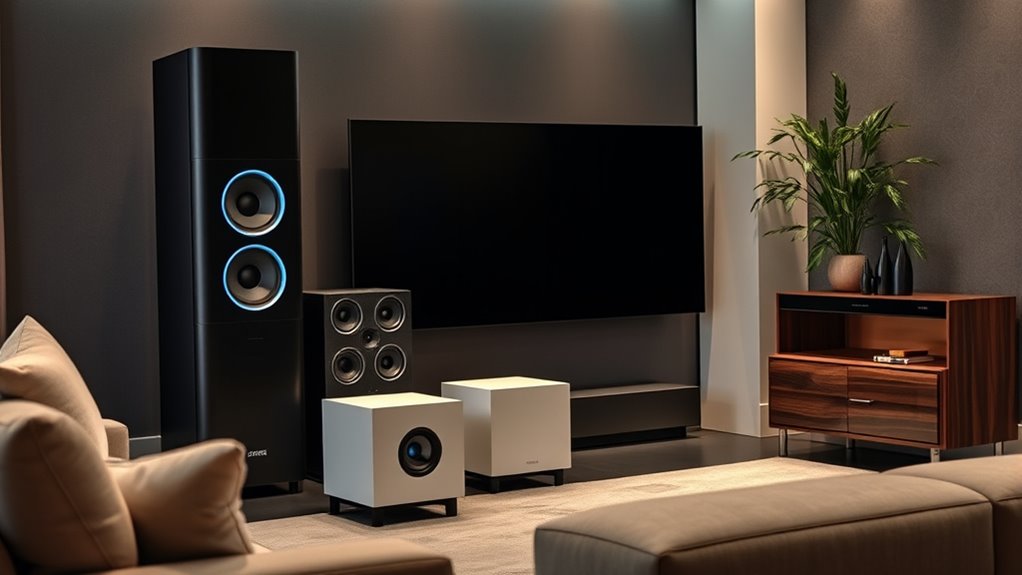

For most homes, I’d start with the Denon D-M41: its receiver-and-speaker setup offers a more traditional stereo listening experience than the all-in-one systems here. The Klipsch R-51M pair suits buyers who already have amplification, while the ULTIMEA 5.1.2 is a stronger fit for TV and surround sound. The key tradeoff is between straightforward music playback, flexible component systems, and room-filling home theater features. Room size, available connections, and setup complexity matter as much as speaker count. Read on for the full breakdown and a pick for each kind of listener.

Get baby and family essentials delivered free — and shop member deals
- Fast, free delivery on millions of items
- Access to Prime Big Deal Days deals on October 6–7
- Prime Video, Amazon Music and more included
Complete the kit


Key Takeaways
- The Denon D-M41 is the clearest traditional stereo choice because it combines a receiver and bookshelf speakers, while the passive Klipsch and Saiyin systems need compatible amplification.
- Klipsch R-51M and Saiyin 5.0 are speaker packages rather than complete source-and-amplifier systems, so their lower setup simplicity comes with more control over the rest of the system.
- The compact systems from HANLIM, Jensen, Philips, and WISCENT bundle everyday sources such as CD, radio, and Bluetooth, but they do not offer the same upgrade path as separates.
- The two Ultimea Aura A40 systems target TV surround use; the Pro variant adds a different channel configuration, so buyers should compare connection needs and room layout rather than choose by channel count alone.
- ULTIMEA 5.1.2 and HiMuses M514 5.1.4 add Dolby Atmos-style height channels, but those setups make the most sense when the room, source material, and installation can support them.


More Details on Our Top Picks
Klipsch R-51M Bookshelf Speakers (Pair), Black
The Klipsch R-51M pair suits listeners who want passive bookshelf speakers to build around a separate stereo amplifier or receiver. Its horn-loaded tweeter and dual 5.25-inch woofers give it a different role from the Denon D-M41 system, which arrives with a CD/FM receiver and matching speakers ready to play. The Klipsch pair offers room to choose your own electronics, but that flexibility means budgeting for an amplifier and sources separately. The rear-firing bass port can support fuller low frequencies, though placement close to a wall may affect bass balance. At 13.3 inches tall, these need more shelf space than the compact all-in-one systems here. Choose them for a component-based home setup; skip them if you want a complete system in one box.
Pros:- Sold as a stereo pair for left and right channel listening
- Tractrix horn tweeters provide a distinct speaker design
- Dual 5.25-inch spun-copper woofers handle midrange and bass
- Bass-reflex enclosure supports low-frequency output
Cons:- Requires a separate amplifier or receiver
- No built-in CD player, radio, or wireless streaming
- Rear-firing ports can make close-to-wall placement less flexible
Best for: Listeners who already own, or plan to choose, a stereo amplifier and want a dedicated bookshelf speaker pair.
Not ideal for: Buyers seeking a ready-to-play CD, radio, and speaker system or anyone without space to position bookshelf speakers away from a wall.
- Quantity:Pair
- Tweeters:1-inch aluminum LTS
- Horn design:90° × 90° Square Tractrix
- Woofers:Dual 5.25-inch spun-copper IMG
- Enclosure:Bass-reflex with rear-firing port
- Dimensions:13.3 × 7 × 8.5 inches
- Color:Black
Our verdict“Choose the R-51M if you want to assemble a component-based stereo around passive bookshelf speakers.”
HANLIM 30W Stereo System with CD Player, FM Radio, Bluetooth, USB, AUX, and Remote
The HANLIM is the straightforward choice for households that rotate between CDs, FM radio, Bluetooth, and USB files without adding separate components. Its 30W total output and two included speakers make it a more complete starter setup than the Klipsch R-51M pair, which needs an amplifier and sources. The Denon D-M41 is the more stereo-focused alternative, with included bookshelf speakers and digital inputs for a TV; HANLIM instead emphasizes broad playback options and simple controls. Resume, repeat, and shuffle functions suit casual listening, while the remote saves trips to the unit. The tradeoff is limited upgrade flexibility and no Bluetooth headphone support. Pick this for convenient mixed-source listening, rather than a system you intend to build around separate hi-fi components.
Pros:- Plays CDs, FM radio, Bluetooth audio, USB, and AUX sources
- Includes two speakers with 30W total output
- Resume, repeat, shuffle, and selectable sound modes support convenient playback
- Remote control is included
Cons:- Bluetooth does not support wireless headphones
- Remote batteries are not included
- Integrated speakers and electronics offer less flexibility than the Klipsch R-51M component setup
Best for: Listeners who want one compact, ready-to-use system for CDs, radio, phone streaming, and USB playback.
Not ideal for: Buyers planning to upgrade individual stereo components or listen through Bluetooth headphones.
- Output power:30W (15W + 15W)
- Connectivity:Bluetooth, USB, AUX in, 3.5 mm headphone jack
- Supported discs:CD, CD-R, CD-RW
- Supported audio formats:MP3, WMA
- FM frequency range:87.5–108 MHz
- USB capacity:Up to 32 GB
- Number of speakers:2
- Overall dimensions:11.81 × 7.09 × 8.46 inches
Our verdict“Choose the HANLIM for an easy all-in-one system that handles several everyday music sources.”
Denon D-M41 Stereo CD/FM Receiver with SC-M41 Bookshelf Speakers
The Denon D-M41 earns the broadest stereo role here by pairing a CD/FM receiver with matching bookshelf speakers, Bluetooth, and two digital inputs. That makes it a stronger fit for a main listening setup than the HANLIM, whose appeal is its simpler mix of playback options and compact all-in-one format. The Denon’s digital inputs also let a TV join the system, while its dedicated headphone amplifier supports private listening. Compared with the Klipsch R-51M pair, it is far easier to get running because the receiver and speakers are included, though the Klipsch leaves more freedom to select an amplifier and tailor the components. The Denon is designed for small to mid-size rooms, so it is not the pick for filling a large open space. Choose it for balanced source flexibility without assembling a system piece by piece.
Pros:- Receiver and SC-M41 bookshelf speaker pair are included
- Bluetooth supports wireless music streaming
- Two digital inputs allow connection to a TV or other digital sources
- Dedicated headphone amplifier supports wired private listening
Cons:- Designed for small to mid-size rooms
- Less freedom to select components than the Klipsch R-51M speaker-only setup
Best for: Listeners furnishing a small or mid-size room who want a matched stereo with CD, radio, Bluetooth, and TV inputs.
Not ideal for: Buyers who need room-filling sound in a large space or want to choose and upgrade speakers and electronics independently.
- Receiver:Stereo CD/FM
- Included speakers:SC-M41 bookshelf speaker pair
- Speaker power:2 × 30W
- Woofer/midrange:4.75 inches
- Tweeter:1-inch silk dome
- Connectivity:Bluetooth, two digital inputs
- Headphone amplifier:Dedicated
Our verdict“Choose the Denon D-M41 for a ready-to-use stereo system with more source flexibility than a basic compact shelf system.”
Home CD Stereo Shelf System with Bluetooth
This retro-styled shelf system puts CD, FM radio, Bluetooth, USB, and AUX playback in one compact stereo package. Its 30W RMS output matches the HANLIM’s stated total power, while DSP and five EQ modes give listeners a few ways to adjust the sound for different music. That makes it a flexible casual-listening choice, though neither compact system offers the component-upgrade path of the Klipsch R-51M speakers with a separate amplifier. The top-loading CD design needs clear space above the unit, and USB playback is limited to MP3 and WMA files using FAT16/32. It also lacks AM radio and cannot send Bluetooth audio to wireless earphones. Choose it for a shelf where convenient source switching matters more than building a traditional hi-fi stack.
Pros:- Supports CD, FM radio, Bluetooth, USB, and AUX playback
- 30W RMS stereo output with DSP and five EQ modes
- Remote control is included
- Compact shelf-system format combines the main playback components
Cons:- No AM radio
- Bluetooth does not support wireless earphones
- USB playback is limited to MP3/WMA files and FAT16/32
Best for: Listeners who want a compact, retro-look stereo for a shelf and use CDs, FM, Bluetooth, or compatible USB files.
Not ideal for: Buyers who need AM radio, Bluetooth headphone listening, or broad USB drive and file-system support.
- Output power:30W RMS (2 × 15W); 50W maximum
- Channels:2
- CD formats:CD, CD-R, CD-RW
- Radio:FM
- USB formats:MP3 and WMA; FAT16/32
- Inputs:3.5 mm AUX
- Dimensions:16.9 × 20.5 × 8.66 inches
- Weight:6 pounds
Our verdict“Choose this shelf system for flexible casual listening and sound modes in a compact retro-style package.”
Jensen JBS-300 Bluetooth Stereo System with CD Player, AM/FM Radio, USB, Remote, and Wall Mount
The Jensen JBS-300 fills a niche the other systems miss: a wall-mountable stereo with CD, USB, Bluetooth, and both AM and FM radio. Its alarm can wake to radio, CD, USB, or a tone, so it works well in a bedroom or kitchen where the system also serves as a clock. Compared with the HANLIM and Home CD Stereo Shelf System, it adds AM radio and a headphone jack, but its listed 10-watt speaker output is far below their 30W totals. That makes it less suited to a room where music needs to carry across a wide space. The four EQ presets offer basic adjustments, not the component choice available with the Klipsch R-51M speakers. Choose Jensen for convenient placement and alarm functions, accepting more modest output.
Pros:- Wall mount kit is included for flexible placement
- Supports CD, MP3 CD, USB MP3, Bluetooth, and AM/FM radio
- Alarm can wake to radio, CD, USB, or alarm tone
- Remote control, auxiliary input, and stereo headphone jack are included
Cons:- Listed speaker output is 10 watts, below the 30W systems in this lineup
- USB playback is specified for MP3 files
- Four EQ presets offer less adjustment than the Home CD Stereo Shelf System’s five modes
Best for: Bedroom or kitchen listeners who want a wall-mounted CD and radio system with an alarm and multiple playback sources.
Not ideal for: Buyers who prioritize stronger speaker output, broad USB format support, or a component-based hi-fi setup.
- Model:JBS-300
- Audio playback:CD, CD-R/RW, MP3 CD, USB MP3, Bluetooth
- Radio:AM/FM digital PLL tuner
- Radio presets:20 AM and 20 FM
- Speaker output:10 watts
- Connections:USB port, auxiliary input, stereo headphone jack
- Alarm:Wake to radio, CD, USB, or alarm; sleep timer
- Included accessories:Remote control, 120V AC adapter, wall mount kit
Our verdict“Choose the Jensen when wall mounting, AM/FM reception, and alarm functions matter more than higher speaker output.”
Philips FX10 Bluetooth Stereo System with CD Player
The Philips FX10 suits listeners who want a traditional stereo system with more playback options and stated output than the compact WISCENT Micro HiFi. Its 230 W RMS output and dual amplifier are aimed at filling a living room, while the CD, Bluetooth, USB, audio-in, and FM inputs make it easy to switch between a disc collection, radio, and personal devices. MAX Sound adds a bass and volume boost for listeners who prefer a weightier presentation. Compared with the WISCENT, the FX10 emphasizes output and punch over a small, vintage-style footprint. The tradeoff is that this is a conventional stereo setup rather than a surround system like the Ultimea Aura A40, and its Bluetooth is described as short-range. I’d choose it for flexible everyday listening, not cinema-style rear-channel effects.
Pros:- Plays CDs, Bluetooth audio, USB files, and audio-in sources
- FM radio with preset stations adds a built-in broadcast option
- 230 W RMS output and dual amplification are designed for powerful stereo playback
- Remote control makes source and playback changes convenient
Cons:- Short-range Bluetooth may limit where a streaming device can be used
- Stereo playback does not provide the separate surround speakers found in the Ultimea Aura A40
- MAX Sound bass boost may not suit listeners seeking a more restrained sound
Best for: Listeners who want a higher-output living-room stereo for CDs, radio, USB playback, and Bluetooth streaming
Not ideal for: Home theater buyers seeking dedicated surround speakers or listeners who need longer-range Bluetooth
Our verdict“Choose the FX10 for a versatile, higher-output stereo with CD and radio playback, but look elsewhere for dedicated surround sound.”
Ultimea Aura A40 Pro 7.1-Channel Surround Soundbar System with Subwoofer
The Aura A40 Pro is the strongest fit here for viewers who want dialogue help and adjustable surround effects in one package. Its soundbar, subwoofer, and four surround speakers provide a more enveloping home theater layout than the two-speaker Philips FX10 or WISCENT stereo systems. VocalMatrix and VoiceMX are designed to clarify voices, while the app’s 10-band equalizer, 121 presets, and 13 surround levels give listeners room to tailor playback by content. Compared with the standard Ultimea Aura A40, this Pro model highlights vocal placement and dialogue clarity. The rear speakers do bring extra wiring and placement demands, including a mix of wired and wireless connections; buyers seeking a simple, cable-light setup may prefer a basic stereo. Its soundbar is also corded, so it needs a nearby outlet.
Pros:- Includes a subwoofer and four surround speakers for a multi-speaker home theater layout
- VocalMatrix and VoiceMX are designed to make dialogue clearer
- App provides a 10-band equalizer, 121 presets, and 13 surround adjustment levels
- Bluetooth 6.0 with a stated 15-meter range supports wireless audio streaming
Cons:- Rear speakers use a mix of wired and wireless connections, adding setup complexity
- Corded power and surround speaker placement require planning around the room
- The multi-speaker layout is less suited to buyers who want a compact, self-contained stereo
Best for: TV and movie viewers who want four surround speakers, adjustable effects, and extra dialogue clarity
Not ideal for: Buyers who want a simple two-speaker stereo or a surround setup with minimal rear-speaker wiring
Our verdict“Pick the Aura A40 Pro if clearer dialogue and configurable surround matter more than a simple, low-cable stereo setup.”
WISCENT Vintage Micro HiFi Stereo System with CD Player and Bluetooth
For a bedroom, study, or small living space, the WISCENT packs a broad set of listening options into a compact stereo. It handles standard CDs, MP3 CDs, audiobook CDs, Bluetooth, USB, and AUX, and its headphone jack offers private listening without adding another system. The two 3-inch full-range speakers keep the package modest in scale; by comparison, the Philips FX10 is the better fit for listeners prioritizing its stated 230 W RMS output and stronger bass emphasis. The WISCENT instead makes sense when a smaller footprint and disc format flexibility matter more. Its FM tuner stores up to 30 presets, but there is no AM reception, and FM performance may depend on the soft antenna’s position. I’d shortlist it for everyday compact listening, not for room-filling output or surround sound.
Pros:- Supports CDs, CD-R/RW, MP3 CDs, and audiobook CDs
- Bluetooth, USB, and AUX provide several ways to play audio
- FM tuner stores up to 30 station presets
- Headphone jack, remote, and five EQ modes add listening flexibility
Cons:- No AM radio reception
- FM reception may vary with soft antenna positioning
- Two 3-inch full-range speakers are less suited to filling a large room than the Philips FX10
Best for: Apartment dwellers and audiobook listeners who want a compact system for CDs, FM radio, and Bluetooth
Not ideal for: Listeners who need AM radio, substantial room-filling output, or a home theater surround setup
Our verdict“Choose the WISCENT for compact, flexible CD and audiobook listening where small-room convenience matters more than output.”
Ultimea Aura A40 7.1-Channel Soundbar System with Subwoofer and Four Surround Speakers
The standard Aura A40 is a flexible route to surround sound for buyers who want a soundbar package rather than a traditional receiver-and-speaker system. It includes a subwoofer and four surround speakers, with app and remote control for adjusting sound and surround levels. Its 10-band settings, 121 EQ matrices, and 13 surround levels give more room to shape playback than the stereo-focused Philips FX10 or WISCENT. Compared with the Aura A40 Pro, the listed feature set emphasizes broad sound customization rather than named dialogue-enhancement technologies. The tradeoff is setup: surround speakers need careful placement, and several connect by cable; the rear right speaker also needs power and wireless pairing. Its peak power figure is not directly comparable to the Philips model’s RMS figure, so I’d choose this for adjustable TV and movie sound, not as a simple music-first stereo.
Pros:- Four surround speakers and a subwoofer are included with the soundbar
- 10-band EQ settings and 121 preset matrices allow extensive sound adjustment
- 13 surround levels let listeners tune the surround effect
- App and remote control provide two ways to manage settings
Cons:- Several surround speakers connect with cables, which can complicate room setup
- The rear right speaker requires power and wireless pairing
- A multi-speaker surround layout takes more space and planning than the WISCENT stereo
Best for: TV and movie viewers who want a configurable surround package with app and remote controls
Not ideal for: Listeners seeking a straightforward music stereo or buyers unwilling to position and connect several surround speakers
Our verdict“Choose the Aura A40 for customizable multi-speaker TV sound if you can accommodate its rear-speaker setup.”
Saiyin 5.0 Passive Home Theater Speaker System
The Saiyin 5.0 is aimed at buyers building a home theater around a separate AV receiver or amplifier. Four bookshelf speakers and a dedicated 75 W center speaker give dialogue its own channel, unlike the all-in-one Philips FX10 or WISCENT stereo systems. That layout offers a more conventional, component-based surround foundation, and the speakers can sit on shelves or stands or be wall mounted. The wood-grain look also suits rooms where a soundbar would feel out of place. The key tradeoff is that this is a passive system: the receiver and speaker wires are not included, so it needs additional equipment and setup before playing. Compared with the Ultimea Aura A40, it gives up the bundled subwoofer and app controls in exchange for integration with a receiver the buyer already owns.
Pros:- Five-speaker configuration provides separate front, center, and surround channels
- 75 W center speaker is designed to give dialogue a dedicated channel
- Bookshelf, stand, and wall placement options allow flexible positioning
- Wood-grain enclosures offer a classic appearance
Cons:- Requires a separate AV receiver or amplifier
- Speaker wires are not included
- No subwoofer is included, unlike the Ultimea Aura A40 systems
Best for: Home theater builders who own or plan to buy an AV receiver and want a five-speaker layout with a dedicated center
Not ideal for: Buyers seeking a ready-to-use kit, wireless streaming, or a bundled subwoofer and amplifier
Our verdict“Choose the Saiyin system if you already have a receiver and want a passive five-speaker foundation with a dedicated dialogue channel.”
ULTIMEA 5.1.2-Channel Dolby Atmos Soundbar System
The ULTIMEA 5.1.2 makes sense for home listeners who want height effects and rear surround speakers in a soundbar-based setup. Its up-firing drivers add overhead cues, while HDMI eARC carries lossless Dolby Atmos from compatible TVs; CEC control also lets the TV and bar share power and volume commands. Compared with the HiMuses M514, it has fewer height channels and is less focused on a room full of separate speakers, but its app offers a 10-band EQ, 121 presets, and adjustable surround levels for tailoring sound. The main format limitation is meaningful: it does not support DTS, so buyers with DTS sources should check their playback chain before choosing it. This is the more adjustable pick; HiMuses is the more expansive speaker layout.
Pros:- Up-firing drivers and two rear speakers add height and surround effects
- HDMI eARC supports lossless Dolby Atmos transmission
- App provides a 10-band EQ, 121 presets, and surround-level adjustment
- CEC can synchronize TV and soundbar power, volume, and input
Cons:- Does not support DTS
- 5.1.2 layout has fewer height channels than the HiMuses M514’s 5.1.4 configuration
Best for: TV owners who want Dolby Atmos height and rear effects with app-based sound adjustments and HDMI eARC.
Not ideal for: Listeners with DTS-based media or equipment who need the sound system itself to decode DTS.
- Channels:5.1.2
- Audio format:Dolby Atmos
- Connectivity:HDMI eARC with CEC
- eARC bandwidth:Up to 37 Mbps
- Surround speakers:Two rear speakers
- Graphic EQ:10-band
- Sound presets:121
- DTS compatibility:Not compatible
Our verdict“Choose the ULTIMEA for customizable Dolby Atmos and rear surround in a soundbar system, provided DTS support is not a requirement.”
HiMuses M514 5.1.4 Dolby Atmos Home Theater Sound System
The HiMuses M514 is the pick for buyers who can place several speakers around the room and want a 5.1.4 layout. Four up-firing height channels, four surround speakers, and a dedicated center channel are intended to spread effects overhead and around the listening position while keeping dialogue anchored. Its wired subwoofer is specified to reach 25Hz, and the wooden cabinets and independent crossovers are designed to reduce resonance and distortion. Against the ULTIMEA 5.1.2, the M514 offers two additional height channels and a more separate-speaker arrangement, while ULTIMEA brings app-based EQ and HDMI eARC details that are not specified here. The tradeoff is practical: multiple speakers need room placement, and the subwoofer must connect by wire. Its 900W peak figure describes peak power, not a guarantee of room-filling performance.
Pros:- 5.1.4 configuration includes four up-firing height channels
- Dedicated center speaker is intended to keep dialogue focused
- Subwoofer is specified for bass response down to 25Hz
- Wooden cabinets and independent crossovers are designed to limit resonance and distortion
Cons:- Wired subwoofer limits placement flexibility
- Multiple separate speakers require room space and placement
- HDMI eARC and app-based adjustment features are not specified in the supplied product details
Best for: Home theater listeners with room for multiple speakers who prioritize a dedicated center channel and four height channels.
Not ideal for: People seeking a simple, minimal-cable setup or who cannot accommodate separate surround speakers and a wired subwoofer.
- Channels:5.1.4
- Peak power:900W
- Speaker configuration:Center speaker, four surround speakers, four up-firing height channels, and dedicated subwoofer
- Number of drivers:16
- Subwoofer:13.5L wired
- Bass response:Down to 25Hz
- Cabinet material:Wood
Our verdict“Choose the HiMuses M514 if you have space to position its separate speakers and want a four-height-channel home theater layout.”

How We Picked
I ranked these systems by how well each fits a real home listening setup: whether it handles music, TV, or both; what sources and connections it supports; how much extra equipment it needs; and how practical it is to place and use. A complete stereo system earns credit for reducing setup decisions, while passive speaker packages can suit buyers who already own a receiver and want more say over the rest of the chain. For surround systems, I weighed channel layout and room demands against the benefit of adding immersive TV sound.
The order favors versatility for everyday home use, then specialization. The Denon D-M41 leads as a balanced stereo package; Klipsch and the compact CD systems serve distinct music and convenience needs. Soundbar and home-theater options follow for buyers whose priority is TV immersion, with the more involved Dolby Atmos packages reserved for rooms and listeners that can make use of them. Every system has a tradeoff, including extra gear, limited upgrade flexibility, or greater placement demands.
Factors to Consider When Choosing Hifi Speaker Systems For Home
Before choosing a system, decide what you want it to do in the room and what equipment you already own. These points help distinguish a convenient all-in-one stereo from a component setup or a surround system, even when their feature lists overlap.
Match the system to your main listening
Start with the activity that matters most: focused music listening, background radio and CDs, or TV and films. A stereo pair creates a left-right soundstage for music, while a surround package spreads effects across more channels. A system designed around TV may not be the best fit for someone who mainly listens to records or CDs at a desk. Conversely, a compact stereo may not provide the directional effects a movie watcher wants. Avoid choosing by the word “HiFi” alone; identify the sources and listening habits the setup needs to serve every week.
Check what is included before planning the setup
Product names can obscure whether you are buying speakers alone or a complete system. Passive speakers need an amplifier or receiver, and that component must match their connections and intended use. Bundled stereo systems simplify the chain by including amplification and sources, but they usually leave fewer parts to swap later. Soundbars may require a different connection path from traditional stereo components, especially when linking a TV and other sources. Make a list of existing gear and required cables before comparing features, so an apparently simple purchase does not turn into an unexpected system build.
Let the room guide speaker size and placement
Room layout affects what a speaker system can deliver as much as its published channel count. Bookshelf speakers need stable surfaces and space to form a useful stereo image; pushing them into a tight corner can change the balance. Surround systems also need positions for the subwoofer and rear or height speakers, plus practical cable routes or suitable wireless links. In an open-plan room, speaker placement may be less symmetrical than the diagrams suggest. Measure the available locations and consider seating position before selecting a system that depends on speakers spread around the room.
Treat channel count as a layout, not a sound-quality score
More channels can add directional effects, but only when the system, content, and room work together. Dolby Atmos and other height-channel formats can make compatible films more immersive, yet ordinary stereo music will not automatically use every speaker in the same way. A well-placed stereo pair can be a more satisfying choice for music than a larger system arranged poorly. Check which inputs and formats your TV or source device can pass through, and whether the content you watch supports the format. Choose the simplest channel layout that meets your needs instead of paying for speakers that your room cannot sensibly accommodate.
Balance convenience against upgrade flexibility
All-in-one systems reduce setup work: one unit may cover radio, CD playback, Bluetooth, and amplification. That convenience is useful when you want a self-contained music station, but a limitation if you later want to replace one part at a time. Separate passive speakers and a receiver take more planning yet give you more freedom to change sources or amplification. Neither approach is automatically better; the right choice depends on whether you value a quick, tidy setup or gradual system changes. Think about how likely your listening habits and equipment needs are to change over the next few years.
Prioritize the connections you will actually use
Connection lists matter most when they solve a specific need. Bluetooth can make phone playback easy, while USB, AUX, radio, and CD support serve different sources and routines. For TV use, confirm that the system can connect to your television in a way both devices support; do not assume every stereo or soundbar accepts the same inputs. A remote can help when the system is used across a room, while a compact footprint or wall-mount option may matter more in a tight space. Skip features you will not use if they come with extra setup or clutter.
Frequently Asked Questions
Do I need a separate receiver for the Klipsch R-51M or Saiyin 5.0 speakers?
Yes. Both are passive speaker packages, so they need an amplifier or AV receiver to provide power and connect your sources. That gives you room to choose components, but it adds cost, setup steps, and space requirements. Check that the amplifier supports the speaker configuration you plan to use before buying. If you want a single ready-to-play stereo system, the Denon D-M41 or a compact CD stereo is a more direct route.
Is a stereo system a better choice than a soundbar for music?
For conventional music listening, a stereo pair is often easier to place for a clear left-right presentation. A soundbar is built around TV sound and can be convenient where a separate pair of speakers will not fit. The answer depends on your room and whether music or television is the main use. Also check which music sources you need, since a stereo system with CD, radio, or Bluetooth may suit your routine better than a TV-focused package. If you want both, confirm that the chosen system connects cleanly to your TV and music devices.
Will a 5.1.2 or 5.1.4 system work well in a small living room?
It can, but the room must have practical positions for the speakers and a listening area where their placement makes sense. More channels do not automatically make a small room sound better; crowded or uneven speaker placement can weaken the effect. Measure the room, check cable routes, and consider whether the height speakers can be installed as intended. If those constraints are difficult, a simpler stereo setup or soundbar may be easier to live with. Choose an Atmos system when you can support its layout and regularly watch compatible content.
Which type is easiest if I mainly play CDs and radio?
A bundled micro or shelf stereo is usually the easiest fit because CD playback, radio, amplification, and speakers come together. Models such as the HANLIM, Jensen, Philips, and WISCENT systems cover this convenience-oriented role, though their specific connections and placement options differ. Check whether you need AM or FM, Bluetooth, USB, or wall mounting before choosing among them. A separate receiver-and-speaker system can offer more flexibility, but it adds components and setup decisions. Buy for the sources you actually use rather than a long list of rarely needed features.
Can I connect one of these systems to a TV and still use it for music?
That depends on the inputs on both the system and the television, so check the exact connection options before purchasing. Soundbars are generally aimed at TV playback, while a receiver-based stereo can serve music and TV if it has a compatible input path. Compact CD stereos may accept AUX or Bluetooth but may not offer the same direct TV integration as a home-theater system. Think through how you switch between sources and control volume, not just whether a cable can connect them. If TV sound is a regular priority, favor a system designed with that use in mind.
Conclusion
For an all-around home stereo, I’d choose the Denon D-M41 as my best overall pick. The best value in convenience is a compact CD stereo such as the HANLIM, especially for listeners who want everyday sources bundled together; choose a passive pair like the Klipsch R-51M only if you already have suitable amplification. Beginners who want a traditional music setup should start with a complete receiver-and-speaker package, while listeners focused on TV can look to the Ultimea Aura A40 options. For a premium, immersive theater setup, the HiMuses M514 or ULTIMEA 5.1.2 makes sense when the room and compatible content justify the extra speakers. Pick the system that matches your main source and available space, then add complexity only where it improves how you listen.
Fall Picks
fall essentials
As an affiliate, we earn on qualifying purchases.