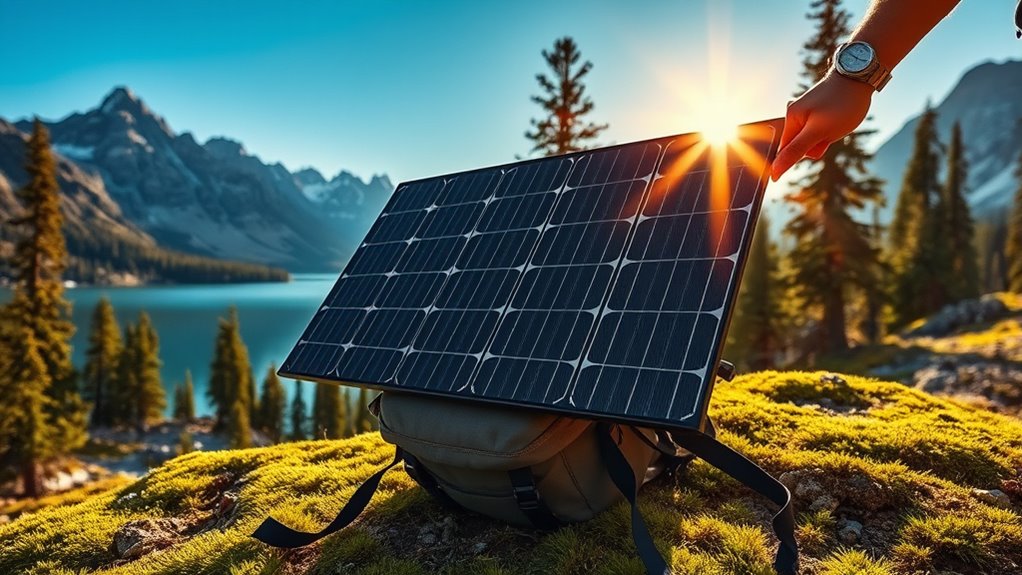

For a solar backpack charger for camping, I’d start with the BigBlue 28W as the best overall balance of output and port choice, while the FlexSolar 40W suits campers who can carry a larger panel and want more charging capacity. The Durecopow power bank takes a different approach: it stores energy for later and adds built-in cables and a flashlight. The main tradeoff is between a lightweight panel that needs direct sun and a heavier battery that can charge devices after sunset. Panel wattage alone does not predict real-world charging speed, since clouds, angle, and device limits all matter. Read on for how the six options compare and which setup fits your camping style.

Get baby and family essentials delivered free — and shop member deals
- Fast, free delivery on millions of items
- Access to Prime Big Deal Days deals on October 6–7
- Prime Video, Amazon Music and more included
Complete the kit


Key Takeaways
- BigBlue 28W is the most balanced panel pick: its dual USB-C and USB-A ports give campers more ways to connect devices than a single-port design.
- FlexSolar 40W prioritizes capacity over packability: it makes more sense when charging needs justify carrying a larger panel.
- Durecopow is the only listed option with an integrated 20,000mAh battery: stored power helps after sunset, though its solar panel is not equivalent to a dedicated high-output panel.
- FlexSolar 25W and SOLUPUP 30W sit between compact and high-output choices: weigh their port layouts and carrying needs rather than choosing by wattage alone.
- BLAVOR 10W favors a smaller, simpler setup: its lower stated output is a real limitation for charging multiple devices or keeping pace with heavier use.
| BLAVOR 10W Portable Foldable Solar Charger |  | Best Compact Panel | Maximum output: 10W | Maximum output voltage/current: 5V/2A | Conversion efficiency: Up to 24% | VIEW ON AMAZON | See Our Full Breakdown |
| FlexSolar 40W Foldable Solar Panel Charger |  | Best for Higher Output | Power output: 40W | USB-A output: QC3.0, up to 18W | USB-C output: PD2.0, up to 18W | VIEW ON AMAZON | See Our Full Breakdown |
| BigBlue 28W Portable Solar Panel Charger with Dual USB-C and USB-A |  | Best for Multi-Device USB Charging | Power: 28W | Ports: 2 USB-C and 1 USB-A | Output: 5V/3A per port; 5V/4.8A combined | VIEW ON AMAZON | See Our Full Breakdown |
| Durecopow 20,000mAh Solar Charger Power Bank with Built-In Cables, 3 Ports, and Dual Flashlight |  | Best for Stored Backup Power | Capacity: 20,000mAh | Built-in cables: Type-C, Lightning, and Micro USB | Ports: Type-C input/output and 2 USB outputs | VIEW ON AMAZON | See Our Full Breakdown |
| FlexSolar 25W Portable Solar Panel Charger with USB-A and USB-C Ports |  | Best Balanced Pack Panel | Power output: 25W | Ports: USB-A and USB-C | Device output: 5V/3A to two devices simultaneously | VIEW ON AMAZON | See Our Full Breakdown |
| SOLUPUP 30W Foldable Portable Solar Charger |  | Best Compact Standalone Panel | Panel power: 30W | Cell type: Monocrystalline silicon | Conversion efficiency: 23%+ | VIEW ON AMAZON | See Our Full Breakdown |
| solar backpack charger for camping | Weight | Included accessories | Ports |
|---|---|---|---|
| BLAVOR 10W Portable Foldable S | 0.81 lb | USB-A to USB-C cable and 2 carabiners | — |
| FlexSolar 40W Foldable Solar P | 1.76 lb (0.8 kg) | — | — |
| BigBlue 28W Portable Solar Pan | 1.5 lb | — | 2 USB-C and 1 USB-A |
| Durecopow 20,000mAh Solar Char | — | — | Type-C input/output and 2 USB outputs |
| FlexSolar 25W Portable Solar P | 1.2 lb | 2 carabiners and 1 fixed strap | USB-A and USB-C |
| SOLUPUP 30W Foldable Portable | 2.4 lb | USB-to-USB-C cable, 2 carabiners, user manual | — |
More Details on Our Top Picks
BLAVOR 10W Portable Foldable Solar Charger
The BLAVOR 10W is the easiest panel here to attach to a pack when keeping bulk and weight down matters most. At 0.81 lb and 7.4 × 7.5 inches folded, it takes up less room than the FlexSolar 25W and BigBlue 28W, making it a fit for day hikes where a small top-up for a phone or GPS is the goal. Its two USB outputs let you connect more than one small device, though the 10W ceiling limits how quickly that can help, especially with two devices drawing power. The ETFE and oxford cloth construction is described as dust- and water-resistant, but this panel does not store energy and depends on usable sun. Choose it for a light pack; choose BigBlue for more ports or FlexSolar 40W for higher output.
Pros:- Lightest panel in this group at 0.81 lb
- Compact folded size fits easily in a daypack
- Two USB outputs can serve two small devices
- Carabiners are included for pack attachment
Cons:- 10W maximum output limits charging speed
- No battery stores power for use after sunset
- Charging depends on direct sunlight and panel positioning
Best for: Day hikers and minimalist campers who want a small panel for topping up a phone or GPS while walking.
Not ideal for: Campers who need faster charging, reliable power during cloudy spells, or enough output for larger devices.
- Maximum output:10W
- Maximum output voltage/current:5V/2A
- Conversion efficiency:Up to 24%
- USB outputs:2
- Weight:0.81 lb
- Folded size:7.4 × 7.5 × 1 in
- Materials:ETFE film and oxford cloth
- Included accessories:USB-A to USB-C cable and 2 carabiners
Our verdict“Pick the BLAVOR if low weight and a compact pack attachment matter more than charging speed or stored power.”
FlexSolar 40W Foldable Solar Panel Charger
For a camping setup that needs more than phone charging, the FlexSolar 40W offers the broadest output range in this group: USB-A, USB-C, and 19V DC up to 40W. That makes it more adaptable than the BLAVOR 10W or BigBlue 28W when charging a small power station alongside USB devices. Its 1.76 lb weight is still manageable, but the larger folded footprint makes it a less convenient choice to leave strapped to a small daypack all day. The panel is IP67-rated, while its junction box is not fully waterproof, so wet conditions still call for care around the connections. Like the other panels here, it has no energy storage and needs direct sun; campers wanting power after sunset need a separate battery.
Pros:- 40W output exceeds the other listed panels
- USB-A, USB-C, and DC outputs support different device types
- IP67-rated panel resists dust and water
- Foldable design includes carabiners for attachment
Cons:- At 1.76 lb, it is heavier than the other panels here
- Junction box is not fully waterproof
- No built-in storage; output depends on direct sunlight
Best for: Campers carrying a compatible small power station who want higher panel output and USB charging options in one foldable unit.
Not ideal for: Ultralight hikers or anyone who needs stored power, laptop charging, or dependable charging in inconsistent sunlight.
- Power output:40W
- USB-A output:QC3.0, up to 18W
- USB-C output:PD2.0, up to 18W
- DC output:19V, up to 40W
- Solar conversion efficiency:24%
- Folded dimensions:8.0 × 11.1 × 1.8 in
- Weight:1.76 lb (0.8 kg)
- Water and dust resistance:IP67-rated panel; junction box is not fully waterproof
Our verdict“Choose the FlexSolar 40W if your camp kit includes a compatible power station and can accommodate its extra weight.”
BigBlue 28W Portable Solar Panel Charger with Dual USB-C and USB-A
With three USB ports—two USB-C and one USB-A—the BigBlue 28W suits campsites where several small devices need a daytime top-up. Its stated combined output of 5V/4.8A gives it more USB capacity than the BLAVOR 10W, while its 1.5 lb weight sits between BLAVOR and FlexSolar 40W. The tradeoff is that this is still a direct-sun panel, not a power bank: there is no built-in battery to carry energy into the evening. Its IP44 rating offers less protection than the IP67-rated FlexSolar panels, and the USB junction box is not waterproof. It makes sense for charging phones, GPS units, or flashlights in camp, but not for larger power stations or anyone counting on charging through poor weather.
Pros:- Three ports include two USB-C and one USB-A
- 5V/4.8A combined output supports multiple small devices
- At 1.5 lb, it balances capacity with portability
- Includes a USB-C cable and carabiners
Cons:- No built-in battery for storing solar energy
- IP44 protection is lower than the FlexSolar panels’ IP67 rating
- USB junction box is not waterproof
Best for: Small groups or campers with several phones, GPS devices, and flashlights to charge from USB during sunny periods.
Not ideal for: Campers who need evening power, stronger weather protection, or output for laptops and large power stations.
- Power:28W
- Ports:2 USB-C and 1 USB-A
- Output:5V/3A per port; 5V/4.8A combined
- Solar conversion efficiency:25.4%
- Water resistance:IP44; USB junction box is not waterproof
- Folded dimensions:11 × 6 × 1.4 in
- Weight:1.5 lb
- Battery:No built-in battery
Our verdict“Choose BigBlue for daytime USB charging across several small devices if you can keep its connections protected from water.”
Durecopow 20,000mAh Solar Charger Power Bank with Built-In Cables, 3 Ports, and Dual Flashlight
Unlike the BLAVOR 10W and other foldable panels, the Durecopow combines a 20,000mAh battery with built-in cables, so it can keep devices supplied after the sun goes down. That stored energy is its main advantage for camping; the solar panel is a way to replenish the bank, but the description warns that solar recharging may be slow. Three built-in cable types reduce the need to pack separate leads, and the dual LED lights add a practical backup for camp tasks or emergencies. There is a mismatch in the listed connectivity: the product mentions three built-in output cables and three ports, while also listing USB-A as an input. Its claim of charging up to six devices at once is unclear, so I would treat the stated capacity and backup features as the stronger reasons to choose it.
Pros:- 20,000mAh capacity stores energy for use after sunset
- Built-in Type-C, Lightning, and Micro USB cables reduce loose accessories
- Dual LED lights include steady, SOS, and strobe modes
- Rugged design includes drop-resistant corners and water-, dust-, and shock-resistant features
Cons:- Solar recharging may be slow
- Simultaneous charging claims are unclear
- Weight and dimensions are not specified in the supplied product data
Best for: Car campers and weekend campers who want a stored phone-charging reserve, built-in cables, and emergency lighting in one unit.
Not ideal for: Backpackers prioritizing low weight, or campers expecting the small solar panel to quickly refill the battery during a trip.
- Capacity:20,000mAh
- Built-in cables:Type-C, Lightning, and Micro USB
- Ports:Type-C input/output and 2 USB outputs
- Recharge methods:Solar panel or outlet
- Lighting:Dual LED flashlight with steady, SOS, and strobe modes
- Additional features:Carabiner, compass, and battery indicators
- Certifications:CE, FCC, RoHS
- Warranty:12 months
Our verdict“Pick the Durecopow if stored backup power and built-in emergency lights matter more than a light, fast-recharging solar setup.”
FlexSolar 25W Portable Solar Panel Charger with USB-A and USB-C Ports
The FlexSolar 25W lands between the compact BLAVOR 10W and the higher-output FlexSolar 40W, giving campers a useful middle ground for two-device USB charging. Its USB-A and USB-C ports are listed to charge two devices simultaneously, while MPPT technology helps optimize collection as sunlight changes. At 1.2 lb, it is lighter than both larger-output alternatives here, and the included strap and carabiners offer flexible ways to attach it around camp or to a pack. The product data does not specify folded dimensions or a battery, so it is harder to judge pack fit and it cannot preserve energy for later. Its IP67 rating is appealing for outdoor use, though—as with any panel—charging still depends on finding suitable sun.
Pros:- USB-A and USB-C support two-device charging
- MPPT technology helps optimize solar collection
- At 1.2 lb, it is lighter than the 28W and 40W panels
- IP67-rated design includes both carabiners and a fixed strap
Cons:- No battery capacity or energy storage is specified
- Folded dimensions are not provided in the product data
- Charging performance depends on available sunlight
Best for: Backpackers who want a moderate-weight panel to charge a phone and another small USB device during daylight.
Not ideal for: Campers who need stored energy, a DC output for a power station, or a clearly specified folded footprint before buying.
- Power output:25W
- Ports:USB-A and USB-C
- Device output:5V/3A to two devices simultaneously
- Weight:1.2 lb
- Photovoltaic efficiency:23.2%
- Operating temperature:-4°F to 149°F (-20°C to 65°C)
- Weather resistance:IP67-rated
- Included accessories:2 carabiners and 1 fixed strap
Our verdict“Choose the FlexSolar 25W for a moderate-weight, two-device panel when a DC output or stored power is not needed.”
SOLUPUP 30W Foldable Portable Solar Charger
For campers who want a panel that packs down small and can sit angled toward the sun, the SOLUPUP 30W earns a place for its 10.63-inch folded size, adjustable stand, and included carabiners. Its USB-A and USB-C ports can serve two small devices at once in ample sunlight, which is handy at camp when phones and other essentials need a top-up. Compared with the FlexSolar 40W Foldable Solar Panel Charger, SOLUPUP is the more compact, lighter carry at 2.4 pounds, though it gives up panel capacity. The key tradeoff is that its 30W panel rating does not mean 30W reaches devices: the listed maximum output is 15W, and actual charging depends on sun and weather. I’d choose it for portability, not fast or dependable charging in poor conditions.
Pros:- Folds to 10.63 inches for easier packing
- Adjustable stand helps angle the panel toward sunlight
- USB-A and USB-C outputs support charging up to two devices
- IPX5 rating and built-in electrical protections suit outdoor use
Cons:- Actual charging varies with sunlight and weather
- Device output is limited to 15W despite the 30W panel rating
- At 2.4 pounds, it adds more pack weight than a small power bank
Best for: Backpackers and weekend campers who want a compact panel with a stand for topping up two small devices in sunny conditions
Not ideal for: Campers who need predictable charging in cloudy weather or faster device charging, since output depends on sunlight and is capped at 15W
- Panel power:30W
- Cell type:Monocrystalline silicon
- Conversion efficiency:23%+
- Outputs:USB-A and USB-C
- Maximum listed output:5V/3A, 15W max
- Simultaneous charging:Up to 2 devices
- Weight:2.4 lb
- Folded size:10.63 inches
- Included accessories:USB-to-USB-C cable, 2 carabiners, user manual
Our verdict“Choose the SOLUPUP if compact packing and a freestanding panel matter more than high output or charging through changeable weather.”

How We Picked
I compared these options for the practical demands of camping: carrying bulk, stated solar output, connection choices, and whether power is available only while the panel is in sun or can be stored for later. I gave more weight to useful output and flexible connections for multi-device trips, while accounting for the extra space and setup that larger foldable panels can require. I also considered how well each product’s format fits backpack use, where a panel may need to be positioned in direct sunlight rather than simply attached to a pack and forgotten.
That puts the BigBlue 28W first for its combination of output and USB-C/USB-A options. The FlexSolar 40W ranks higher for campers willing to trade pack space for more panel capacity, while the Durecopow earns a distinct place for stored energy and built-in convenience. The mid-range FlexSolar 25W and SOLUPUP 30W serve campers balancing output with portability; the BLAVOR 10W is best for lighter charging needs. Stated wattage is a comparison point, not a promise of charging speed in changing outdoor conditions.
Factors to Consider When Choosing Solar Backpack Charger For Camping
Choosing a camping solar charger starts with how and when you use power. I’d plan around your devices, daily routine, and access to sun before comparing headline wattage. These broader factors can prevent a panel that looks capable on paper from becoming dead weight on the trail.
Match Solar Output to Your Daily Use
List what you plan to charge and how often, then separate essential devices from occasional ones. A phone used for navigation and photos has a different power demand from a headlamp charged once during a weekend. Higher stated wattage can help when sunlight is strong, but it does not tell you how much energy you will collect on a shaded trail or a cloudy day. Campers with modest needs may prefer a smaller panel they are more likely to carry and position well. If several devices need regular charging, a larger panel may earn its space. Keep a backup plan for stretches without useful sun.
Choose Between Direct Charging and Stored Power
A solar panel sends power to a device while conditions allow, whereas a battery bank can hold energy for later. That difference matters when you hike during the day and need a phone or light after dark. Some campers solve this by charging a separate power bank in daylight, while an integrated battery combines storage and charging in one item. Storage adds weight and introduces another component to keep charged before departure. Do not assume a small panel built into a battery will refill it quickly; check the solar input claims and plan around ordinary wall charging before the trip. Pick the format that fits your routine, not just the one with more features.
Treat Pack-Mounted Charging as a Bonus
Attaching a panel to a backpack can expose it to sun while walking, but movement, body position, and changing trail direction make consistent exposure hard. A panel laid out in a sunny campsite can be easier to angle toward the sun, though it needs supervision and a place to sit. This creates a useful choice: convenience during a hike or more deliberate positioning during a break. Avoid relying on a panel attached to your pack as your only charging plan for a demanding trip. A short cable and a secure pocket can keep a device connected without leaving it loose on the outside. Check attachment points and cable routing before heading out.
Check Ports and Device Compatibility
Count the devices you expect to charge and check which connectors they use. USB-C and USB-A availability can reduce the need for adapters, but port count alone does not show whether several connected devices receive useful power at once. Look for the product’s output details and your device’s charging requirements, especially if you depend on a particular cable or fast charging. Carry a spare cable that matches your phone or navigation device. A port can also become a weak point if it is exposed to dust, rain, or rough handling. Favor a setup you can connect and protect easily at camp.
Plan for Weather, Shade, and Storage
Solar charging depends on usable sunlight, which can be limited by tree cover, short winter days, cloud, or a campsite in a narrow valley. Build your power plan around less-than-ideal conditions instead of assuming a clear midday sky. A battery bank can cover short gaps, while a larger panel can collect more when the sun is available; each adds weight in a different way. Check the manufacturer’s care guidance for moisture and storage, since foldable panels and exposed ports may need protection from rain and grit. Keep electronics shaded and dry even when the panel itself is in direct sun. For remote trips, carry enough stored power for essential navigation and safety devices.
Frequently Asked Questions
Can a solar backpack charger keep my phone charged on a multi-day camping trip?
It can help, but the result depends on sunlight, how much you use your phone, and how well the panel is positioned. Navigation, photos, and weak-signal searching can consume power faster than occasional calls or messages. I’d use the panel to replenish a battery bank during sunny breaks, then charge the phone from that stored power when needed. For a trip where a phone is a safety tool, start with a full charge and bring enough reserve for cloudy stretches. Treat solar as added supply rather than a guaranteed daily refill.
Should I choose a foldable panel or a solar power bank?
Choose a foldable panel if you want to collect more power in daylight and can spare room to unfold and position it. A solar power bank is easier to carry as one unit and offers stored energy, but its small built-in panel may collect power slowly. For evening use, stored capacity is more useful than a panel that only produces power in the sun. Some campers get the most flexibility from a separate panel and battery bank, though that means carrying two items. Match the choice to whether daytime collection or charging after dark matters more.
Is a higher-wattage solar panel always better for camping?
No. A higher rating may offer more charging potential in strong sunlight, but it can also mean a larger, heavier panel that is harder to pack and position. Shade, cloud cover, panel angle, and the connected device all affect the power reaching your gear. If your needs are limited to occasional phone charging, a smaller panel may be the more practical choice. For several devices or frequent charging, extra panel capacity can be worth carrying. Compare the complete setup and output details, not the wattage number alone.
Can I charge devices while hiking with a panel attached to my backpack?
Often you can connect a device, but the panel may receive uneven sunlight as the trail turns or passes under trees. Walking also makes it harder to keep a phone or cable secure and protected. A pack-mounted panel can supplement power during exposed sections, but it is less predictable than setting the panel in direct sun at camp. Use a secure pocket and keep the cable from snagging. For reliable charging, stop to position the panel and connect a battery bank when conditions are favorable.
What should I carry if several days of bad weather are forecast?
Plan to meet essential power needs without meaningful solar input. Start with fully charged devices and a battery bank sized for your expected use, and reduce nonessential screen time where practical. A larger panel may help during brief clear periods, but it cannot make cloudy conditions dependable. Keep a separate power plan for navigation, communication, and emergency lighting. If those devices are critical, do not count on a solar charger as your only source of power.
Conclusion
For most campers comparing these six options, I’d choose the BigBlue 28W as best overall for its useful output and USB-C/USB-A flexibility. The BLAVOR 10W is the simpler value pick for light charging needs, while the FlexSolar 40W is the premium capacity choice for trips where carrying a larger panel is acceptable. Beginners who want stored power and built-in conveniences may prefer the Durecopow, with the tradeoff that its integrated solar charging should not replace a dedicated panel for sustained collection. Choose the FlexSolar 25W or SOLUPUP 30W if you want a middle ground; compare their port details and packing fit against your gear. For any of them, match your expectations to available sunlight and bring reserve power for essential devices.
Fall Picks
fall essentials
As an affiliate, we earn on qualifying purchases.