For Wi-Fi water leak sensor alerts, the YoLink Water Leak Sensor 4 Kit is my best overall pick for broad coverage, while the SwitchBot WiFi Water Sensor stands out for its loud local alarm and no-hub setup. The GoveeLife Smart Water Leak Detector 2, 4-Pack is another strong choice for covering several spots with a multi-sensor kit. The main tradeoffs are direct Wi-Fi versus a gateway, sensor count versus placement flexibility, and app alerts versus alarms that can still sound at home. The right choice depends on where leaks are likely and how you want to be notified. Read on for the full breakdown of all 15 options and the features that separate them.

Turn the school run and nap time into listening time
- Thousands of audiobooks, podcasts and originals
- Listen on your phone, tablet or Echo — also offline
- Cancel anytime
Complete the kit


Key Takeaways
- Hub design separates the main choices: several kits use a gateway, while the SwitchBot WiFi Water Sensor and X-Sense single sensor are listed as no-hub options.
- Multi-sensor kits suit spread-out risk areas: TECKNET‘s five-sensor kit and the six-sensor gateway kit offer more included sensing points than single units or two-sensor starter kits.
- Probe cables change placement options: the GoveeLife detector with a 4.92-foot cable and SwitchBot‘s 1 m probe model can reach along appliances or into tighter spaces.
- Local alarms remain useful when phones are out of reach: the SwitchBot WiFi Water Sensor advertises a 100 dB alarm, adding an at-home alert path alongside Wi-Fi notifications.
- Specialized needs narrow the field: X-Sense‘s single-sensor model adds a freeze alarm, while the Tapo T300 and D-Link starter kit may suit buyers already weighing ecosystem compatibility.
| Stechro WiFi Water Leak Detector Kit with App Alerts, 4 Sensors and Gateway |  | Best for Flexible Room Coverage | Included sensors: 4 | Included gateway: 1 | Wi-Fi compatibility: 2.4 GHz only | VIEW ON AMAZON | See Our Full Breakdown |
| YoLink Water Leak Sensor 4 Kit (3-Pack + Hub) |  | Best for Long-Range Coverage | Included items: 1 hub and 3 sensors | Wireless technology: LoRa | Maximum range: Up to 2,034 feet | VIEW ON AMAZON | See Our Full Breakdown |
| GoveeLife Smart Water Leak Detector with 4.92 ft Cable |  | Best for Hard-to-Reach Leaks | Cable length: 4.92 ft | Detection modes: Water alarm and water-level detection | Wireless technology: 915 MHz Sub-1G | VIEW ON AMAZON | See Our Full Breakdown |
| SwitchBot WiFi Water Sensor – Smart Leak Detector with 100 dB Alarm, IP67 Waterproof, No Hub Required (2.4 GHz) |  | Best Hub-Free Pick | Connectivity: Direct 2.4 GHz Wi-Fi; no hub required | Detection: Four probes; detects leaks as small as 0.5 mm | Audible alarm: 100 dB | VIEW ON AMAZON | See Our Full Breakdown |
| GoveeLife Smart Water Leak Detector 2, 4-Pack |  | Best Multi-Sensor Value | Pack size: 4 detectors | Wireless technology: LoRa with Wi-Fi gateway | Wireless range: Up to 1,968.5 feet | VIEW ON AMAZON | See Our Full Breakdown |
| TECKNET Wi-Fi Water Leak Detector Kit (5 Sensors + 1 Gateway) |  | Best for Whole-Home Coverage | Included components: 5 sensors and 1 gateway | Connectivity: 2.4 GHz Wi-Fi | App: Tuya Smart | VIEW ON AMAZON | See Our Full Breakdown |
| X-Sense Wi-Fi Water Leak Detector and Freeze Alarm, No Hub Required, 1-Pack |  | Best Hub-Free Pick for Leak and Freeze Alerts | Pack size: 1 sensor | Connectivity: 2.4 GHz Wi-Fi; no hub required | Water detection: Six probes; detects water as shallow as 0.4 mm | VIEW ON AMAZON | See Our Full Breakdown |
| Tapo Smart Water Leak Detector T300 |  | Best for Tapo Smart-Home Owners | Detection time: As little as 1 second | Sensor probes: 6 dual-side probes | Alarm volume: 90 dB | VIEW ON AMAZON | See Our Full Breakdown |
| SwitchBot Wi-Fi Water Leak Detector with 1 m Probe Cable |  | Best for Hard-to-Reach Leak Spots | Connectivity: 2.4 GHz Wi-Fi; no hub required | Probe cable length: 1 m | Water detection sensitivity: 0.5 mm | VIEW ON AMAZON | See Our Full Breakdown |
| X-Sense Wi-Fi Water Leak Detector Kit with 3 Sensors and Base Station, SWS54 | 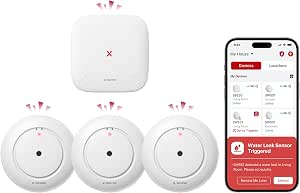 | Best for Large or Multi-User Properties | Sensors: 3 | Base station: Included | Alarm volume: Dual 120 dB alarms | VIEW ON AMAZON | See Our Full Breakdown |
| TECKNET WiFi Water Leak Detector with App Alerts |  | Best Hub-Free Two-Pack | Pack size: 2 sensors | Connectivity: 2.4GHz Wi-Fi; no hub required | App: Tuya Smart | VIEW ON AMAZON | See Our Full Breakdown |
| Wi-Fi Water Leak Detector with App Alerts, Gateway and 6 Sensors |  | Best for Expandable Whole-Home Coverage | Included sensors: 6 | Connectivity: 2.4GHz Wi-Fi gateway; no 5GHz support | App: TUYA Smart for iOS and Android | VIEW ON AMAZON | See Our Full Breakdown |
| D-Link Wi-Fi Water Leak Detector Starter Kit with 2 Sensors |  | Best for Multiple Local Alerts | Sensors included: 2: plug-in master unit with sensing cable and extension, plus remote pod | Connectivity: Wi-Fi; no hub required | Alarm volume: 100dB | VIEW ON AMAZON | See Our Full Breakdown |
| Winees WiFi Water Leak Detector, 3-Pack |  | Best for Flexible Alert Channels | Pack size: 3 sensors | Wi-Fi compatibility: 2.4GHz | Hub requirement: Wi-Fi-connected hub required | VIEW ON AMAZON | See Our Full Breakdown |
| GoveeLife Upgraded Smart Water Leak Detector, 5-Pack |  | Best for Long-Range, Long-Life Coverage | Pack size: 5 sensors | Wireless range: Up to 1,804 ft (550 m) | Gateway Wi-Fi: 2.4GHz | VIEW ON AMAZON | See Our Full Breakdown |
| water leak sensor wi fi alert | Water resistance | Alarm volume | Battery life |
|---|---|---|---|
| Stechro WiFi Water Leak Detect | IP66 | Adjustable up to 120 dB | Up to 3 years |
| YoLink Water Leak Sensor 4 Kit | IP66 | — | Over 5 years |
| GoveeLife Smart Water Leak Det | — | 105 dB | Up to 5 years |
| SwitchBot WiFi Water Sensor | IP67 | — | Up to 2 years |
| GoveeLife Smart Water Leak Det | IP66 | 100 dB | Over 5 years under normal use |
| TECKNET Wi-Fi Water Leak Detec | IP67 | Up to 120 dB | Over 2 years |
| X-Sense Wi-Fi Water Leak Detec | IP66 | — | — |
| Tapo Smart Water Leak Detector | IP67 | 90 dB | Up to 3 years |
| SwitchBot Wi-Fi Water Leak Det | IP67 | 100 dB | Up to 2 years |
| X-Sense Wi-Fi Water Leak Detec | — | Dual 120 dB alarms | — |
| TECKNET WiFi Water Leak Detect | IP67 | — | — |
| Wi-Fi Water Leak Detector with | — | — | — |
| D-Link Wi-Fi Water Leak Detect | — | 100dB | — |
| Winees WiFi Water Leak Detecto | IP66 | — | — |
| GoveeLife Upgraded Smart Water | IP67 | — | — |
More Details on Our Top Picks
Stechro WiFi Water Leak Detector Kit with App Alerts, 4 Sensors and Gateway
I’d choose the Stechro kit when four detection points and adjustable local alarms matter more than long-distance sensor reach. Its gateway reports through the TUYA app, and alerts identify which sensor has detected water—a useful distinction when sensors are spread around a home. The four bottom probes handle floor flooding, while a top sensor can catch drips before they spread. Compared with the SwitchBot WiFi Water Sensor, Stechro includes multiple sensors but requires a gateway; SwitchBot connects directly over Wi-Fi but is a single-sensor option. Stechro’s 120 dB adjustable alarm and IP66 rating suit damp utility areas, though Wi-Fi is limited to 2.4 GHz. SMS, phone, and email alerts require a subscription, so buyers relying on those channels should look at alternatives.
Pros:- Four sensors provide coverage for several leak-prone locations.
- App alerts can identify which sensor detected water.
- Bottom flood probes and a top drip sensor cover different leak paths.
- Adjustable alarm reaches 120 dB, and the sensors carry an IP66 rating.
Cons:- Gateway works only with 2.4 GHz Wi-Fi.
- SMS, phone, and email alerts require a subscription.
- A gateway is required for app-connected alerts.
Best for: Households that want four app-identifiable detection points for places such as sinks, laundry areas, and water heaters.
Not ideal for: Buyers who need SMS, phone, or email alerts without a subscription, or who have only a 5 GHz Wi-Fi network.
- Included sensors:4
- Included gateway:1
- Wi-Fi compatibility:2.4 GHz only
- App:TUYA
- Maximum gateway capacity:24 sensors
- Detection:4 bottom flood probes and 1 top drip sensor
- Alarm volume:Adjustable up to 120 dB
- Battery life:Up to 3 years
- Water resistance:IP66
Our verdict“Choose Stechro for four location-specific alerts and a loud adjustable alarm, but skip it if you need subscription-free messages beyond app notifications.”
YoLink Water Leak Sensor 4 Kit (3-Pack + Hub)
For leak monitoring beyond the reach of ordinary Wi-Fi-linked sensors, I’d put the YoLink kit ahead of the other picks here. Its sensors communicate with the hub over LoRa**, with a stated range of up to 2,034 feet, making it a stronger fit for basements or outbuildings than the SwitchBot WiFi Water Sensor, whose listed range is 120 meters. The three sensors also add freeze warnings, so the system can flag a pipe-risk condition as well as water. Replaceable AAA batteries are rated for over five years. The tradeoff is the hub: it needs Ethernet or 2.4 GHz Wi-Fi for connected alerts, and the sensors cannot operate as a standalone Wi-Fi system. Free SMS alerts are limited to five per device each month, so frequent texters may prefer another alert setup.
Pros:- LoRa connection has a stated range of up to 2,034 feet.
- Freeze warnings add pipe-temperature risk monitoring to leak detection.
- Battery life is rated at over five years with replaceable AAA batteries.
- Hub can connect through Ethernet or 2.4 GHz Wi-Fi.
Cons:- Hub is required; sensors do not work as a standalone system.
- Free SMS alerts are limited to five per device per month.
- The hub still depends on a network connection for app alerts.
Best for: Homeowners monitoring leak-prone areas across a large property, detached outbuilding, or basement, especially where freeze warnings are useful.
Not ideal for: Renters or small-home buyers who want a single direct-Wi-Fi sensor without a hub, or who expect unlimited SMS notifications.
- Included items:1 hub and 3 sensors
- Wireless technology:LoRa
- Maximum range:Up to 2,034 feet
- Hub connectivity:Ethernet or 2.4 GHz Wi-Fi
- Audio alarm:105 dB
- Battery life:Over 5 years
- Additional detection:Freeze warning
- Water resistance:IP66
Our verdict“Pick YoLink when long sensor reach and freeze warnings matter more than avoiding a hub or SMS limits.”
GoveeLife Smart Water Leak Detector with 4.92 ft Cable
The 4.92-foot cable probe is the reason I’d choose this GoveeLife detector over a flat floor sensor: it can reach into awkward spaces around appliances or water-level areas without placing the main unit right beside the leak point. It offers both water alarm and water-level detection modes, plus a 105 dB local alarm and app, SMS, and email notifications. Compared with the four-sensor GoveeLife Smart Water Leak Detector 2, this model trades multiple room sensors for a cable probe and level monitoring. Its stated range reaches up to 550 meters, and battery life is rated up to five years. The gateway still needs 2.4 GHz Wi-Fi, and compatibility is limited to specified GoveeLife sensor models. The listing gives conflicting IP66 and IP67 resistance details, so I would not rely on one rating without checking the current product documentation.
Pros:- 4.92-foot cable probe can reach beyond the main unit.
- Water alarm and water-level modes support different monitoring needs.
- App, SMS, email, and audible alerts are listed.
- Battery life is rated up to five years.
Cons:- Gateway requires 2.4 GHz Wi-Fi.
- Compatible sensors are limited to GoveeLife H5059 and H5830 models.
- Product information conflicts on whether the water-resistance rating is IP66 or IP67.
Best for: Owners who need a cable probe to reach a sump, appliance gap, or other hard-to-access water detection point and want water-level monitoring.
Not ideal for: Buyers seeking a multi-room sensor pack, broad third-party sensor compatibility, or a clearly consistent published water-resistance rating.
- Cable length:4.92 ft
- Detection modes:Water alarm and water-level detection
- Wireless technology:915 MHz Sub-1G
- Connectivity range:Up to 550 meters
- Alerts:App, SMS, email, and audible alarm
- Alarm volume:105 dB
- Battery life:Up to 5 years
- Gateway Wi-Fi:2.4 GHz
Our verdict“Choose this GoveeLife model for cable-reach and water-level monitoring, not for broad multi-room coverage.”
SwitchBot WiFi Water Sensor – Smart Leak Detector with 100 dB Alarm, IP67 Waterproof, No Hub Required (2.4 GHz)
If I wanted one sensor to send Wi-Fi alerts without a separate hub, SwitchBot would be my pick in this group. Its four probes are specified to detect leaks as small as 0.5 mm, and the 100 dB alarm can be muted from the app. That direct connection makes setup simpler than the Stechro kit or the GoveeLife Smart Water Leak Detector 2, both of which rely on a gateway for connected alerts. SwitchBot also lists integration with Alexa, Google Assistant, Siri, IFTTT, and SmartThings. The compromise is coverage: this is a single sensor with a stated 120-meter maximum range, not a multi-point kit with the broader LoRa reach of YoLink. Its battery-life claim is up to two years, shorter than several gateway-based options.
Pros:- Connects directly to Wi-Fi without a hub.
- Four probes are specified to detect leaks as small as 0.5 mm.
- 100 dB alarm can be muted through the app.
- Lists integrations with Alexa, Google Assistant, Siri, IFTTT, and SmartThings.
Cons:- Requires a 2.4 GHz Wi-Fi network.
- One sensor offers less coverage than the multi-sensor kits in this roundup.
- Battery life is rated up to two years, shorter than several alternatives.
Best for: People who want one straightforward leak sensor with direct 2.4 GHz Wi-Fi alerts and smart-home integrations, without adding a hub.
Not ideal for: Buyers covering several rooms, monitoring far-flung outbuildings, or using only 5 GHz Wi-Fi.
- Connectivity:Direct 2.4 GHz Wi-Fi; no hub required
- Detection:Four probes; detects leaks as small as 0.5 mm
- Audible alarm:100 dB
- Water resistance:IP67
- Maximum range:120 m
- Battery:AAA alkaline
- Battery life:Up to 2 years
- Smart-home compatibility:Alexa, Google Assistant, Siri, IFTTT, and SmartThings
Our verdict“Choose SwitchBot for a single hub-free sensor with broad smart-home compatibility, but use a multi-sensor kit for whole-home coverage.”
GoveeLife Smart Water Leak Detector 2, 4-Pack
I’d favor the GoveeLife 4-pack for buyers who need several detection locations and want remote alerts by app, SMS, and email. Each detector has six probes—two on top and four below—so it can respond to water reaching the unit from different directions. LoRa communication has a stated range of up to 1,968.5 feet, a major advantage over the single-sensor, direct-Wi-Fi SwitchBot WiFi Water Sensor when placing sensors farther from the gateway. The system also supports up to 100 sensors, leaving room to expand. The tradeoff is that Wi-Fi alerts still depend on an included gateway and a 2.4 GHz network. It is less suited to someone who wants a single hub-free installation, and its 100 dB alarm is lower than Stechro’s adjustable 120 dB maximum.
Pros:- Four detectors provide coverage across multiple leak-prone locations.
- App, SMS, and email alerts offer several ways to receive notifications.
- LoRa range is listed up to 1,968.5 feet.
- Six probes per detector and a stated battery life over five years support broad detection and long intervals between battery changes.
Cons:- A gateway is required for Wi-Fi notifications.
- Gateway supports only 2.4 GHz Wi-Fi.
- 100 dB alarm is less powerful than Stechro’s adjustable alarm rated up to 120 dB.
Best for: Households that want several leak-monitoring points, multiple remote alert channels, and the option to expand the system.
Not ideal for: Buyers who want one direct-Wi-Fi sensor, have no suitable 2.4 GHz network, or prefer a louder adjustable alarm.
- Pack size:4 detectors
- Wireless technology:LoRa with Wi-Fi gateway
- Wireless range:Up to 1,968.5 feet
- Alerts:SMS, app, and email
- Sensor probes:2 top probes and 4 bottom probes per detector
- Alarm volume:100 dB
- Battery life:Over 5 years under normal use
- Maximum system capacity:100 sensors
- Water resistance:IP66
Our verdict“Choose this GoveeLife pack for multi-location coverage and several alert channels, but skip it if you want a hub-free sensor.”
TECKNET Wi-Fi Water Leak Detector Kit (5 Sensors + 1 Gateway)
For buyers who want several leak-prone areas covered at once, this kit pairs five sensors with a gateway and sends remote alerts through the Tuya Smart app. Its dual-probe design can detect water at the top or bottom of a sensor, while the 120 dB alarm adds a local warning if someone is home. Compared with the single-sensor X-Sense Wi-Fi Water Leak Detector and Freeze Alarm, TECKNET covers more locations in one purchase, but requires a gateway and has no freeze-alert feature listed. The IP67 housing and stated battery life of over two years suit damp utility areas, though water mist in very humid conditions may trigger false alarms. I’d also plan for a separate USB adapter for the gateway and a compatible 2.4 GHz network.
Pros:- Includes five sensors for coverage across multiple leak-prone areas
- Tuya Smart app provides remote alerts through the included gateway
- Dual-probe sensing and IP67 housing suit varied placement conditions
- Up to 120 dB alarm, low-battery alerts, and stated battery life over two years
Cons:- Requires a gateway and a 2.4 GHz Wi-Fi network
- USB charger adapter for the gateway is not included
- Water mist in high-humidity areas may cause false alarms
Best for: Households that want to monitor several appliances, pipes, or basement spots through one Tuya Smart setup.
Not ideal for: Buyers who want a hub-free sensor, freeze alerts, or a kit that works on 5 GHz Wi-Fi.
- Included components:5 sensors and 1 gateway
- Connectivity:2.4 GHz Wi-Fi
- App:Tuya Smart
- Sensor design:Dual probes
- Water resistance:IP67
- Alarm volume:Up to 120 dB
- Battery life:Over 2 years
- Included batteries:10 AAA
- Warranty:36 months for registered users
Our verdict“Choose this kit if you want five app-connected leak sensors in one setup and can accommodate its gateway and 2.4 GHz requirement.”
X-Sense Wi-Fi Water Leak Detector and Freeze Alarm, No Hub Required, 1-Pack
This compact sensor is a strong fit when a single vulnerable spot needs both water-leak and low-temperature alerts. It connects directly to 2.4 GHz Wi-Fi, so there’s no separate base station to place or configure, unlike the X-Sense SWS54 kit. Six probes detect drips and shallow pooling, and the app can notify up to 12 users—useful when family members or property helpers share responsibility. The device also sounds a 110 dB local alarm, but its pack includes only one sensor, making whole-home coverage a larger commitment than the five-sensor TECKNET kit. Its IP66 rating and replaceable CR123A battery suit flexible placement, though buyers seeking 5 GHz support should skip it. The 39°F freeze threshold adds a kind of warning the other listed sensors do not specify.
Pros:- Connects directly to 2.4 GHz Wi-Fi without a hub
- Monitors both water leaks and temperatures below 39°F
- Six probes detect drips and water as shallow as 0.4 mm
- App alerts can be shared with up to 12 users
Cons:- One sensor covers only one placement area
- Does not support 5 GHz Wi-Fi
- Replaceable CR123A battery may be less convenient than common AAA cells
Best for: Homeowners who want hub-free monitoring at one pipe, appliance, or cold-prone area, with alerts shared among household members.
Not ideal for: Buyers needing several monitored locations in one kit or a sensor compatible with 5 GHz Wi-Fi.
- Pack size:1 sensor
- Connectivity:2.4 GHz Wi-Fi; no hub required
- Water detection:Six probes; detects water as shallow as 0.4 mm
- Freeze alert threshold:Below 39°F (4°C)
- Water resistance:IP66
- Local alarm:110 dB
- Battery:Replaceable CR123A; up to 2 years under normal operating conditions
- App alerts:Water leak, low temperature, and low battery
- Alert sharing:Up to 12 users
Our verdict“Pick this single sensor for a hub-free spot check where freeze warnings matter as much as leak alerts.”
Tapo Smart Water Leak Detector T300
The Tapo T300 prioritizes fast detection within an existing Tapo setup: its six dual-side probes are specified to sense leaks in as little as one second, then trigger app notifications and a 90 dB alarm. That rapid response is useful under a sink or beside a washing machine, where catching a small leak early can limit damage. Unlike the hub-free SwitchBot Wi-Fi Water Leak Detector with 1 m Probe Cable, the T300 requires a Tapo Hub, so it makes most sense for buyers already using that system or willing to add its hub. Its two AAA batteries are rated for up to three years, longer than the stated life of several alternatives, but they still need eventual replacement. The alarm is also quieter than the 100 dB SwitchBot and 120 dB TECKNET options.
Pros:- Six dual-side probes are specified to detect leaks in as little as one second
- App notifications pair with a 90 dB local alarm
- Up to three years of stated battery life
- IP67 rating suits damp leak-prone placements
Cons:- Requires a Tapo Hub for full functionality
- 90 dB alarm is quieter than the alarms on the TECKNET and SwitchBot picks
- Two AAA batteries eventually need replacement
Best for: Tapo users who want a compact leak sensor with quick detection and app alerts through their existing hub.
Not ideal for: Buyers without a Tapo Hub who want a direct-to-Wi-Fi sensor or a louder local alarm.
- Detection time:As little as 1 second
- Sensor probes:6 dual-side probes
- Alarm volume:90 dB
- Battery type:2 replaceable AAA batteries
- Battery life:Up to 3 years
- Hub requirement:Tapo Hub required
- Water resistance:IP67
Our verdict“Choose the T300 if you already have a Tapo Hub and value rapid detection over hub-free setup or a louder alarm.”
SwitchBot Wi-Fi Water Leak Detector with 1 m Probe Cable
The standout here is the 1 m probe cable, which lets the detector body sit away from a tight or awkward leak point while the probe reaches beneath appliances or into narrow spaces. It connects to 2.4 GHz Wi-Fi without a hub and sends both app and email alerts, giving it a simpler installation path than the hub-dependent Tapo T300. A 100 dB alarm and 0.5 mm water sensitivity cover local and remote warning needs, while IP67 protection suits damp areas. The tradeoff is that this is a single sensor, so covering a home with several risk points means adding more units; the five-sensor TECKNET kit is better suited to broad coverage. Its listed battery life is up to two years, and 5 GHz networks are not supported.
Pros:- One-meter probe cable reaches confined or hard-to-access leak points
- App and email alerts work over Wi-Fi without a hub
- Detects water at a stated sensitivity of 0.5 mm
- IP67 design and 100 dB alarm
Cons:- Single sensor is less suited to covering many leak-prone areas at once
- Requires a 2.4 GHz Wi-Fi network
- Stated battery life is up to two years
Best for: People who need to place a probe beneath or behind an appliance while keeping the detector body accessible.
Not ideal for: Buyers seeking multi-room coverage in one kit or Wi-Fi support beyond 2.4 GHz.
- Connectivity:2.4 GHz Wi-Fi; no hub required
- Probe cable length:1 m
- Water detection sensitivity:0.5 mm
- Alarm volume:100 dB
- Battery life:Up to 2 years
- Power source:2 included AAA batteries
- Water resistance:IP67
- Dimensions:1.3 × 1.3 × 3.1 in
- Control:App and voice
Our verdict“Pick this SwitchBot model when a cable probe solves a placement problem that a standard sensor cannot.”
X-Sense Wi-Fi Water Leak Detector Kit with 3 Sensors and Base Station, SWS54
The SWS54 is aimed at households that need several sensors and a central alert point: it includes three sensors plus a base station, with dual 120 dB alarms and app notifications. Its stated sensor-to-base range reaches 1,804 ft in open areas, which can help when leak-prone locations are spread out, though walls and other obstacles mean that figure should not be treated as an indoor guarantee. Each sensor has six probes for drips and pooling water as shallow as 0.4 mm. Compared with the five-sensor TECKNET kit, X-Sense includes fewer sensors but offers access sharing for up to 12 users and configurable alert reminders. It also requires a base station and 2.4 GHz Wi-Fi; the IP66 rating is lower than IP67 on TECKNET and the cable-equipped SwitchBot.
Pros:- Includes three sensors and a base station with dual 120 dB alarms
- Six probes per sensor detect drips and pooling water as shallow as 0.4 mm
- Supports shared access for up to 12 users
- Offers selectable alert reminder intervals
Cons:- Requires a base station and 2.4 GHz Wi-Fi; 5 GHz is unsupported
- The 1,804 ft range figure applies to open areas, not guaranteed indoor coverage
- IP66 rating is below the IP67 rating of the TECKNET and SwitchBot options
Best for: Owners of larger homes or properties who want a base-station system, several sensing points, and alerts shared with multiple people.
Not ideal for: Buyers who need the most sensors in one kit, direct-to-Wi-Fi operation, or IP67-rated sensors.
- Sensors:3
- Base station:Included
- Alarm volume:Dual 120 dB alarms
- Detection probes:6 per sensor: 2 upper and 4 bottom
- Minimum pooling depth:0.4 mm
- Wireless range:Up to 1,804 ft (550 m) in open areas
- Wi-Fi:2.4 GHz supported; 5 GHz not supported
- Ingress protection:IP66
- Shared access:Up to 12 users
Our verdict“Choose the SWS54 if shared alerts and a base-station system matter more than getting five sensors or avoiding a hub.”
TECKNET WiFi Water Leak Detector with App Alerts
The TECKNET makes a straightforward choice for buyers who want two Wi-Fi-connected sensors without a separate hub. Each unit connects directly to 2.4GHz Wi-Fi and sends leak and low-battery notices through the Tuya Smart app, so you can place one near a water heater and another under a sink. Its six detection probes and adjustable alarm reaching 120dB add local warning alongside phone alerts. Compared with the Winees WiFi Water Leak Detector, TECKNET avoids a hub but includes fewer sensors and does not list SMS or email alerts as standard. The tradeoff is that SMS and phone-call notifications require a third-party subscription, and 5GHz Wi-Fi is unsupported. I’d choose it for simple, independent coverage rather than a larger expandable system.
Pros:- Connects directly to 2.4GHz Wi-Fi without a hub
- App sends leak and low-battery alerts
- Six detection probes and an adjustable alarm up to 120dB
- Two sensors and their AAA batteries are included
Cons:- SMS and phone-call alerts require a third-party subscription
- Supports 2.4GHz Wi-Fi only
- Two sensors offer less coverage than the six-sensor gateway kit in this roundup
Best for: Households that want two app-alert sensors, included batteries, and no gateway to set up
Not ideal for: Buyers who need SMS or phone-call alerts without a third-party subscription, or whose Wi-Fi network only uses 5GHz
- Pack size:2 sensors
- Connectivity:2.4GHz Wi-Fi; no hub required
- App:Tuya Smart
- Detection probes:6 per sensor: 2 top and 4 bottom
- Alarm:Adjustable, up to 120dB
- Power:2 included AAA batteries per sensor
- Stated battery life:Up to 2 years
- Water resistance:IP67
- Warranty:36 months with registration
Our verdict“Choose TECKNET for a simple two-area setup with direct Wi-Fi alerts, but pick a larger kit if you need broader coverage.”
Wi-Fi Water Leak Detector with App Alerts, Gateway and 6 Sensors
This kit’s main advantage is its six included sensors plus room to expand: one gateway can support up to 24 WD61 sensors. That makes it a stronger fit for buyers mapping several leak-prone spots than the two-sensor TECKNET WiFi Water Leak Detector. The TUYA Smart app provides remote alerts, while the gateway’s stated range of up to 328 feet can help connect sensors placed across a larger home. Sensors detect both drips and floor flooding, and adjustable alarms let you tailor sound levels across the system. There are costs to that coverage in setup and compatibility: this is a gateway-based system, supports 2.4GHz Wi-Fi only, and expansion is limited to WD61 sensors. SMS and call alerts may also bring third-party charges, so I’d favor it for app-first monitoring.
Pros:- Six sensors are included, with expansion support for up to 24 WD61 sensors
- Detects both drips and floor flooding
- TUYA Smart app provides remote alerts and device settings
- Sensor and gateway alarms offer adjustable volume levels
Cons:- Requires a gateway and supports 2.4GHz Wi-Fi only
- Expansion is limited to WD61 sensors
- SMS and call alerts may involve third-party charges
Best for: Homeowners who want to monitor multiple rooms now and add compatible WD61 sensors later
Not ideal for: Buyers seeking a direct-to-Wi-Fi sensor, 5GHz support, or freedom to expand with other sensor types
- Included sensors:6
- Connectivity:2.4GHz Wi-Fi gateway; no 5GHz support
- App:TUYA Smart for iOS and Android
- Detection:Drips and floor flooding
- Expansion capacity:Up to 24 WD61 sensors
- Maximum transmission range:328 ft (100 m)
- Sensor alarm:Up to 120dB, 4 levels
- Gateway alarm:Up to 100dB, 5 levels
- Power:12 included AAA batteries; 3V
Our verdict“Pick this kit for broad, expandable app-alert coverage if you’re comfortable with its gateway and WD61-only ecosystem.”
D-Link Wi-Fi Water Leak Detector Starter Kit with 2 Sensors
D-Link stands out when a leak warning needs to reach people in more than one way: the kit combines app notifications, a 100dB siren, an LED strobe, and optional Google Assistant announcements. Its plug-in master unit uses a sensing cable and extension, while a remote pod covers a second area; additional pods can extend monitoring to 17 areas. Compared with the TECKNET WiFi Water Leak Detector, D-Link offers a strobe and Google Assistant support, but its listed kit has a lower alarm ceiling and depends on a plug-in master unit. That can be useful near a reliable outlet, but less convenient where outlet placement is awkward. I’d also check the compatibility note before buying: several older D-Link water sensors are not supported. This is best for buyers who value layered local alerts over a fully battery-powered setup.
Pros:- Alerts can arrive through the app, a 100dB siren, LED strobe, and optional Google Assistant announcements
- Monitors two areas out of the box
- Can expand to monitor up to 17 areas
- Plug-in master unit connects to Wi-Fi without a separate hub
Cons:- The master unit requires a power outlet
- Remote pod requires AAA batteries
- Not compatible with D-Link DCH-161-US, DCH-S1621KT, or DCH-S163 sensors
Best for: Households that want audible, visual, app, and optional voice-assistant warnings across several areas
Not ideal for: D-Link owners relying on listed legacy sensors, or buyers who need every monitoring unit to be battery-powered
- Sensors included:2: plug-in master unit with sensing cable and extension, plus remote pod
- Connectivity:Wi-Fi; no hub required
- Alarm volume:100dB
- Maximum monitored areas:17
- Remote pod power:AAA batteries
- Remote pod battery life:Up to 2 years
- Smart home integration:Google Assistant
- Compatibility note:Not compatible with D-Link DCH-161-US, DCH-S1621KT, or DCH-S163 sensors
Our verdict“Choose D-Link if layered local warnings and Google Assistant announcements matter more than an all-battery, outlet-free setup.”
Winees WiFi Water Leak Detector, 3-Pack
The Winees kit is a good match for buyers who want alerts beyond a phone app: it lists app, SMS, and email notifications, plus IFTTT compatibility for connected routines. Three pre-paired sensors cover more spots than the TECKNET two-pack, and their stated 200-meter range from the hub gives more placement flexibility where a sensor is far from the router. The slim 1.8mm sensor profile may also help in tight gaps. The compromise is that Winees requires a Wi-Fi-connected hub, unlike the direct-connect TECKNET, and its Wi-Fi support is limited to 2.4GHz. The product data does not specify whether SMS alerts carry a separate service charge, so buyers relying on them should check the terms. I’d favor this kit for varied notification preferences, not for hub-free simplicity.
Pros:- App, SMS, and email notifications are listed
- Three pre-paired sensors are included
- Sensors communicate with the hub at distances up to 200 meters
- IP66-rated sensors and IFTTT compatibility
Cons:- Requires a hub connected to Wi-Fi
- Supports 2.4GHz Wi-Fi only
- SMS service terms are not specified in the provided product data
Best for: Buyers who want three remote sensors and prefer app, SMS, or email options with IFTTT compatibility
Not ideal for: People avoiding a hub, using 5GHz-only Wi-Fi, or needing a clearly stated SMS service arrangement before purchase
- Pack size:3 sensors
- Wi-Fi compatibility:2.4GHz
- Hub requirement:Wi-Fi-connected hub required
- Sensor range:Up to 200 meters from hub
- Sensor thickness:1.8mm
- Notifications:App, SMS, and email
- Smart home compatibility:IFTTT
- Alarm settings:Three volume levels and selectable alarm duration
- Water resistance:IP66
Our verdict“Choose Winees for three sensors and multiple alert channels if a hub-based, 2.4GHz system suits your setup.”
GoveeLife Upgraded Smart Water Leak Detector, 5-Pack
GoveeLife pairs a five-sensor bundle with a stated wireless range of up to 1,804 feet and battery life of up to five years. Those figures make it appealing for larger homes or properties where leak-prone areas are spread out and frequent battery changes are unwelcome. App, SMS, and email alerts provide several ways to receive warnings, while each sensor has an adjustable alarm up to 105dB and an IP67 rating. Compared with the Wi-Fi Water Leak Detector with Gateway and 6 Sensors, this kit includes one fewer sensor but claims a much longer wireless range and battery life. It still requires a compatible gateway, supports only 2.4GHz Wi-Fi, and works with the listed H5059/H5830 sensors rather than an open sensor ecosystem. I’d pick it for reach and low-maintenance coverage, not direct Wi-Fi simplicity.
Pros:- Five sensors are included
- Stated wireless range reaches up to 1,804 feet
- App, SMS, and email alerts are listed
- IP67 sensors with adjustable alarms up to 105dB
Cons:- A compatible gateway is required and uses 2.4GHz Wi-Fi only
- Gateway compatibility is limited to GoveeLife H5059/H5830 sensors
- SMS service terms are not specified in the provided product data
Best for: Owners of larger homes or outbuildings who want several sensors, multiple alert channels, and infrequent battery changes
Not ideal for: Buyers who need a direct-to-router sensor, 5GHz Wi-Fi, or compatibility with sensors outside the H5059/H5830 family
- Pack size:5 sensors
- Wireless range:Up to 1,804 ft (550 m)
- Gateway Wi-Fi:2.4GHz
- Gateway requirement:Compatible gateway required
- Alarm:Up to 105dB; 4 volume levels
- Notifications:App, SMS, and email
- Stated battery life:Up to 5 years
- Batteries:10 AAA batteries included
- Water resistance:IP67
Our verdict“Choose this GoveeLife kit for far-reaching coverage and a long stated battery life, provided its gateway and sensor limits fit your system.”

How We Picked
I ranked these sensors by how well their stated features address the central job: detecting water and sending a useful alert. I weighed connectivity and hub requirements, the number and type of sensors included, placement flexibility, and the presence of local alarms or added freeze detection. A direct Wi-Fi device can simplify setup, while a gateway kit may make more sense when a buyer wants several sensors working through one base; neither approach is automatically better for every home.
The order also reflects practical fit, not just feature count. I favored options with a clear role, such as a cable probe for awkward locations or a multi-sensor bundle for several leak-prone areas, while noting that product names alone do not establish alert reliability, app limits, or compatibility. Since the supplied product information varies, I avoid treating unspecified range, subscription terms, battery life, and smart-home support as confirmed. Buyers should check those details for the exact model before choosing.
| water leak sensor wi fi alert | Battery life | Water resistance |
|---|---|---|
| Stechro WiFi Water Leak Detect | Up to 3 years | IP66 |
| YoLink Water Leak Sensor 4 Kit | Over 5 years | IP66 |
| GoveeLife Smart Water Leak Det | Up to 5 years | — |
| SwitchBot WiFi Water Sensor | Up to 2 years | IP67 |
| GoveeLife Smart Water Leak Det | Over 5 years under normal use | IP66 |
| TECKNET Wi-Fi Water Leak Detec | Over 2 years | IP67 |
| X-Sense Wi-Fi Water Leak Detec | — | IP66 |
| Tapo Smart Water Leak Detector | Up to 3 years | IP67 |
| SwitchBot Wi-Fi Water Leak Det | Up to 2 years | IP67 |
| X-Sense Wi-Fi Water Leak Detec | — | — |
| TECKNET WiFi Water Leak Detect | — | IP67 |
| Wi-Fi Water Leak Detector with | — | — |
| D-Link Wi-Fi Water Leak Detect | — | — |
| Winees WiFi Water Leak Detecto | — | IP66 |
| GoveeLife Upgraded Smart Water | — | IP67 |
Factors to Consider When Choosing Water Leak Sensor Wi Fi Alerts
Before choosing a sensor, map the places where water could cause damage and decide what an alert needs to do for you. The product list shows that Wi-Fi connectivity can mean different setups: a sensor that connects directly, a sensor that depends on a gateway, or a device that adds a local alarm. These broader checks can prevent a kit that looks suitable on paper from leaving a blind spot at home.
Match the connection setup to your home network
Do not assume that a product labeled Wi-Fi connects each sensor directly to your router; some kits rely on a separate gateway. A gateway adds another device to plug in and configure, but it can serve as the connection point for several sensors. Direct-connect models can mean less hardware, though they may have their own network-band or setup requirements. Check the exact model’s supported Wi-Fi band, app requirements, and what happens if the router or internet connection goes down. If you are buying for a rental or a home where you cannot adjust the network, a simpler connection path may be easier to maintain. Choose based on the network you actually have, not the broad label on the box.
Plan sensor positions before choosing a pack size
Count likely leak points before comparing how many sensors come in each kit. Common targets include the area beside a washing machine, under a sink, near a water heater, and around plumbing in a basement. A large pack only helps if you can place its sensors where water is likely to reach them and keep them accessible for battery checks. Think about floor shape, storage, and whether the sensor needs to sit flat against a surface. For a home with one high-risk appliance, a single well-placed unit may be more useful than several sensors scattered without a plan. Leave room to expand only if extra coverage is a real need.
Choose between contact points and a probe cable
Floor-contact sensors detect water where their sensing points touch the surface, which can suit open, accessible areas. A probe cable can reach under or behind equipment without placing the whole sensor body in a cramped spot. Cable length matters: measure the route from the sensor body to the likely leak point rather than guessing from the appliance’s width. A longer cable can improve placement flexibility, but it can also be harder to route neatly and keep clear of moving parts. Avoid placing a cable where it may be pinched, pulled, or exposed to routine splashes that could trigger unwanted alerts. The best format is the one that can sit at the first likely point of water contact.
Treat phone alerts and local alarms as separate protections
A phone notification is useful when you are away, but it depends on the sensor’s connection, the home’s internet, and your phone’s notification settings. A built-in sounder can alert someone nearby even when a phone is muted or in another room, though it cannot help if nobody is home. Look for clear information on notification behavior, alarm volume, and whether the sound can be silenced without stopping app alerts. Test the full alert path after setup, including the app permissions that can suppress notifications. Do not rely on a push alert as a substitute for an alarm if you need a warning inside the house. If remote response matters, think about who else can receive or act on the notification.
Check alert limits, battery upkeep, and ecosystem fit
Before buying, verify whether the app needs an account, whether multiple household members can receive alerts, and whether any features depend on a subscription. Confirm battery type and replacement access, since a sensor that is difficult to maintain can quietly become a weak point. Smart-home compatibility should be checked for the exact model and region rather than inferred from the brand name. Also look for a low-battery warning and a way to confirm the sensor is still online. A product that fits an existing ecosystem can simplify household routines, but only if its leak alerts remain easy to find and act on. Set a recurring reminder to inspect sensors, batteries, and app permissions.
Frequently Asked Questions
Should I choose a direct Wi-Fi sensor or a kit with a gateway?
Choose direct Wi-Fi when you want fewer devices to set up and the sensor’s network requirements match your router. A gateway kit can make sense when you want several sensors connected through one base, but it adds a powered device and another point to troubleshoot. Compare the exact setup steps and supported network bands before buying. Also check whether the gateway needs to sit near the router or can be placed elsewhere in the home. If internet access drops, confirm which local alarms or functions still work.
Are more sensors always better for a home?
No; coverage depends on placement, not just the number in the box. A sensor should sit where water is likely to collect first, with enough access for testing and battery changes. Start by listing appliances and plumbing areas that could leak, then match the count to those locations. Extra sensors can be useful in a spread-out home, but unused units do not add protection. If your priority is one appliance with a hard-to-reach leak point, a cable-probe model may help more than a larger pack.
Will Wi-Fi leak alerts still work if my internet goes down?
Remote app alerts generally depend on a working network path, so an internet or router outage can interrupt notifications to your phone. A local alarm may still sound, but behavior differs by model and should be confirmed in its documentation. Ask whether the sensor communicates locally with a gateway and what functions remain available offline. After setup, test the audible alarm separately from the phone notification. For a property that is often empty, consider how you would learn about an outage as well as a leak.
Where should I place a sensor if an appliance has a hidden leak point?
Place the sensing area at the lowest accessible point where water is likely to escape and collect, not simply beside the appliance’s front panel. A probe cable can help reach underneath or behind equipment while leaving the main sensor body accessible. Measure the distance and route first, and keep the cable away from hot surfaces, moving parts, and sharp edges. Do not place a sensor where routine cleaning or condensation is likely to trigger repeated alerts. After installation, use the manufacturer’s test method to check that the sensor and alert path respond.
What should I verify before relying on app notifications?
Confirm that the app has permission to send notifications and that your phone is not silencing them through focus or battery-saving settings. Check whether more than one person can receive alerts, especially if someone else may be closer to the home. Review what the app reports for low battery or lost connection, since a silent sensor can create a false sense of coverage. Test a water alert after installation and repeat the test after changing routers or phones. If the model also has a sounder, check that it can be heard from the rooms where people spend time.
Conclusion
My best overall choice is the YoLink Water Leak Sensor 4 Kit for buyers prioritizing a multi-sensor setup; choose the GoveeLife Smart Water Leak Detector 2, 4-Pack if you want another four-sensor option to compare. For best value in coverage, consider the TECKNET five-sensor gateway kit or the six-sensor gateway bundle, after checking their app and network requirements. The SwitchBot WiFi Water Sensor is my pick for buyers who want a stated 100 dB local alarm without a hub, while the X-Sense single sensor is better suited to a focused spot where its freeze alarm is useful. Beginners should favor the setup that matches their router and offers the fewest extra steps; shoppers with awkward appliance gaps should compare the cable-probe models. Before deciding, verify model-specific alert behavior, compatibility, and maintenance needs so the chosen sensor fits the way your home is set up.