For most older adults who can propel themselves, I would start with the Drive Medical Blue Streak; it is a standard wheelchair with footrests, unlike the transport chairs in this roundup, which need a caregiver to push. For caregiver-led outings, the Drive Medical Lightweight Expedition stands out for its hand brakes, while the Medline Folding Wheelchair with Elevating Footrests better suits someone who needs leg positioning support. The main choice is between self-propulsion and easier caregiver handling, followed by seat fit, chair weight, and footrest style. No single design suits every older adult or every doorway, vehicle, and daily routine. Read on for the full comparison, selection criteria, and guidance on matching a chair to its user.

Turn the school run and nap time into listening time
- Thousands of audiobooks, podcasts and originals
- Listen on your phone, tablet or Echo — also offline
- Cancel anytime
Complete the kit

Key Takeaways
- Transport versus standard wheelchair is the main dividing line: transport models with small rear wheels are caregiver-pushed, while the Drive Blue Streak is the clear self-propelling option in this lineup.
- Hand brakes distinguish several caregiver-focused picks: the Drive Expedition and Medline 12-inch-wheel models add a way for an attendant to control the chair, while other transport models prioritize simpler folding formats.
- Seat dimensions and footrest choices matter more than color: the lineup includes 18-inch and 19-inch seats, a 20 x 16-inch option, swing-away footrests, and elevating footrests, each suited to different fit and transfer needs.
- Lightweight does not mean interchangeable: the ultra-lightweight Medline transport model emphasizes easier handling, while steel-frame options may suit buyers who prioritize a more substantial frame over lifting ease.
- Some listings are near-duplicates: the Invacare 19-inch transport chairs and the two Medline models with elevating footrests appear twice, so verify the exact listing and configuration before choosing.



| wheelchair for elderly | Weight capacity | Seat dimensions | Frame material | Weight |
|---|---|---|---|---|
| Drive Medical Lightweight Expe | 300 lb | — | Aluminum | 19 lb |
| Drive Medical Blue Streak Ligh | — | — | Alloy steel | — |
| Medline Lightweight Foldable T | 300 lb | 19 in wide x 16 in deep | Aluminum | 26 lb |
| Drive Medical Folding Transpor | — | — | Steel | — |
| Invacare Lightweight Folding T | — | 19 x 16 inches | Reinforced steel | — |
| WHLICKS Lightweight Foldable T | — | — | Aluminum | 23.1 lbs |
| Medline Folding Wheelchair wit | 300 lbs | 18 in W x 16 in D | — | — |
| Medline Comfortable Folding Wh | 300 lbs | 18 in W x 16 in D | — | 38 lbs |
| Medline Folding Steel Transpor | 250 lbs | 19 in W x 16 in D | — | — |
| Invacare Lightweight Folding T | — | 19 x 16 in | Steel | — |
| Medline Lightweight Foldable T | 300 lb | 19 in wide x 16 in deep | — | 23.5 lb in product description; 26 lb in item details |
| Medline Folding Wheelchair wit | 300 lb | 20 W x 16 D in | — | 38 lb |
| Medline Ultra Lightweight Fold | 300 lb | 19 in wide x 16 in deep | Aluminum | 19 lb |
| Medline Folding Wheelchair wit | 300 lb | 20 in W x 16 in D | — | — |
| Drive Medical Silver Sport 1 F | 250 lb | — | — | 37.6 lb |
More Details on Our Top Picks
Drive Medical Lightweight Expedition Transport Wheelchair with Hand Brakes, Red
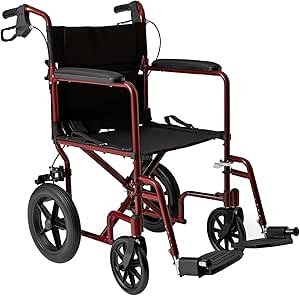
I’d put the Expedition near the top for families who regularly lift a chair into a car and need a companion to manage stops. Its 19-pound aluminum frame is much lighter to carry than the 41.3-pound Drive Blue Streak, while companion-operated loop-lock brakes give the person pushing control when parking or helping with transfers. The 12-inch rear wheels and curb assist also offer more help over small bumps than the Blue Streak’s solid tires are described as providing. The tradeoff is fundamental: this is a transport chair, not a self-propelled wheelchair, so the older adult needs someone to push and work the brakes. Its stated use on mildly uneven surfaces also makes it a poor choice for rough paths or frequent outdoor trips over larger obstacles.
Pros:- At 19 pounds, the aluminum frame is easier to lift than the 41.3-pound Drive Blue Streak.
- Companion-activated loop-lock brakes help the attendant control stops and parking.
- 12-inch rear wheels and curb assist help with small bumps.
- Folds using a rear lever for storage and transport.
Cons:- Requires a companion to push and operate the hand brakes.
- The described use is limited to mildly uneven surfaces.
- A transport-chair format may not suit someone who needs independent mobility.
Best for: Older adults who need an attendant for outings, especially families who often lift the chair into a vehicle and want companion-operated brakes.
Not ideal for: People who want to propel themselves, or households expecting regular use on rough paths, steep slopes, or substantial steps.
- Frame material:Aluminum
- Weight:19 lb
- Weight capacity:300 lb
- Rear wheel size:12 inches
- Brake type:Companion-activated loop-lock hand brakes
- Folding mechanism:Rear lever
- Color:Red
Our verdict“Choose the Expedition if a companion will push and you value a particularly light frame with attendant-controlled brakes.”
Drive Medical Blue Streak Lightweight Wheelchair with Footrests, 18-Inch Seat
Unlike the Expedition and Medline transport chairs, the Blue Streak is a manual wheelchair suited to an older adult who wants the option to propel the chair rather than depend on a companion every moment. Its 18-inch seat, removable swing-away footrests, and flip-back desk arms support everyday use, including getting closer to a table and making transfers easier. Solid tires need little maintenance, and the chair folds to 12.5 inches wide for storage. The tradeoff is carrying weight: at 41.3 pounds, it is much heavier to lift than the aluminum Expedition or Medline transport chair. Its stated setting is level outdoor terrain, so I would not choose it for rough routes; for attendant-led trips and a lighter lift, the Expedition is a better fit.
Pros:- Manual-wheelchair design allows the user to propel the chair.
- Flip-back desk arms make it easier to approach tables.
- Removable swing-away footrests support transfers.
- Solid tires require little maintenance, and the chair folds to 12.5 inches wide.
Cons:- At 41.3 pounds, it is substantially heavier to lift than the aluminum transport chairs in this group.
- Designed for level outdoor terrain rather than rough surfaces.
- Requires more effort to load into a vehicle than the lighter Expedition.
Best for: Older adults who want a conventional manual wheelchair for self-propelling on level surfaces, with a caregiver available for transfers and vehicle loading.
Not ideal for: People who need a light chair for frequent car loading or regular travel over uneven terrain; the chair weighs 41.3 pounds and is designed for level outdoor use.
- Frame material:Alloy steel
- Item weight:41.3 lb
- Seat width:18 inches
- Seat depth:16 inches
- Seat height:18 inches
- Wheel type:Solid
- Brake style:Push-to-lock
- Folded width:12.5 inches
Our verdict“Pick the Blue Streak if self-propelling matters more than minimizing lifting weight and your routes are mostly level.”
Medline Lightweight Foldable Transport Wheelchair with Handbrakes, 12-Inch Wheels, Blue Frame
I’d choose this Medline when seat width and transfer security matter more than getting the lightest possible transport chair. Its 19-inch-wide seat offers an inch more width than the Drive Blue Streak’s 18-inch seat, while a seat belt and both attendant handbrakes and rear-wheel locking brakes add useful control around stops and transfers. At 26 pounds, it is heavier than the 19-pound Drive Expedition, but still avoids the Blue Streak’s 41.3-pound lifting burden. Swing-away, detachable footrests support easier entry and exit; the folded width is 12 inches, though the overall folded dimensions may still challenge a small trunk. As with the Expedition, this chair needs an attendant to push, so it is not a solution for someone seeking independent propulsion.
Pros:- 19-inch seat is wider than the Drive Blue Streak’s 18-inch seat.
- Seat belt, handbrakes, and rear-wheel locking brakes support controlled use and transfers.
- At 26 pounds, it is lighter than the steel-framed Blue Streak.
- Swing-away, detachable footrests and a 12-inch folded width aid transfers and storage.
Cons:- Requires an attendant to push.
- At 26 pounds, it is heavier than the 19-pound Drive Expedition.
- Folded dimensions may be bulky for some car trunks.
Best for: Older adults who need an attendant-pushed chair with a wider seat, a seat belt, and locking features to support transfers and outings.
Not ideal for: People who need to propel themselves or caregivers who prioritize the lowest possible lifting weight and a compact car-trunk fit.
- Frame material:Aluminum
- Weight:26 lb
- Weight capacity:300 lb
- Seat dimensions:19 in wide x 16 in deep
- Rear wheel size:12 inches
- Assembled dimensions:30.25 x 19 x 37.25 inches
- Folded dimensions:30.25 x 12 x 37.5 inches
- Footrests:Swing-away and detachable
Our verdict“Choose this Medline if an attendant will push and the wider seat and added transfer-related controls outweigh the extra weight over the Expedition.”
Drive Medical Folding Transport Wheelchair, Swing-Away Footrest, Silver
This Drive transport chair makes the most sense for older adults whose routine is mainly indoors or involves short, smooth-surface trips. Its 8-inch wheels, padded armrests, and swing-away footrests suit close-quarters movement and transfers, while the fold-flat backrest gives the chair another way to pack down for storage. Compared with the 12-inch-wheel Expedition and Medline transport chairs, this model is oriented more toward compact indoor handling than small outdoor bumps. The product information does not give its weight, weight capacity, or a brake specification, which leaves important questions for caregivers planning vehicle loading or secure parking. I’d favor a model with documented handbrakes, such as the Expedition, when attendant control on stops is a priority.
Pros:- 8-inch wheels are suited to indoor movement on smooth surfaces.
- Swing-away footrests help clear the way for transfers.
- Padded armrests and a padded nylon seat offer contact cushioning.
- Fold-flat backrest supports storage and transport.
Cons:- Product data does not provide a weight capacity or chair weight.
- Brake details are not specified, unlike the Expedition’s companion-operated hand brakes.
- Smaller wheels are less suited to bumps than the 12-inch wheels on the Expedition and Medline.
Best for: Older adults who need an attendant-pushed chair for indoor use and short trips on smooth surfaces, with swing-away footrests for transfers.
Not ideal for: Caregivers who need a stated weight capacity, documented brakes, or a chair suited to frequent outdoor bumps and uneven paths.
- Frame material:Steel
- Wheel size:8 inches
- Seat width:17 inches
- Seat material:Padded nylon
- Footrest type:Swing-away
- Armrests:Padded
- Backrest:Fold-flat
Our verdict“Choose this Drive for attendant-led indoor errands, but favor a model with documented brakes and capacity if those details matter to your care plan.”
Invacare Lightweight Folding Transport Wheelchair with 19-Inch Seat
The Invacare stands out for buyers who need a transport chair that stores in a narrow space: it folds to 9 inches wide, compared with 12 inches for the Medline transport chair. Its 19 x 16-inch breathable nylon seat, seat belt, and swing-away footrests address comfort and transfer needs, while the folding backrest and full-size storage pocket add practical touches for outings. It arrives fully assembled, so there is no setup task before use. The tradeoff is uncertainty around lifting and fit: the frame is reinforced steel, but the product data provides neither chair weight nor weight capacity. The 8-inch casters also point more toward smooth indoor surfaces than the 12-inch-wheel Expedition’s small-bump assistance. I’d choose it for tight storage, not for buyers who need those missing specifications.
Pros:- Folds to 9 inches wide, narrower than the Medline transport chair’s 12-inch folded width.
- 19 x 16-inch breathable nylon seat includes a seat belt.
- Swing-away footrests and a folding backrest support transfers and storage.
- Arrives fully assembled and includes a full-size storage pocket.
Cons:- Product data does not state chair weight or weight capacity.
- Reinforced steel may make it heavier to lift than an aluminum-frame option such as the Expedition.
- 8-inch casters are less suited to bumps than the 12-inch rear wheels on the Expedition.
Best for: Caregivers who need an attendant-pushed chair that folds especially narrow for home storage or vehicle travel and want a 19-inch seat.
Not ideal for: Buyers who must confirm chair weight or weight capacity before purchase, or who need larger wheels for regular uneven-surface use.
- Seat dimensions:19 x 16 inches
- Folded width:9 inches
- Folded backrest height:28.75 inches
- Unfolded height:39.5 inches
- Wheel size:8 inches
- Frame material:Reinforced steel
- Seat material:Breathable nylon
- Warranty:3-year frame warranty
- Assembly:Fully assembled
Our verdict“Choose the Invacare when narrow folded storage and a 19-inch seat matter most, provided its unstated weight and capacity meet your needs.”
WHLICKS Lightweight Foldable Transport Wheelchair with 12-Inch Wheels and Removable Cushions
For families who need a chair that can travel and store neatly, the WHLICKS combines a 23.1-pound aluminum frame with a folded size of 20 x 11 x 26 inches. Its 12-inch rear wheels are larger than the 8-inch wheels on the Medline Folding Steel Transport Wheelchair, a distinction that may help with rolling over small changes in surface, though this remains a transport chair rather than a self-propelled wheelchair. The washable, removable cushions are useful for routine cleaning and can be detached for shower-seat use. Adjustable handles and footrests, a safety belt, dual-action brakes, and an anti-fold lock add practical support for caregiver use. The tradeoffs are a 300-pound capacity limit and the need for someone else to push it; buyers wanting elevating leg rests may prefer the Medline Folding Wheelchair with Elevating Footrests.
Pros:- 23.1-pound aluminum frame folds to 20 x 11 x 26 inches for storage and travel.
- Removable, machine-washable cushions simplify cleaning and can be detached for shower-seat use.
- Adjustable handles and footrests help caregivers adapt the chair to the user.
- Safety belt, dual-action brakes, and anti-fold lock provide several practical safety features.
Cons:- Transport-chair design requires a caregiver to push; it is not suited to independent self-propulsion.
- 300-pound maximum capacity may rule it out for some users.
- Does not offer the elevating leg rests found on the Medline Folding Wheelchair with Elevating Footrests.
Best for: Older adults who need a caregiver-pushed chair for outings, compact storage, and removable washable seating, with a user weight at or below 300 pounds.
Not ideal for: People who need to propel themselves independently, users above 300 pounds, or buyers who need elevating leg rests.
- Weight:23.1 lbs
- Maximum weight capacity:300 lbs
- Frame material:Aluminum
- Rear wheel size:12 inches
- Folded dimensions:20 x 11 x 26 inches
- Handle height:32.68–34.65 inches, 3 levels
- Footrest height:4.13–5.91 inches, 3 levels
- Cushions:Removable and machine washable
- Warranty:3 years on frame; 1 year of free parts replacement
Our verdict“Choose the WHLICKS for caregiver-assisted trips and easy cleaning if its 300-pound limit and transport-chair design fit the user’s needs.”
Medline Folding Wheelchair with Swing-Back Arms and Elevating Footrests
The strongest reason to choose this Medline is its elevating leg rests, which offer a different kind of positioning support from the swing-away footrests on the Medline Comfortable Folding Wheelchair. Its swing-back desk-length arms also make side transfers and access to tables or desks easier, useful for an older adult who spends time both at home and in care settings. The 18 x 16-inch seat, breathable nylon upholstery, and flat-free tires suit everyday indoor and outdoor use. This is a conventional folding wheelchair with a 300-pound capacity, rather than a compact transport chair such as the WHLICKS. That added functionality comes with a notable handling cost: at 38 pounds, it may be difficult for an older user or caregiver to lift into a vehicle. Choose it for leg positioning, not for minimizing lifting weight.
Pros:- Elevating leg rests provide positioning options beyond standard swing-away footrests.
- Swing-back desk-length arms can make lateral transfers and table access easier.
- 18 x 16-inch seat and breathable nylon upholstery suit regular use.
- Flat-free tires avoid routine tire inflation.
Cons:- At 38 pounds, it may be hard for some users or caregivers to lift and load.
- Its folding dimensions are relatively large compared with compact transport chairs such as the WHLICKS.
- The supplied product information does not specify a warranty.
Best for: Older adults who need elevating leg rests and swing-back arms for transfers, and have a caregiver able to manage a 38-pound folding chair.
Not ideal for: People who frequently lift a chair into a car, need a compact transport chair, or do not need elevating leg support.
- Seat dimensions:18 in W x 16 in D
- Weight capacity:300 lbs
- Chair weight:38 lbs
- Frame:Hammertone finish
- Upholstery:Breathable nylon
- Arms:Swing-back, desk-length
- Footrests:Elevating
- Dimensions assembled:32.5 in L x 26.5 in W x 36.5 in H
- Dimensions folded:32.5 in L x 11.5 in W x 36.5 in H
Our verdict“Pick this Medline when elevating leg rests matter more than keeping the chair light to lift or compact to transport.”
Medline Comfortable Folding Wheelchair with Swing-Back Desk-Length Arms and Swing-Away Footrests, 18″ W x 16″ D Seat
This Medline makes the most sense for an older adult who needs a conventional wheelchair with swing-back arms for side transfers, but does not need elevating leg rests. Compared with the similarly sized Medline Folding Wheelchair with Elevating Footrests, its swing-away footrests keep entry and exit straightforward while avoiding a leg-rest feature some users may not need. The 18 x 16-inch seat and 300-pound capacity provide a clear fit range, and the chair folds to 11.5 inches wide for storage. Its 38-pound weight is the same as the elevating-footrest model, so neither is an especially easy choice for a caregiver who must lift a chair often. The product data also does not mention a built-in brake system, making it less compelling for buyers who prioritize stated brake features; the Medline Folding Steel Transport Wheelchair specifies manual locking brakes and a seat belt.
Pros:- Swing-back desk-length arms support side transfers and access to tables.
- Swing-away footrests clear space for getting in and out.
- 18 x 16-inch seat and 300-pound capacity suit a range of everyday users.
- Folds to 11.5 inches wide for storage.
Cons:- At 38 pounds, it may be challenging to lift into a vehicle.
- Product information does not specify a built-in brake system.
- Footrests swing away but are not described as elevating, unlike the other Medline folding model.
Best for: Older adults who use a conventional wheelchair and need swing-back arms to make side transfers or reaching a desk easier.
Not ideal for: Caregivers who need a lighter chair to lift, users who require elevating leg rests, or buyers who want a specifically listed built-in brake system.
- Seat dimensions:18 in W x 16 in D
- Weight:38 lbs
- Weight capacity:300 lbs
- Material:100% polyester
- Dimensions assembled:32.5 in L x 26 in W x 36.6 in H
- Dimensions folded:32.5 in L x 11.5 in W x 36.5 in H
- Arm style:Swing-back desk-length
- Footrests:Swing-away and foldable
Our verdict“Choose this Medline for transfer-friendly arms and a standard folding-wheelchair setup, but look elsewhere if elevating leg rests or easy lifting are priorities.”
Medline Folding Steel Transport Wheelchair with Swing-Away Footrests, 19-Inch Seat
For a caregiver-pushed chair, this Medline pairs a 19-inch seat with a fold-down backrest, detachable swing-away footrests, a seat belt, and push-to-lock manual brakes. Those listed controls give it a clearer safety-feature profile than the Medline Comfortable Folding Wheelchair, whose supplied details do not mention a brake system. The steel frame weighs 30 pounds and folds to 22.24 x 10.43 x 29.13 inches, making it more compact than a conventional folding wheelchair but heavier than the 23.1-pound WHLICKS. Its 8-inch wheels are smaller than the WHLICKS’s 12-inch rear wheels, and its 250-pound capacity is lower than the 300-pound limits on both Medline folding chairs above. That capacity is the key fit check: choose this for its wider seat and specified brakes only if the user’s weight is within its limit.
Pros:- 19-inch-wide seat offers more width than the 18-inch Medline folding chairs in this batch.
- Push-to-lock manual brakes and an included seat belt are specified.
- Detachable swing-away footrests can clear the way for transfers.
- Folds to 22.24 x 10.43 x 29.13 inches and requires no assembly.
Cons:- 250-pound capacity is lower than the 300-pound limits of several alternatives.
- 30-pound steel chair is heavier than the WHLICKS transport chair.
- 8-inch wheels are smaller than the WHLICKS’s 12-inch rear wheels.
Best for: Older adults who need caregiver assistance, a 19-inch seat, swing-away footrests, and clearly specified manual brakes, with a user weight no higher than 250 pounds.
Not ideal for: Users above 250 pounds, people seeking a self-propelled chair, or caregivers who want a lighter option than the WHLICKS.
- Frame:Carbon steel with chip-resistant chrome plating
- Weight capacity:250 lbs
- Product weight:30 lbs
- Seat dimensions:19 in W x 16 in D
- Wheels:8 in front and rear
- Brakes:Push-to-lock manual brakes
- Folded dimensions:22.24 in L x 10.43 in W x 29.13 in H
- Assembly:No assembly required
Our verdict“Choose this Medline if its 19-inch seat and specified brakes suit the user and the 250-pound capacity limit is sufficient.”
Invacare Lightweight Folding Transport Wheelchair for Adults, 19-Inch Seat
The standout here is the 9-inch folded width, narrower than the 10.43-inch folded width of the Medline Folding Steel Transport Wheelchair and the 11-inch width of the WHLICKS. That can help when a caregiver needs to store a transport chair in a tight closet or fit it alongside other items. The 19 x 16-inch breathable nylon seat, swing-away footrests, fold-down backrest, and included storage pocket make the setup practical for assisted outings; it also arrives fully assembled. Non-marring TPU casters are intended to protect indoor floors. Still, this is a steel-frame transport chair, and the product data gives neither its weight nor its weight capacity. Those missing figures make it harder to judge lifting effort and user fit than the WHLICKS or the Medline steel transport chair. I would confirm both with the seller before choosing it for regular use.
Pros:- Folds to a listed width of just 9 inches for narrow storage.
- 19 x 16-inch breathable nylon seat and swing-away footrests support assisted outings.
- Arrives fully assembled, so setup is not required.
- Non-marring TPU casters are designed to protect indoor floors.
Cons:- Product information does not provide the chair’s weight or weight capacity.
- Steel frame may be less convenient to lift than a lighter aluminum option such as the WHLICKS.
- Transport-chair design requires a caregiver to push.
Best for: Caregivers with limited storage space who need an assembled transport chair with a 19-inch seat and can verify weight capacity and chair weight before purchase.
Not ideal for: Buyers who need confirmed chair-weight or user-capacity figures, or older adults seeking independent self-propulsion.
- Seat dimensions:19 x 16 in
- Folded width:9 in
- Backrest folded height:28.75 in
- Backrest unfolded height:39.5 in
- Caster size:8 in front and rear
- Frame material:Steel
- Seat material:Breathable nylon
- Assembly:Fully assembled
- Warranty:3 years on frame
Our verdict“Consider this Invacare when narrow folded width is the priority, but confirm chair weight and user capacity before buying.”
Medline Lightweight Foldable Transport Wheelchair with Handbrakes, 12-Inch Wheels, Red Frame, and Black Upholstery
For an older adult who needs a caregiver to steer, I’d choose this transport chair when braking control and larger rear wheels matter more than the lightest possible load. Its caregiver hand brakes and rear-wheel locks offer more ways to manage stops than the basic push-to-lock setup on the Drive Medical Silver Sport 1, while 12-inch rear wheels are larger than the 8-inch wheels on the Medline Ultra Lightweight Transport Wheelchair. That can make uneven paths easier to manage, though it does not turn the chair into a self-propelled wheelchair. The folding aluminum frame, detachable swing-away footrests, and 19-inch seat suit errands and transfers. One practical drawback: the listed weight varies between 23.5 and 26 pounds, so I would confirm lifting needs before buying.
Pros:- Caregiver hand brakes plus rear-wheel locks provide added control when stopping or parking.
- 12-inch rear wheels are larger than those on the Medline Ultra Lightweight Transport Wheelchair.
- Folds without assembly and has detachable swing-away footrests for storage and transfers.
- Cushioned armrests and a 19-inch-wide seat support comfort on short trips.
Cons:- It is a transport chair and requires another person to push.
- Product information lists two different weights: 23.5 and 26 pounds.
- At 300-pound capacity, it may not suit users who need a higher-capacity chair.
Best for: Older adults who rely on a caregiver and need hand-operated braking, a 19-inch seat, and larger rear wheels for outings.
Not ideal for: People who need to propel themselves, or caregivers seeking a clearly stated low carry weight for frequent lifting.
- Frame:Aluminum
- Weight:23.5 lb in product description; 26 lb in item details
- Weight capacity:300 lb
- Seat dimensions:19 in wide x 16 in deep
- Rear wheel size:12 in
- Assembled dimensions:30.25 x 19 x 37.25 in
- Folded dimensions:30.25 x 12 x 37.5 in
- Footrests:Swing-away and detachable
Our verdict“Choose this Medline when caregiver braking and larger rear wheels take priority over a verified carry weight or independent propulsion.”
Medline Folding Wheelchair with Swing-Back Arms and Elevating Footrests
I’d put this full-size Medline first for older adults who need elevating footrests and easier access during side transfers. Its swing-back desk-length arms can move out of the way for transfers or let the user sit closer to a table, while the elevating footrests offer a positioning feature absent from the Medline chair with swing-away footrests. Compared with that model, this chair better suits users who value leg positioning over a simpler footrest setup. Flat-free tires also remove the worry of a puncture interrupting an outing. The tradeoff is its 38-pound weight: it is much heavier to lift than the 19-pound Medline Ultra Lightweight Transport Wheelchair, and this is a self-propel wheelchair rather than a caregiver-only transport chair. I’d also check the 20-inch seat width against the user and doorway clearances.
Pros:- Elevating footrests support leg positioning in a way swing-away-only models do not.
- Swing-back desk-length arms aid lateral transfers and access to tables.
- Flat-free tires avoid puncture-related interruptions.
- Folds to a relatively narrow stated width of 11.5 inches.
Cons:- At 38 pounds, it is considerably heavier to lift than the Medline Ultra Lightweight Transport Wheelchair.
- The 20-inch seat may be too wide for some users or tight spaces.
- The product information does not specify hand brakes for caregiver control.
Best for: Older adults who need elevating leg support, swing-back arms for transfers, and a full-size wheelchair for indoor and outdoor use.
Not ideal for: Caregivers who must lift a chair into a vehicle often, or users who need a narrower seat or transport-chair format.
- Seat dimensions:20 W x 16 D in
- Weight:38 lb
- Weight capacity:300 lb
- Frame:Hammertone finish
- Armrests:Swing-back, desk-length
- Footrests:Elevating
- Tires:Smooth-rolling, flat-free
- Folded dimensions:32.5 L x 11.5 W x 36.5 H in
Our verdict“Pick this Medline for elevating footrests and transfer-friendly arms if its 38-pound weight is manageable.”
Medline Ultra Lightweight Folding Transport Wheelchair for Adults, 19-Inch Seat, Blue Frame
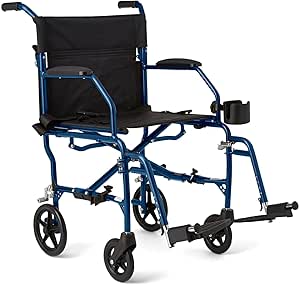
At a stated 19 pounds, this is the easiest chair in this group to lift and store, making it my pick for families who load a wheelchair into a car often. It is lighter and folds smaller than the 23.5-to-26-pound Medline transport chair with 12-inch rear wheels, but it uses 8-inch rear wheels rather than 12-inch ones. That tradeoff favors portability over rolling comfort on rougher outdoor surfaces. A seat belt, locking brakes, cushioned armrests, and swing-away footrests cover useful basics for caregiver-assisted outings; the cup holder is a small convenience, not a substitute for transfer support. Like the other transport chairs here, it cannot be propelled independently. Its 19-inch seat and 300-pound capacity will work for many users, but buyers should check fit rather than assume the width is universal.
Pros:- At 19 pounds, it is lighter than the other Medline transport chair in this batch.
- Compact folded dimensions make vehicle storage easier.
- Seat belt, locking brakes, and swing-away footrests support caregiver-assisted use and transfers.
- Cushioned armrests and a cup holder add practical comfort for outings.
Cons:- Requires a caregiver to push; it is not a self-propelled wheelchair.
- 8-inch rear wheels are smaller than the 12-inch wheels on the other Medline transport chair here.
- The 19-inch seat may not fit every user.
Best for: Caregivers who frequently lift a chair into a car and want a light, compact transport option for appointments and smooth paths.
Not ideal for: Older adults seeking independent propulsion or regular travel over uneven ground where larger rear wheels may be preferable.
- Weight:19 lb
- Weight capacity:300 lb
- Seat dimensions:19 in wide x 16 in deep
- Frame material:Aluminum
- Rear wheel size:8 in
- Folded dimensions:24 x 10 x 30 in
- Upholstery:Black nylon
- Footrests:Swing-away
Our verdict“Choose this model when low lifting weight and compact storage matter more than larger wheels for outdoor rolling.”
Medline Folding Wheelchair with Swing-Back Arms and Swing-Away Footrests, 20 x 16-Inch Seat
This full-size Medline is a straightforward choice for an older adult who needs transfer access without elevating footrests. Its swing-back desk-length arms and swing-away footrests clear space beside the chair, which can make getting on and off easier than with fixed arms and footrests. Compared with the Medline model with elevating footrests, this one has a simpler footrest arrangement; I’d favor it when transfers and routine sitting matter more than adjustable leg positioning. Flat-free tires and padded armrests suit regular indoor use and occasional outdoor trips. The chair folds, but its stated folded length remains 32.5 inches, so it may be awkward for smaller trunks. Unlike the 19-pound Medline transport chair, this is a full-size wheelchair, and the supplied details do not list its weight.
Pros:- Swing-back desk-length arms and swing-away footrests clear space for transfers.
- Padded armrests add support during everyday sitting.
- Flat-free tires reduce puncture concerns.
- Folds to 11.5 inches wide for storage.
Cons:- The 32.5-inch folded length may be difficult to fit in a small vehicle.
- No chair weight is provided, making lifting suitability harder to judge.
- Footrests swing away but do not elevate like those on the other full-size Medline model.
Best for: Older adults who can use a full-size wheelchair and need swing-back arms and swing-away footrests for transfers and table access.
Not ideal for: Caregivers with limited vehicle space or users who need elevating footrests or a known lightweight chair for frequent lifting.
- Seat dimensions:20 in W x 16 in D
- Weight capacity:300 lb
- Frame:High-strength hammertone finish
- Armrests:Padded, swing-back, desk-length
- Footrests:Swing-away
- Tires:Flat-free
- Assembled dimensions:32.5 L x 26.5 W x 36.5 H in
- Folded dimensions:32.5 L x 11.5 W x 36.5 H in
Our verdict“Choose this Medline for transfer-friendly everyday use if you do not need elevating footrests and have room for its folded length.”
Drive Medical Silver Sport 1 Folding Transport Wheelchair, Black
I’d choose the Silver Sport 1 for caregiver-assisted trips where a folding frame and carry pocket matter more than a high weight capacity or the lowest lift weight. Its foldable back and removable swing-away footrests make it easier to store between outings, while the pocket gives the caregiver a place for small items. Compared with the 19-pound Medline Ultra Lightweight Transport Wheelchair, however, this chair weighs 37.6 pounds, so it is a much heavier lift despite its travel-oriented design. Its 250-pound capacity is also below the 300-pound capacity listed for both Medline transport chairs in this batch. Padded full-length arms and push-to-lock brakes offer a simple setup, but this remains a transport chair that needs a caregiver to push; the supplied product details do not list hand brakes.
Pros:- Folding back and frame support storage and travel.
- Carry pocket provides a handy place for small essentials.
- Removable swing-away footrests support transfers and storage.
- Padded full-length armrests and push-to-lock brakes cover basic comfort and parking needs.
Cons:- The 250-pound capacity is lower than the 300-pound Medline transport chairs in this batch.
- At 37.6 pounds, it is much heavier than the 19-pound Medline Ultra Lightweight Transport Wheelchair.
- It requires a caregiver to push and the listed brakes do not include hand brakes.
Best for: Older adults under the stated capacity who need a caregiver-pushed chair with a carry pocket and folding back for occasional travel.
Not ideal for: Users above 250 pounds, people seeking independent propulsion, or caregivers who need a particularly light chair to lift into a vehicle.
- Weight:37.6 lb
- Weight capacity:250 lb
- Frame:Powder-coated steel
- Upholstery:Nylon
- Armrests:Full-length padded
- Footrests:Removable, swing-away
- Brakes:Push-to-lock
- Carry pocket:Included
Our verdict“Pick the Silver Sport 1 for its storage features and carry pocket only if its 250-pound capacity and 37.6-pound weight fit your needs.”

How We Picked
I ranked these chairs by how clearly their designs address common older-adult mobility needs: self-propulsion, caregiver-assisted transport, manageable folding and lifting, seat fit, and useful footrest or armrest adjustments. I gave more weight to features that change daily use than to frame color or broad claims such as lightweight. A chair is only a practical match when its seat dimensions, user capacity, folded size, and transfer setup fit the person and the places it will be used; confirm those details with the specific seller and manufacturer.
The order reflects how broadly each design can serve its intended user, then how well its features address a more specific need. Standard wheelchairs rank differently from transport chairs because they support different forms of mobility, not because one format is universally better. Where the supplied product names identify near-duplicate models, I treat them as configuration checks rather than claiming distinctions that the names do not establish.
| wheelchair for elderly | Frame material | Footrests |
|---|---|---|
| Drive Medical Lightweight Expe | Aluminum | — |
| Drive Medical Blue Streak Ligh | Alloy steel | — |
| Medline Lightweight Foldable T | Aluminum | Swing-away and detachable |
| Drive Medical Folding Transpor | Steel | — |
| Invacare Lightweight Folding T | Reinforced steel | — |
| WHLICKS Lightweight Foldable T | Aluminum | — |
| Medline Folding Wheelchair wit | — | Elevating |
| Medline Comfortable Folding Wh | — | Swing-away and foldable |
| Medline Folding Steel Transpor | — | — |
| Invacare Lightweight Folding T | Steel | — |
| Medline Lightweight Foldable T | — | Swing-away and detachable |
| Medline Folding Wheelchair wit | — | Elevating |
| Medline Ultra Lightweight Fold | Aluminum | Swing-away |
| Medline Folding Wheelchair wit | — | Swing-away |
| Drive Medical Silver Sport 1 F | — | Removable, swing-away |
Factors to Consider When Choosing Wheelchair For Elderly
Before choosing a chair, start with who will move it, where it will go, and how the user will transfer in and out. Those answers can matter more than a feature list: the easiest chair to fold may be the wrong one if the person needs to push with their arms or have their legs elevated.
Choose Self-Propulsion or Caregiver Pushing
A standard wheelchair with large rear wheels lets a user propel themselves, provided they have the strength, coordination, and range of motion to do so safely. A transport chair’s smaller rear wheels are designed for an attendant to push, which can make it easier to guide through busy spaces but removes independent self-propulsion. Do not choose a transport model just because it sounds lighter; first ask whether the older adult wants and can move the chair without help. If both modes are needed, consider whether a single chair can meet them safely rather than expecting a caregiver-pushed model to work like a standard chair. A clinician or mobility specialist can help judge what is suitable when strength or balance is changing.
Measure the User and the Route
Seat width is only one part of fit: seat depth, arm height, footrest position, and the user’s posture all affect comfort and safe support. A seat that is too narrow can press at the hips, while excessive width can make it harder to reach the wheels on a self-propelled chair. Measure the user while seated and compare those measurements with the manufacturer’s sizing guidance rather than guessing from clothing size. Then measure doorways, hallways, bathroom approaches, and the vehicle’s storage opening; a chair that fits the user may still be awkward at home. Leave room for hands, clothing, and footrests when checking clearances.
Match Footrests to Transfer and Leg Needs
Swing-away footrests can clear space for standing transfers and make it easier to position the chair beside a bed or toilet. Elevating footrests address a different need: they support the legs in a raised position and may suit someone whose care plan calls for that positioning. These features are not substitutes for clinical advice about swelling, pain, or circulation. Check whether footrests can be removed or adjusted, and confirm that the user’s heels and lower legs are supported without pressure. A frequent mistake is choosing a feature by name without checking whether it helps with the person’s actual transfer routine.
Balance Portability Against Stability and Handling
For regular car trips, the chair’s actual weight, folded dimensions, and the caregiver’s ability to lift it matter more than the word lightweight in a product title. Ask who will lift the chair and how often, then compare the listed weight with the vehicle’s trunk opening and available storage space. A more substantial frame may feel preferable to some buyers, but added weight can make loading and stairs harder. Folding the chair does not make it safe to carry a person in a vehicle; use an appropriate vehicle seat and restraint system. If possible, confirm the handling and lifting plan before purchase rather than after the chair arrives.
Check Brakes, Arms, and Everyday Transfers
Transport-chair hand brakes are generally for the attendant’s control, while a standard wheelchair may have user-accessible wheel locks for stationary transfers. Neither type should be treated as a substitute for a safe transfer technique or supervision when needed. Swing-back or desk-length arms can help a user get closer to a table or allow more room during a transfer, but the specific mechanism and arm height should suit the user’s routine. Check how brakes are reached, whether locks engage firmly, and whether the chair remains stable on the surfaces where it will be used. If the user has limited hand strength, have a qualified person check whether the controls are manageable.
Verify Fit, Maintenance, and the Exact Configuration
Product names can hide meaningful differences between seat sizes, frame types, and included footrests, and similar listings may refer to the same base model. Confirm the exact model number, seat width and depth, overall width, weight, weight capacity, and accessories before ordering. Ask how to clean the upholstery and inspect the wheels, brakes, fasteners, and footrests on a regular schedule. Replacement parts and local repair support can matter when a chair is used daily, so check availability before committing. When a person’s medical or mobility needs are complex, get a seating evaluation instead of relying on a product title to determine fit.
Frequently Asked Questions
Should I buy a transport wheelchair or a standard wheelchair for an older adult?
Choose based on who will propel the chair. A transport wheelchair is intended for caregiver pushing and has small rear wheels; a standard wheelchair such as the Drive Blue Streak has large rear wheels that can support user self-propulsion. If the older adult has enough strength and coordination to move independently, a transport model may limit that independence. If an attendant will always push and easier handling is the priority, a transport chair may be a better fit. Ask a clinician or mobility specialist if the user’s abilities or needs are uncertain.
How do I tell whether an 18-, 19-, or 20-inch seat will fit?
Do not choose seat width by age or appearance alone. Measure the user’s seated hip width and compare it with the manufacturer’s fitting instructions, while also checking seat depth and the space needed for clothing or positioning supports. A seat that is too tight can cause pressure, while one that is too wide may affect posture and, on a self-propelled chair, wheel reach. The listed 18-, 19-, and 20-inch options in this roundup do not establish that one size is right for every person. A seating specialist can help when fit is difficult or skin protection is a concern.
Are hand brakes on a transport chair the same as wheelchair wheel locks?
No. Hand brakes on caregiver-focused transport chairs are typically operated by the person pushing, while wheel locks on a standard wheelchair are set at the wheels to help keep the chair still. Their exact design and intended use vary by model, so read the instructions for the chair you select. Brakes do not replace assistance or a safe transfer plan, especially on slopes or uneven ground. Check that the attendant can reach and use the controls and that the chair stays in place during the user’s usual transfers.
When should I choose elevating footrests instead of swing-away footrests?
These features solve different problems. Swing-away footrests move out of the way to make side transfers and close approaches easier, while elevating footrests raise and support the legs. Choose based on the user’s transfer routine and any positioning guidance from a healthcare professional, not on the feature name alone. Elevating leg supports may be unsuitable or need adjustment for some users, so ask a clinician if swelling, pain, or a circulation condition is involved. Also check whether the footrests can be positioned comfortably without pressing behind the knees or leaving the feet unsupported.
What should I check before ordering a folding wheelchair for car travel?
Confirm the chair’s weight and folded dimensions, then compare them with the caregiver’s lifting ability and the vehicle’s storage opening. Check whether the chair will fit alongside other items and whether it can be loaded without awkward lifting or twisting. A foldable wheelchair is not a vehicle seat and should not be used to transport a seated person inside a car unless the specific chair and vehicle are designed and approved for that purpose. Plan for the user to ride in an appropriate vehicle seat with a suitable restraint. If loading is difficult, a mobility or vehicle-access specialist may suggest a safer setup.
Conclusion
My best overall pick for independent self-propulsion is the Drive Medical Blue Streak, while the Drive Medical Lightweight Expedition is my leading choice for caregiver-assisted outings where attendant hand brakes are useful. For a best value direction, I would compare the simpler folding transport chairs, such as the Drive Folding Transport Wheelchair, against the exact seat and accessory needs rather than paying for features the user will not use. Buyers seeking a premium-style feature set should focus on fit and useful adjustments, with the Medline Folding Wheelchair with Elevating Footrests worth a closer look when leg positioning is part of the care plan. For first-time buyers, the clearest starting point is deciding who will push and measuring the user and home routes before comparing models. For a specific need, choose swing-away footrests for transfer clearance, an appropriately sized seat for fit, or a lightweight transport frame when caregiver lifting is the limiting factor. Confirm the precise configuration and consult a mobility professional when the user’s needs call for tailored seating.