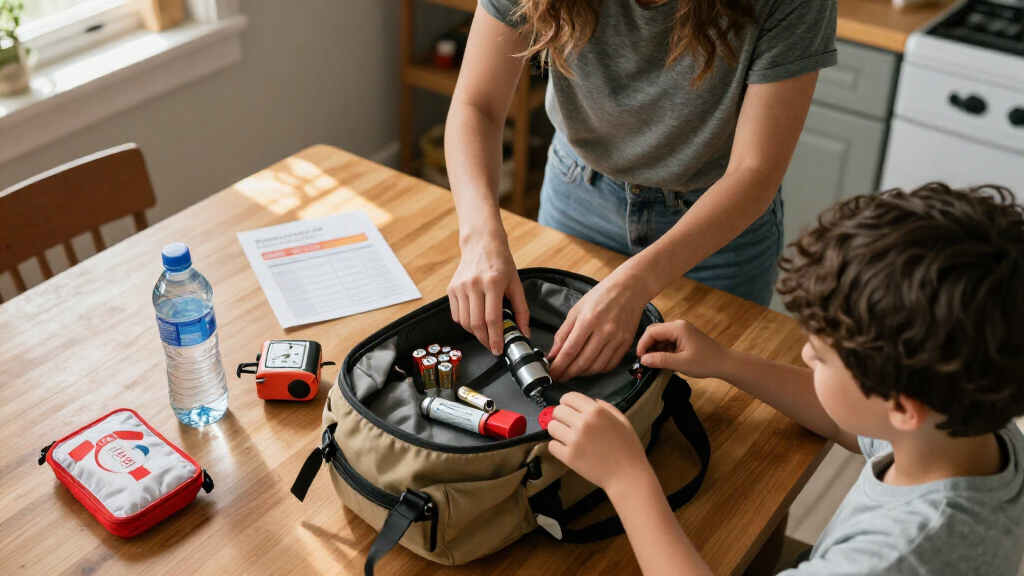

This checklist is for families preparing together for emergencies at home or on the go. It focuses on practical supplies, with a child ID bracelet section offering advice rather than a specific product pick.

Turn the school run and nap time into listening time
- Thousands of audiobooks, podcasts and originals
- Listen on your phone, tablet or Echo — also offline
- Cancel anytime
The sections are organized by what each item supports: first aid, information, water, power, food, and child identification. Consider how each supply fits your household and the situations you are planning for.
Use the checklist to review one category at a time. Check what you already have, note who will use each item, and make sure family members know where supplies are kept and how to use them.
First Aid Kit
A first aid kit gives a household a central place for care supplies when someone is hurt. The Scherber Fully-Stocked First Responder Bag | EMT/EMS Trauma & Bleeding is the pick for this slot. Before choosing a bag, think through who may need to use it, where it will be stored, and whether it can be reached quickly by an adult in the household.
A common mistake is treating a large or specialized bag as ready for every family without checking its contents and organization. Review the included supplies against your household’s needs, and make a plan for keeping items in their intended places. Consider whether the bag is manageable to carry, whether its compartments make sense to the people who may use it, and whether it can be stored accessibly. If it will travel between home and a vehicle, check that its size and shape fit the available storage space. Keep the kit easy to locate and make sure caregivers know where it is. The right choice is one your family can find, carry, and understand.
What to look for:
- A layout that caregivers can navigate quickly
- A size that fits the chosen storage location
- A carry format suitable for home or travel
- Contents reviewed for household needs
- A storage spot adults and caregivers can reach
Scherber Fully-Stocked First Responder Bag | EMT/EMS Trauma & Bleeding Medical K

This comprehensive first responder bag is designed for emergency medical professionals and enthusiasts, containing over 250 supplies including tourniquets, chest seals, bandages, and more. Made from durable, water-resistant polyester with organized compartments, it offers quick access and portability for on-the-go situations.
Pros:
- Includes over 250 essential first aid supplies for emergencies
- Durable and water-resistant construction with organized compartments
- Comfortable, ergonomic shoulder strap and top handle for portability
- Designed for professional EMT/EMS use and training
Cons:
- Large size may be cumbersome for casual use
- Heavy when fully stocked, may be tiring to carry over long distances
Best for: Households seeking a dedicated first responder bag
Not ideal for: Families wanting a compact, minimal kit
Bottom line: Choose the Scherber bag if its contents, layout, and carrying size suit your household.
Emergency Radio
An emergency radio can help a family keep information within reach when normal routines are disrupted. The Sony ICF-B300 Emergency Radio with Hand Crank, Solar Charging, and LED is the pick for this section. Consider who will operate it and where it will live so family members can find it when needed.
A common buying mistake is focusing on the listed features without considering how they fit your household’s habits. Check that the controls and charging options are understandable to the adults who may use the radio, and think about how it will be stored alongside other emergency supplies. The hand crank, solar charging, and LED are part of the product name; consider whether these features match the ways your family expects to use and maintain the radio. Check its size against your storage space, and choose a spot where it is accessible rather than buried beneath other gear. Make sure caregivers know where it is and can identify the controls. A radio is most useful to your plan when the household can locate it and operate it without guesswork.
What to look for:
- Controls caregivers can understand
- A storage location that is easy to reach
- Charging options that suit household routines
- A size that fits your emergency-supply area
- A shared plan for where the radio is kept
Sony ICF-B300 Emergency Radio with Hand Crank, Solar Charging, and LED Light

This compact emergency radio receives FM and AM broadcasts and supports hand-crank, solar, and USB charging. It includes an LED spotlight, USB phone charging, and an IPX4 water-resistant design.
Pros:
- Multiple charging options, including hand crank and solar
- Built-in LED spotlight
- Can charge a mobile phone
- Compact and water resistant
Cons:
- No USB AC adapter is specified as included
Best for: Families planning a shared emergency information station
Not ideal for: Households seeking a radio with minimal features
Bottom line: Choose the Sony radio if its controls and charging options fit your family’s plan.
Water Storage Container
Water storage deserves a deliberate place in a family checklist because the household needs to know where its supply is kept. The 55-Gallon Stackable Emergency Water Storage Tank is the pick for this slot. Before choosing a container, measure the intended storage area and consider how the tank will fit into the rest of your emergency setup.
A common mistake is selecting a container by capacity alone and overlooking the space and handling it requires. Check the tank’s dimensions and the surface where you plan to place it, and confirm that the location works with the way your household uses that room. Think through access: who can reach the container, how the family will get water from it, and whether stored items nearby could block it. Stackable design may suit some storage plans, but make sure the arrangement you have in mind is practical for your available space. Keep the location known to adult household members and include it in your family’s supply plan. Choose a container based on fit and access as well as its stated capacity.
What to look for:
- Dimensions that suit the planned storage area
- A stable, suitable placement location
- Access that will not be blocked by other supplies
- A practical plan for getting water from the tank
- A spot adults in the household can identify
55-Gallon Stackable Emergency Water Storage Tank

This 55-gallon tank is made from rotationally molded polyethylene for long-term potable water storage. Its stackable design saves space, while the 5-inch twist lid and built-in brass spigot make filling, cleaning, and dispensing easier.
Pros:
- Large capacity for emergency water storage
- Stackable design saves floor space
- Includes a twist lid for filling and cleaning
- Built-in brass spigot simplifies dispensing
Cons:
- Large and heavy when filled
Best for: Families with a suitable dedicated storage area
Not ideal for: Households with limited room for a large tank
Bottom line: Choose the 55-gallon tank when its footprint and access work for your home.
Power Bank
A portable power station gives a family a dedicated place for stored power within its emergency supplies. The Jackery Explorer 300 Portable Power Station, 292Wh is the pick for this section. Think about what your household would connect to it and where it will be kept when not in use.
A common mistake is assuming that a stated capacity alone answers whether a power station fits the household’s needs. Make a list of the devices you expect to use, review their connection requirements, and compare those needs with the product information before deciding. Consider who will operate the unit, whether its controls are clear to them, and how it will fit into your chosen storage spot. If you expect to move it between locations, consider the carrying and storage setup your household can manage. Keep the station with the supplies it is meant to support, and make sure adults know where it is and how to access it. A good fit depends on matching the device to your intended use and making it easy for the family to find.
What to look for:
- Device connections that match intended use
- Capacity reviewed against household needs
- Controls familiar to the adults who may use it
- A storage location that is easy to access
- A carrying plan if it will move between locations
Jackery Explorer 300 Portable Power Station, 292Wh

This portable power station provides 292Wh capacity and 300W rated output, with two AC outlets, USB-C PD, USB-A, and a car port for powering compatible devices. It weighs 7.5 lbs and uses LiFePO4 battery chemistry rated for over 4,000 charge cycles.
Pros:
- Portable 7.5 lb design with an integrated handle
- Six ports support charging multiple compatible devices
- LiFePO4 battery is rated for over 4,000 charge cycles
- Compatible with Jackery solar panels for off-grid charging
Cons:
- Solar panel is not included
- 300W rated output may limit use with higher-power devices
Best for: Families planning power for selected devices
Not ideal for: Households needing a station for unreviewed loads
Bottom line: Choose the Jackery Explorer 300 after checking that its capacity and connections suit your intended devices.
Emergency Food Supply
An emergency food supply helps make household planning more specific to who will eat from the kit. The Ready America Elite 72-Hour Emergency Kit for 2 People is the pick for this slot. Start by considering how many people your household needs to plan for and where the kit will be stored.
A common mistake is assuming a kit labeled for two people automatically matches every family. Check the product details and compare them with the number of people you intend to cover, including whether you need a separate plan for children or other household members. Consider the kit’s storage dimensions and choose a location that caregivers can find. Review the contents with your household’s preferences and needs in mind, and decide how this kit fits alongside other supplies. If you plan to keep it in a vehicle or move it between locations, make sure the form and storage arrangement are practical for that use. Clear labeling and an agreed storage place help prevent confusion when family members are gathering supplies.
What to look for:
- Coverage that matches the number of people planned for
- Contents reviewed for household needs
- A storage location caregivers can find
- Dimensions that fit the selected storage space
- A plan for anyone not covered by the kit
Ready America Elite 72-Hour Emergency Kit for 2 People

This emergency backpack is designed to provide basic supplies for two people for up to three days. It includes food and water, first aid and hygiene supplies, protective gear, lighting, and survival tools for emergency preparedness.
Pros:
- Combines food, water, first aid, hygiene, and survival equipment in one backpack
- Includes supplies intended for two people for up to 72 hours
- Emergency food and water pouches have a stated five-year shelf life
- Includes N95 dust masks, emergency blankets, ponchos, and water purification tablets
Cons:
- The kit weighs 11.5 pounds
- The listed food and water quantities are limited to three food bars and 18 water pouches
Best for: Households preparing a kit for two people
Not ideal for: Families needing one kit to cover more people
Bottom line: Choose this kit when its stated two-person coverage fits your household plan.
Child ID Bracelet
A child ID bracelet can give caregivers a simple identification aid to consider as part of family preparedness. There is no product pick for this section, so focus on choosing an option that suits the child and the way your family plans to use it. Consider the child’s age, comfort with wearing jewelry, and the settings where the bracelet would be used.
A common mistake is choosing a bracelet without checking how it fits or whether the child will tolerate wearing it. Look for a fit that is secure but comfortable, and check the maker’s sizing guidance rather than guessing from age alone. Consider the material and closure, and make sure an adult can inspect the fit as the child grows. Decide what identification information is appropriate to include and keep it current. If the bracelet is intended for outings, make a habit of checking that it is on before leaving and that caregivers know it is part of the plan. The useful choice is one that fits the child, stays comfortable, and makes sense for your family’s routine.
What to look for:
- Sizing guidance that allows a comfortable fit
- A closure that caregivers can check
- Materials the child is comfortable wearing
- Identification details kept current
- A routine for checking it before outings
Preparedness can be approached one checklist item at a time. Keep supplies organized, tell caregivers where they are, and revisit your plan as your family’s needs change. A clear, shared plan makes it easier for everyone to know what is available.