
To navigate without signs, pay attention to visual cues like how furniture is arranged to highlight gathering spots or pathways. Bright lighting and color contrasts guide your focus and suggest safe routes, while textures and architectural shapes create subconscious pathways. The way surfaces reflect light or create patterns also points you in the right direction. By observing these subtle visual cues, you can understand a space’s layout naturally—if you look closely, you’ll discover more details guiding your way.
Key Takeaways
- Furniture placement and spatial arrangement subtly direct movement and highlight gathering areas.
- Lighting and contrast patterns guide attention and indicate safe or preferred pathways.
- Color schemes and visual contrasts emphasize important zones without the need for signs.
- Surface textures, shapes, and reflections create subconscious pathways for navigation.
- Design principles and spatial organization foster intuitive understanding of space layout.
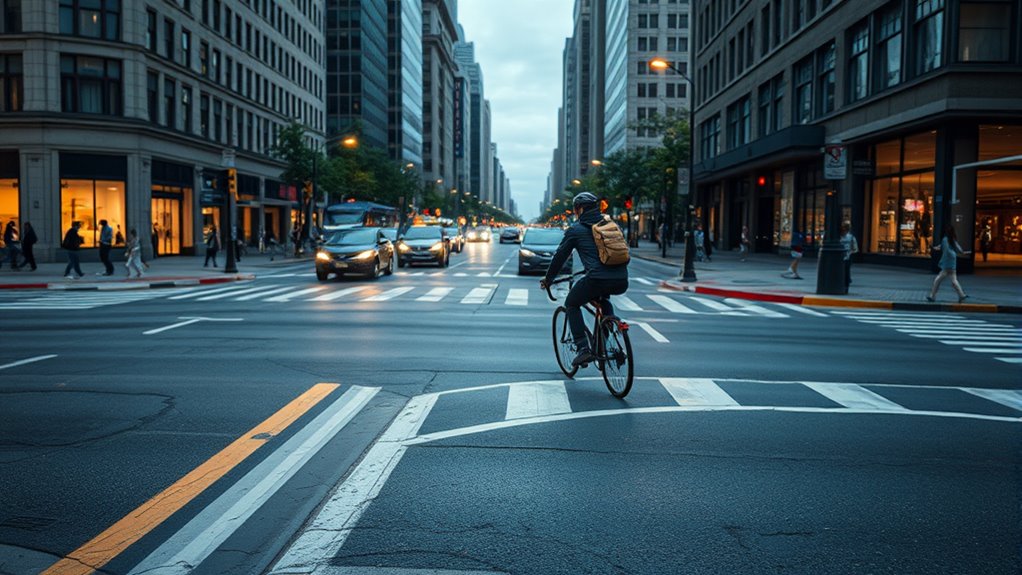
Sometimes, you don’t need signs to find your way; instead, you can rely on visual cues that naturally guide your movement and decisions. These cues are everywhere, subtly shaping how you navigate spaces without any explicit instructions. When you walk into a room, your eyes instinctively scan for familiar patterns: the placement of furniture, the flow of open space, or the way light falls on certain areas. These visual signals help you determine where to go next, often without conscious thought.
Visual cues naturally guide your movement, helping you navigate spaces seamlessly without needing explicit signs.
For example, the arrangement of furniture can direct your path. A sofa positioned near a doorway, facing the center of a room, subtly indicates a gathering spot, drawing you toward it. Conversely, cluttered or awkwardly placed items can signal areas to avoid. You might notice a clear, unobstructed route through a hallway or between rooms, which your brain interprets as the most efficient path. This understanding often happens automatically, based on visual cues like open space, obstacles, or the positioning of key features like doors and windows.
Lighting plays a vital role as well. Brightly lit areas naturally attract your attention and can serve as visual guides. A well-lit corridor or doorway signals a safe or intended route, whereas dim or shadowy zones might indicate danger or areas to bypass. The contrast between light and dark offers important clues about where to focus your attention and how to move through a space smoothly.
Color schemes and visual contrasts also influence your decisions. You may find yourself drawn toward certain colors or patterns, which subtly communicate importance or function. For instance, a brightly colored sign or a distinct wall hue in a corridor can serve as a focal point, guiding your gaze and movement toward specific locations. These cues work without words, relying instead on your natural ability to interpret visual information quickly.
Environmental cues like textures, shapes, and even the way surfaces reflect light can help you understand a space’s layout. Smooth, shiny floors might indicate a main walkway, while textured or patterned surfaces could mark boundaries or special zones. Shapes and visual lines—whether from architectural features or design elements—create pathways for your eyes to follow, guiding your steps seamlessly.
Additionally, familiar design principles and spatial organization within a space reinforce these visual cues, making navigation more intuitive. All these visual cues combine to create a subconscious map in your mind, helping you navigate efficiently without needing explicit signs or instructions. Your visual perception is a powerful tool that, when tuned to your environment, guides your decisions, movements, and understanding of space instinctively.
Frequently Asked Questions
How Do Animals Interpret Visual Cues Differently From Humans?
You might notice that animals interpret visual cues differently because their brains process signals like body language, movement, and colors uniquely. Unlike humans, animals often rely more on instinct and immediate cues for survival, such as detecting predators or finding food. Your pet, for example, reads your gestures and expressions to understand your mood, but their interpretation is driven by their instincts and survival needs rather than cultural or learned signals.
Can Environmental Changes Affect Non-Sign Visual Guidance Systems?
Environmental changes definitely impact non-sign visual guidance systems. You might think animals adapt quickly, but even subtle shifts like altered lighting, new obstacles, or changing landscapes can confuse their natural cues. This disrupts their navigation, leading to disorientation or increased vulnerability. You should recognize that these cues rely heavily on stable surroundings, so maintaining consistent environments helps animals interpret their guides accurately and safely.
What Are Examples of Cultural Differences in Visual Cues?
You’ll notice cultural differences in visual cues, like gestures, colors, or symbols. For example, in some countries, a thumbs-up means approval, while in others, it’s offensive. Colors also convey different meanings; white symbolizes purity in Western cultures but can signify mourning in parts of Asia. Recognizing these differences helps you interpret non-verbal communication accurately and adapt your behavior when interacting across cultures.
How Do Visual Cues Influence Navigation in Low-Light Conditions?
In low-light conditions, visual cues act as your guiding stars, helping you navigate even when darkness hides signs. You lean on familiar symbols like glowing exit signs or reflective markers, which stand out against the dim environment. Your eyes pick up subtle contrasts, textures, and movement cues, guiding you safely. These cues become your silent compass, ensuring you avoid obstacles and find your way without relying on words or signs.
Are There Technological Tools That Enhance Understanding of Visual Cues?
Yes, there are technological tools that enhance your understanding of visual cues. You can use augmented reality (AR) apps that overlay navigation directions onto your surroundings, making cues more apparent. Smart glasses and wearable devices can highlight pathways or objects, providing real-time guidance. Additionally, advanced lighting systems and sensors can adapt to low-light conditions, improving visibility of cues and helping you navigate safely and efficiently without relying solely on traditional signs.
Conclusion
So, next time you think signs are your guiding light, remember the subtle cues around you—like a worn path or a gentle breeze. Sometimes, the most obvious directions are hiding in plain sight, quietly leading you astray. It’s ironic how the absence of signs can actually steer you better, while you’d trust a billboard over a whisper of nature. After all, who needs signs when the world’s quiet cues are enthusiastic to show you the way?