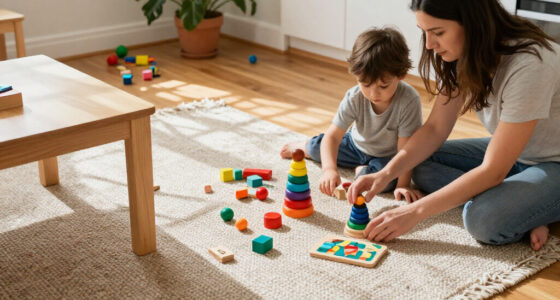
When choosing educational toys for a toddler, the real choice is often between a toy that leaves play in the child’s hands and one that guides play through sounds, lights, buttons, or spoken prompts. Wooden and other open-ended toys, such as blocks, shape sorters, and stacking rings, tend to support repeated experimentation. Electronic toys, such as talking activity boards and musical learning toys, can make cause and effect or early words immediately engaging.

Turn the school run and nap time into listening time
- Thousands of audiobooks, podcasts and originals
- Listen on your phone, tablet or Echo — also offline
- Cancel anytime

LeapFrog Learning Friends 100 Words Book
- ✔ Brand: LeapFrog
- ✔ Age range: 18 months–4 years
- ✔ Word count: More than 100

Airbition Talking Flash Cards for Toddlers, 224 Words, Blue
- ✔ Brand: Airbition
- ✔ Age range: 1–5 years
- ✔ Word count: 224

LeapFrog 2-in-1 LeapTop Touch Learning Laptop
- ✔ Brand: LeapFrog
- ✔ Model: 80-600900
- ✔ Age range: 2–5 years
Neither category is automatically more educational. What matters is whether the toy invites the kind of play a child is ready for, whether an adult can join in, and whether its features earn their place in the home. Open-ended toys are usually the stronger everyday choice for flexible, imaginative play. Electronic toys may suit toddlers who respond well to clear feedback or families seeking a specific feature, such as music or spoken vocabulary. The comparison below focuses on the tradeoffs that affect real use, including developmental range, engagement, durability, safety, and value.
At a Glance
| Criteria | Wooden and open-ended toys | Electronic and interactive toys | Winner |
|---|---|---|---|
| Play flexibility | High: child chooses how to stack, sort, build, or pretend | Low to moderate: activities are often set by buttons, prompts, or modes | A |
| Immediate engagement | Moderate: depends on shape, color, and caregiver interaction | High at first for children who enjoy lights, sounds, or music | B |
| Skills supported | Broad practice in problem-solving, coordination, and imaginative play | Can practice cause and effect, listening, matching, and early vocabulary | Depends |
| Durability and upkeep | Often sturdy with few components; inspect finishes and small parts | Depends on electronics, battery access, and moving parts | A |
| Safety and supervision | No electronics; age rating and choking hazards still matter | Requires checking battery compartments, volume, and age guidance | A |
| Price and long-term value | Often good value when the toy stays interesting across stages | Worth more when a child uses its specific features repeatedly | A |
LeapFrog Learning Friends 100 Words Book
The Learning Friends 100 Words Book is our best overall choice because it makes vocabulary exploration straightforward for a toddler: touch a picture and hear its word, a related fact, or a sound effect. Its topics span animals, food, colors, activities, and opposites, so children can move between familiar words rather than work through one narrow subject. The English and Spanish audio also gives families a way to hear the same picture in two languages.Compared with Airbition’s 224-card set, this book has a smaller stated word count, but children browse the pictures directly instead of inserting cards into a reader. That can make casual, child-led exploration feel simpler. It also differs from the LeapTop Touch: the book centers on picture vocabulary, while the laptop adds numbers, games, music, and messages for older toddlers.The tradeoffs are practical. It is designed for one player, so it is not a built-in group activity, and regular use calls for two AA batteries; the included batteries are for demonstration. We would choose it for a toddler ready to connect pictures with spoken words, especially in a bilingual household. Families looking for the broadest word set or rechargeable power may prefer Airbition instead.
Pros:
- Touch-activated pictures connect images with spoken words, facts, and sound effects.
- English and Spanish audio supports listening across two languages.
- Topics include familiar categories such as animals, food, colors, and opposites.
- Light-up star and songs add variety beyond browsing vocabulary.
Cons:
- Requires two AA batteries for regular use; demo batteries may need replacement.
- Designed for a single player rather than cooperative play.
Best for: Toddlers ages 18 months and up who enjoy picture books, touch-activated audio, and English–Spanish word exposure.
Not ideal for: Families seeking rechargeable operation, multiplayer play, or a larger stated word count than 100-plus.
Bottom line: Choose this book for the most accessible blend of toddler-friendly vocabulary browsing, interactive audio, and bilingual listening.
“Choose this book for the most accessible blend of toddler-friendly vocabulary browsing, interactive audio, and bilingual listening.”
Airbition Talking Flash Cards for Toddlers, 224 Words, Blue
Airbition is the vocabulary specialist in this group. Its 224 illustrated cards cover everyday themes including animals, vehicles, food, fruits, and vegetables, and a reader speaks each card’s word. Animal sounds, a repeat button, and five volume levels give families some control over the audio experience. The screen-free format keeps attention on the illustrations and spoken words rather than a display.Against the LeapFrog book, Airbition offers more stated words and rechargeable power, but the interaction is less like browsing: children need to insert cards one at a time. That routine may suit a child who enjoys sorting and naming individual pictures; it may be less convenient for a toddler who prefers to flip freely from image to image. Compared with the LeapTop, it stays focused on vocabulary rather than adding letters, numbers, and games.The reader runs for up to four hours per charge, and the included USB cable supports recharging. That avoids the book’s AA battery replacement routine, though families still need to keep the reader charged. We see it as the best fit when a caregiver wants a structured, screen-free word activity and is comfortable helping with card handling. Those seeking a self-contained book or a wider mix of learning modes should look to the LeapFrog options.
Pros:
- 224 illustrated cards cover multiple everyday topics.
- Reader is rechargeable and offers up to four hours per charge.
- Repeat button and five volume levels make audio easier to adjust.
- Animal sounds add listening variety to spoken vocabulary.
Cons:
- Cards must be inserted into the reader individually.
- Up to four hours of battery life per charge may require regular recharging.
Best for: Families looking for a screen-free vocabulary activity with many illustrated words and adjustable audio.
Not ideal for: Toddlers who become frustrated by handling cards, or families who want a book-like format with easy browsing.
Bottom line: Pick Airbition when vocabulary breadth and adjustable screen-free audio matter more than quick, page-style browsing.
“Pick Airbition when vocabulary breadth and adjustable screen-free audio matter more than quick, page-style browsing.”
LeapFrog 2-in-1 LeapTop Touch Learning Laptop
The LeapTop Touch makes the most sense for toddlers who are drawn to keyboards and pretend devices. It switches between keyboard mode and a tablet-style touch surface, with activities around ABCs, numbers, games, music, and messages. A parent customization feature can spell a child’s name, giving the toy a personal element alongside its broader activity mix. Its take-along handle also helps when play moves from one room to another.This is a more varied but less vocabulary-focused choice than the Learning Friends book or Airbition cards. The book starts at 18 months and links words to pictures; Airbition concentrates on spoken vocabulary across 224 cards. The LeapTop is aimed at ages 2–5 and spreads attention across several activity types, so it suits older toddlers who are ready for early letters and numbers as well as music and games.Its flexibility comes with limits: three AA batteries are required for regular use, and the product’s age range is narrower than Airbition’s stated 1–5 years. The laptop format may also be less appealing to children who prefer books, physical sorting, or open-ended toys. We would choose it for a child who enjoys pressing keys and switching activities, but skip it if the main goal is focused vocabulary practice or bilingual audio.
Pros:
- Converts between keyboard and tablet-style touch modes.
- Five learning modes cover letters, numbers, games, music, and messages.
- Parent customization can help the toy spell a child’s name.
- Take-along handle supports portability around the home.
Cons:
- Requires three AA batteries for regular use; included batteries are for demonstration.
- Its age range begins at 2 years, later than the other picks.
Best for: Children ages 2–5 who enjoy pretend computer play and want a mix of early letters, numbers, music, and games.
Not ideal for: Younger toddlers, families prioritizing vocabulary and bilingual listening, or anyone seeking rechargeable power.
Bottom line: Choose the LeapTop for older toddlers who want varied pretend-device activities rather than a dedicated vocabulary toy.
“Choose the LeapTop for older toddlers who want varied pretend-device activities rather than a dedicated vocabulary toy.”
As an Amazon Associate we earn from qualifying purchases.
Key Differences
The central difference is who supplies the next idea. With blocks or a shape sorter, a toddler decides what to do, discovers what works, and can turn the same pieces into different games. A musical toy or talking board supplies more of the structure. Pressing a button may trigger a tune, word, or response, which can help a young child notice cause and effect. The open-ended option wins for range and replay; the electronic option wins for immediate, built-in feedback.
That distinction also shapes value. A simple toy may be used in many ways as a child grows, while a feature-rich toy can hold attention quickly but depend on a narrower set of activities. That does not make electronics poor value: a child who repeatedly sings along, matches sounds, or uses spoken prompts may get plenty from one. Pay extra for functions that match your toddler’s interests and that you expect to use, not for a long feature list alone. In either category, adult conversation and safe, age-appropriate play matter more than a toy’s marketing claims.
Detailed Comparison
Play flexibility (Wooden and open-ended toys wins — major)
Wooden blocks, nesting cups, and simple sorters leave room for the toddler to set the activity. A block can become a tower, a road, or pretend food; the child can change the rules as skills develop. Electronic toys typically guide play through a fixed set of buttons, sounds, or prompts. That structure can help a child get started, but it narrows the range of possible uses. Wooden and open-ended toys win by a major margin for families who want one toy to support many kinds of play over time.
Immediate engagement (Electronic and interactive toys wins — moderate)
A flashing light, familiar tune, or spoken response can make an electronic toy compelling without much setup. That can be useful during a short play period or when a toddler enjoys pressing buttons and hearing what happens. A plain stacking toy may take an adult’s demonstration or a child’s curiosity to get going. Electronic toys have a moderate edge for quick initial engagement, but interest varies by child and novelty can fade. Caregiver attention can make a simple toy just as inviting.
Skills supported (moderate difference)
Both types can support learning, but in different ways. Sorting shapes and stacking objects invite toddlers to test size, balance, and fit while using their hands and solving problems. Interactive toys can reinforce listening, early words, matching, or cause and effect through repeated audio and visual feedback. The wooden option has a moderate advantage in broad, child-directed practice; the electronic option may be the better fit for a specific skill or interest. Neither toy can guarantee a developmental outcome, and playing together adds opportunities to name, count, and take turns.
Durability and upkeep (Wooden and open-ended toys wins — moderate)
A well-made wooden toy has no speaker, wiring, or battery compartment to stop working, and it is often easy to wipe clean. It may still chip, splinter, or include pieces too small for a young child, so construction and age guidance matter. Electronic toys add batteries and components that can fail, and some require more cleaning around buttons or seams. The wooden category wins by a moderate margin for low upkeep, though build quality varies and electronic toys can also be sturdy.
Safety and supervision (Wooden and open-ended toys wins — minor)
Neither category is inherently safe for every toddler. For wooden toys, check the manufacturer’s age guidance, finish, construction, and whether any pieces present a choking risk. For electronic toys, make those checks too, and inspect that battery compartments close securely; keep loose batteries out of reach and consider whether sound levels are comfortable. Simple toys have fewer electronic components to manage, giving them a minor practical edge, but supervision and age-appropriate design matter more than the category label.
Price and long-term value (Wooden and open-ended toys wins — moderate)
Basic wooden toys are often less expensive than feature-rich electronic toys, though premium materials can raise the price. Their value can stretch when the child finds new ways to use them or siblings share them. An electronic toy costs more only when its features deliver something the child actually enjoys or practices over time. Wooden toys are the stronger default value by a moderate margin; paying more for electronics makes sense when a specific sound, song, or prompt gets regular use.
Wooden and open-ended toys: Pros and Cons
Pros:
- Supports child-led play and changing games
- Often sturdy and simple to maintain
- Can remain useful as coordination and imagination develop
Cons:
- May need an adult to demonstrate ways to begin
- Offers less immediate sound or visual feedback
- Quality, finish, and small-piece risks vary by product
Electronic and interactive toys: Pros and Cons
Pros:
- Provides immediate responses through sound, light, or music
- Can hold attention for toddlers who enjoy buttons and prompts
- May target listening, matching, or early vocabulary practice
Cons:
- Play can be limited to preset activities
- Batteries and electronic parts add upkeep and possible failure points
- Higher price may not pay off if the child loses interest
Who Should Choose What
Choose Wooden and open-ended toys if:
- You want a versatile toy for stacking, sorting, building, and pretend play.
- You prefer fewer components to maintain and a toy that can adapt as skills grow.
- You want a practical first choice with strong replay value.
Choose Electronic and interactive toys if:
- Your toddler is strongly drawn to music, spoken prompts, or lights.
- You want a particular interactive feature, such as sound matching or simple vocabulary cues.
- The child stays engaged with the toy over repeated sessions, making its extra features useful.
Skip both if: Skip a purchase for now if your toddler already has suitable toys they use happily; shared play with everyday safe objects can offer plenty of exploration.
Value for Money
For most households, a well-chosen open-ended toy is the better value because it can support several kinds of play without batteries or a fixed sequence of activities. A higher-priced electronic toy can be worth it when a toddler returns to its music, prompts, or matching games regularly and those features serve a clear purpose. Pay more for repeated use and a feature your child responds to, not simply for extra buttons or modes. If you are uncertain, start with a simple toy and add an interactive one when you can identify what it will contribute.
Final Verdict
Choose wooden and open-ended toys as the default for a toddler: they offer more flexible play, tend to need less upkeep, and often stay useful across changing interests. Choose an electronic toy when your child clearly enjoys sound or structured prompts and the added features get regular use. The biggest deciding factor is whether you want the toy to generate the activity or give your child room to invent it. For families buying one general-purpose educational toy, open-ended is the stronger choice; for a child captivated by music or button-driven feedback, a carefully selected electronic toy can earn its higher price.
Frequently Asked Questions
Are wooden toys more educational than electronic toys?
Neither category is automatically more educational. Wooden toys often invite flexible problem-solving and pretend play, while electronic toys can reinforce listening, matching, or cause and effect. The best fit is the one your toddler uses actively, especially when an adult joins in.
Are electronic learning toys worth the higher price?
They can be, if your toddler repeatedly uses a feature such as music, spoken prompts, or sound matching. If interest fades quickly or the toy mainly repeats a narrow activity, a simpler open-ended toy is usually better value.
What should I check before buying an educational toy for a toddler?
Follow the age guidance and inspect construction, small parts, and any accessible battery compartment. For electronic toys, check that batteries are secured and consider the sound level. Choose a toy with activities suited to your child’s current interests and abilities.
Can one toy support more than one kind of learning?
Yes. Blocks can involve coordination, balance, and problem-solving; a shape sorter can involve matching and persistence. Interactive toys may combine listening with button use or matching. Talking, naming, and taking turns during play can add further opportunities.