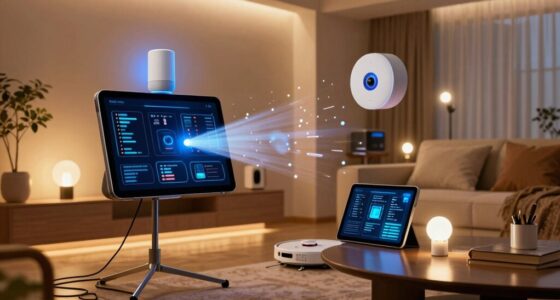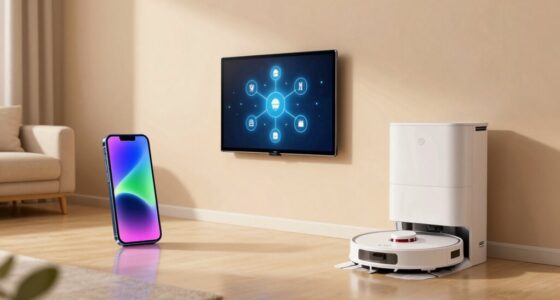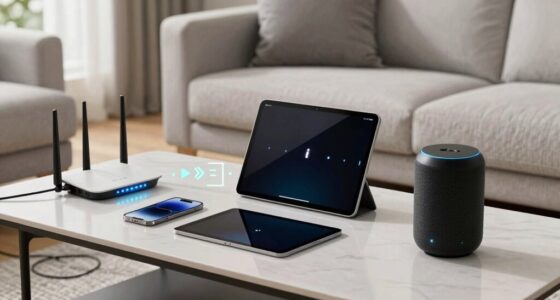

Smart home hubs still matter in a Matter world because they act as the central command, making your devices work smoothly together. They improve security, reduce setup time, and simplify daily routines by unifying control. Even with Matter enhancing device interoperability, hubs enhance your smart home’s reliability and future readiness. They keep your system secure and manageable as technology evolves. Want to discover how you can maximize your smart home experience? Keep exploring to learn more.

Turn the school run and nap time into listening time
- Thousands of audiobooks, podcasts and originals
- Listen on your phone, tablet or Echo — also offline
- Cancel anytime
Key Takeaways
- Smart home hubs centralize device control, ensuring seamless voice command execution across diverse smart devices.
- They act as universal translators, simplifying integration despite varying brands and protocols.
- Hubs enhance security by consolidating device management and supporting robust automation routines.
- They leverage the Matter standard to improve device interoperability without becoming obsolete.
- Hubs serve as a reliable backbone, preparing homes for future connectivity advancements and maintaining system stability.
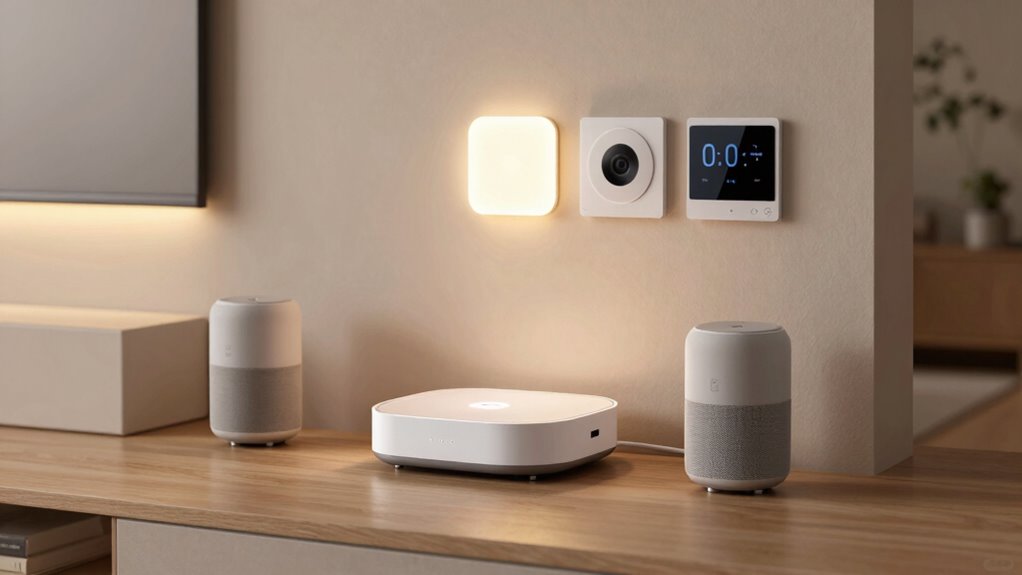
As smart homes become more integrated into daily life, the need for a reliable hub that can seamlessly connect and manage various devices has never been greater. In a world where voice control has become a standard feature, your smart home hub acts as the central command, translating your voice commands into actions across multiple devices. Whether you’re asking for the weather, dimming the lights, or playing music, a good hub ensures that your voice control works smoothly and accurately. Without it, your smart devices might operate independently, causing frustration and limiting their potential.
Device compatibility is another crucial factor. Not all smart devices speak the same language, and many brands develop proprietary systems. This often leads to frustration when trying to integrate devices from different manufacturers. A smart home hub solves this problem by acting as a universal translator, bringing together a wide range of devices under one umbrella. You can connect smart bulbs, thermostats, security cameras, and even appliances from various brands without worrying about compatibility issues. This unified control simplifies your daily routines and enhances the overall smart home experience. Additionally, standardized communication protocols help ensure that devices can work together more effectively within your ecosystem.
A smart home hub acts as a universal translator, uniting devices from different brands for seamless control and integration.
In a Matter world, where the new smart home connectivity standard is gaining momentum, you might think that hubs will become obsolete. However, the reality is quite the opposite. Matter aims to improve device interoperability at a fundamental level, but it doesn’t eliminate the need for a central hub. Instead, it makes hubs more powerful and versatile. With Matter compatibility, your hub can manage even more devices effortlessly, reducing setup times and increasing reliability. You get the best of both worlds: the convenience of a unified ecosystem and the robustness of a dedicated hub. Furthermore, interoperability standards facilitate smoother integration across diverse devices, ensuring a cohesive experience even as new technologies emerge.
Moreover, a smart home hub offers security benefits that are crucial in today’s connected world. By centralizing control, you reduce the risk of vulnerabilities that come with managing multiple devices independently. It also enables you to set specific routines and automations that enhance security, like turning on lights when motion is detected or locking doors remotely. These features give you peace of mind, knowing your home is both smarter and safer. Additionally, advances in security protocols help protect your network from potential cyber threats, reinforcing the importance of a dedicated hub. Incorporating device management capabilities also helps streamline updates and patch vulnerabilities quickly, further safeguarding your smart ecosystem. Using a hub also provides a centralized point for monitoring device health, ensuring your system runs smoothly and issues are detected early.
Ultimately, even in a Matter-connected world, a reliable smart home hub remains vital. It serves as the backbone of your smart ecosystem, ensuring voice control works seamlessly and device compatibility is never a concern. It simplifies management, boosts security, and prepares your home for the next era of connectivity. While standards evolve, the role of a solid hub endures, making your smart home smarter, safer, and more intuitive every day.
smart home hub compatible with Matter
As an affiliate, we earn on qualifying purchases.
As an affiliate, we earn on qualifying purchases.
Frequently Asked Questions
Can Smart Home Hubs Improve Overall Home Security?
Yes, smart home hubs can considerably improve your overall home security. They enable remote monitoring, so you can keep an eye on your property from anywhere. Plus, with voice control, you can quickly arm or disarm security systems, lock doors, or check cameras hands-free. This seamless integration makes your home safer and more convenient, giving you peace of mind whether you’re at home or away.
Are Smart Home Hubs Compatible With All Smart Devices?
Think of your smart home hub as a skilled translator in a bustling market, bridging different languages. While it aims to connect various devices, it isn’t compatible with all smart devices. Device compatibility varies, and ecosystem integration is key. Some hubs work seamlessly within certain ecosystems, but others may require additional software or updates. To guarantee smooth operation, choose a hub designed to support your preferred devices and ecosystem.
How Do Smart Home Hubs Impact Data Privacy?
Smart home hubs substantially impact your data privacy by managing how your information is shared and protected. They use data encryption to secure your sensitive details from unauthorized access. However, since hubs collect and process your device data, they also pose potential privacy risks if not properly secured. It’s essential to choose hubs that prioritize user privacy, ensuring your personal information remains confidential and protected from breaches.
Do Smart Home Hubs Require Professional Installation?
You might be surprised, but smart home hubs often don’t require professional installation; many boast user-friendly interfaces that simplify setup. While some setups can be complex, most are designed for DIY enthusiasts, allowing you to connect devices seamlessly. However, if you encounter setup complexity or prefer a smoother experience, professional installation can guarantee everything runs perfectly, especially for larger or more integrated systems.
What Is the Cost Difference Between Hubs and Standalone Devices?
The cost difference between hubs and standalone devices varies, but generally, hubs cost more upfront due to device integration features. A smart home hub might range from $50 to $200, while standalone devices can be as low as $20 to $50. If you want seamless device integration and a centralized control system, investing in a hub can be worth the extra expense. Consider your budget and the complexity of your smart home setup when choosing.
Conclusion
Even in a world racing toward seamless connectivity, smart home hubs remain your home’s heartbeat, anchoring your devices in a single, steady pulse. Imagine walking into a room where lights gently brighten, your favorite music starts softly, and security is just a tap away—all powered by a hub orchestrating this symphony of convenience. In this fast-moving digital landscape, your smart home hub isn’t just a gadget; it’s the conductor guiding your comfort and security, effortlessly and reliably.
Fall Picks
fall essentials
As an affiliate, we earn on qualifying purchases.