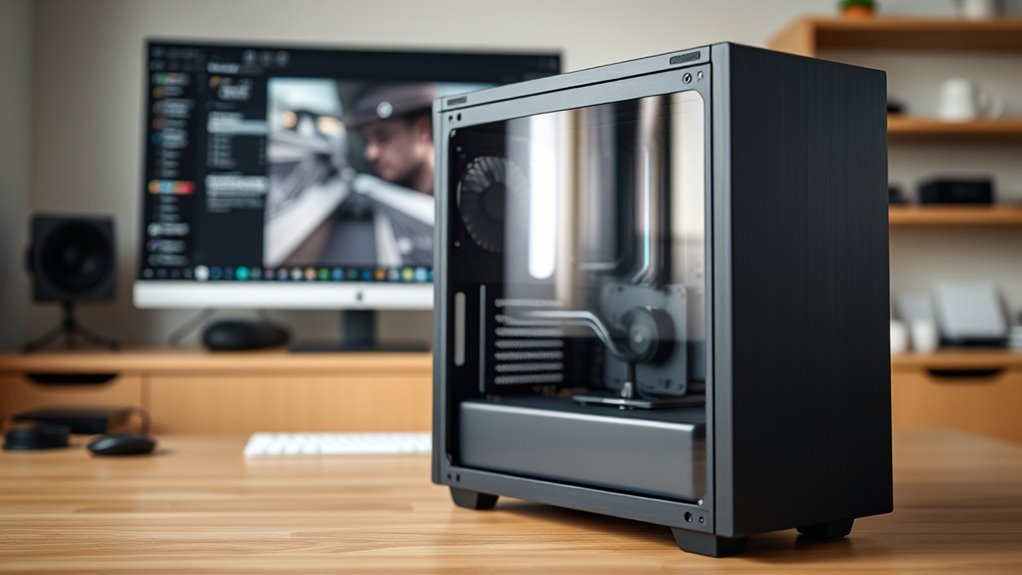

For silent PC cases with sound damping, I rank the be quiet! Silent Base 802 first for its adaptable panels, which let builders balance noise control and airflow. The Fractal Design Define 7 is a strong choice for a flexible, quiet mid tower, while the Cooler Master Silencio S400 suits a compact micro-ATX build. The main tradeoff is that solid, damped panels can limit airflow, while mesh panels may let more fan and component noise escape. Case fit, cooling needs, and the ability to change panels matter as much as the damping material itself. Read on for how all 10 cases compare and which one best fits your build.

Turn the school run and nap time into listening time
- Thousands of audiobooks, podcasts and originals
- Listen on your phone, tablet or Echo — also offline
- Cancel anytime
Complete the kit


Key Takeaways
- Silent Base 802 ranks first for flexibility: its interchangeable panel approach gives buyers more room to tune noise control and airflow than a fixed-panel design.
- Define 7 is the balanced mid-tower alternative: it offers a modular layout for a range of builds, while the Define 7 XL serves buyers who need full-tower space.
- Compact builds have distinct compromises: the Define 7 Mini and Silencio S400 save space, but their smaller formats make component fit and cooling plans more important.
- Solid panels alone do not make a quiet PC: the Pop Silent and Define-family cases still need careful fan, GPU, and cooler choices to avoid heat buildup and excess fan noise.
- The lineup favors different priorities: the XT Pro Silent and SETA Q1 suit buyers comparing noise-focused enclosures with gaming-oriented layouts, while the Define 7 Compact trims the footprint of a mid-tower build.
| SilverStone SETA Q1 Silent Mid Tower Case |  | Best for Workstation Builds | Case type: Mid tower | Motherboard support: SSI-EEB, E-ATX, ATX, Micro-ATX, Mini-ITX | Noise reduction: Cybenetics certified 9.8 dBA | VIEW ON AMAZON | See Our Full Breakdown |
| Phanteks XT Pro Silent Mid-Tower Gaming Case |  | Best for Quiet Gaming Builds | Case type: Mid-tower gaming case | Included fans: 3 × M25-120 black fans | Fan support: Up to 7 × 120 mm fan locations | VIEW ON AMAZON | See Our Full Breakdown |
| be quiet! Silent Base 802 ATX Mid Tower PC Case, Black |  | Best for Adjustable Noise and Airflow | Case type: Mid tower | Motherboard support: ATX | Panels: Interchangeable front and top panels | VIEW ON AMAZON | See Our Full Breakdown |
| Fractal Design Define 7 Mini Black Solid Computer Case |  | Best Compact Sound-Damped Case | Case type: Mini-tower | Motherboard support: Mini-ITX, microATX | GPU clearance: Up to 331 mm with top-mounted 240 mm radiator; up to 306 mm with 25 mm front fans | VIEW ON AMAZON | See Our Full Breakdown |
| Fractal Design Pop Silent Black Solid PC Case |  | Best for ATX Builds with Legacy Storage | Motherboard compatibility: ATX, microATX, Mini-ITX | Included fans: 3 × 120 mm Aspect fans | Drive capacity: Up to 3 HDDs and 6 SSDs, or 2 HDDs and 5 SSDs with an optical bay in use | VIEW ON AMAZON | See Our Full Breakdown |
| Fractal Design Define 7 XL Black Full Tower Computer Case |  | Best for Large, Quiet Builds | Case type: Full tower | Motherboard compatibility: E-ATX, SSI-EEB, ATX, Micro-ATX, Mini-ITX | Maximum HDD capacity: 18 | VIEW ON AMAZON | See Our Full Breakdown |
| Cooler Master Silencio S400 Micro-ATX Mini-Tower PC Case |  | Best Compact Quiet Pick | Case type: Mini-Tower | Supported motherboards: Micro-ATX, Mini-ITX | Power supply mounting: Bottom mount | VIEW ON AMAZON | See Our Full Breakdown |
| Fractal Design Define 7 Black Silent Modular Mid-Tower Computer Case |  | Best for Storage-Focused Builds | Form factor: Mid tower | Materials: Brushed aluminum and steel | Motherboard support: E-ATX | VIEW ON AMAZON | See Our Full Breakdown |
| Fractal Design Define One Light Solid PC Case |  | Best for Closed-Front Styling | Front design: Closed front with aluminum side intake vents | Included fans: 3 pre-installed LCP-blade Momentum fans | Maximum graphics card length: 368 mm | VIEW ON AMAZON | See Our Full Breakdown |
| Fractal Design Define 7 Compact Mid-Tower PC Case, Black |  | Best Compact ATX Pick | Case type: Mid tower | Compatible motherboards: ATX, Micro-ATX, Mini-ITX | Maximum GPU length: 360 mm | VIEW ON AMAZON | See Our Full Breakdown |
| silent pc cases with sound damping | Case type | Included fans |
|---|---|---|
| SilverStone SETA Q1 Silent Mid | Mid tower | — |
| Phanteks XT Pro Silent Mid-Tow | Mid-tower gaming case | 3 × M25-120 black fans |
| be quiet! Silent Base 802 ATX | Mid tower | — |
| Fractal Design Define 7 Mini B | Mini-tower | — |
| Fractal Design Pop Silent Blac | — | 3 × 120 mm Aspect fans |
| Fractal Design Define 7 XL Bla | Full tower | — |
| Cooler Master Silencio S400 Mi | Mini-Tower | 2 × 120 mm PWM |
| Fractal Design Define 7 Black | — | — |
| Fractal Design Define One Ligh | — | 3 pre-installed LCP-blade Momentum fans |
| Fractal Design Define 7 Compac | Mid tower | 1 × 120 mm and 1 × 140 mm |
More Details on Our Top Picks
SilverStone SETA Q1 Silent Mid Tower Case
The SETA Q1 pairs sound-damped construction with room for unusually large motherboards, including SSI-EEB. That makes it a stronger fit for workstation builders than the more gaming-focused Phanteks XT Pro Silent, which emphasizes included fans and radiator support. Its front-bezel soundproofing and asphalt-lined interior target noise directly, while USB-C and two USB 3.0 ports keep everyday connections accessible. The tradeoff is a large mid-tower footprint, and the supplied details do not specify included fans or radiator clearances, so builders should confirm cooling plans before choosing it. I’d rank it for buyers who need broad board compatibility and a quiet-oriented interior more than a compact build.
Pros:- Soundproofing in the front bezel and asphalt-lined interior is designed to limit case noise
- Supports SSI-EEB, E-ATX, ATX, Micro-ATX, and Mini-ITX motherboards
- Includes USB-C and two USB 3.0 ports
- Layout supports air and water cooling
Cons:- Its roughly 19-inch dimensions take up more space than compact cases such as the Fractal Design Define 7 Mini
- The provided specifications do not state included fan count or radiator clearances
Best for: Workstation builders using SSI-EEB, E-ATX, or ATX boards who want sound-damped construction and front USB-C
Not ideal for: Small-desk builders or buyers who need confirmed fan and radiator capacities before selecting a case
- Case type:Mid tower
- Motherboard support:SSI-EEB, E-ATX, ATX, Micro-ATX, Mini-ITX
- Noise reduction:Cybenetics certified 9.8 dBA
- Cooling method:Air
- Fan size:12 cm
- USB ports:1 USB Type-C, 2 USB 3.0
- Material and color:Black steel
- Dimensions:19.4 x 9.13 x 19.44 inches (D x W x H)
Our verdict“Choose the SETA Q1 for a sound-damped workstation build that needs SSI-EEB or other large-board support.”
Phanteks XT Pro Silent Mid-Tower Gaming Case
The XT Pro Silent makes a practical case for gaming builds where sound damping should coexist with ready-to-use cooling. Its three included M25-120 fans and support for a top-mounted 360 mm radiator give buyers a clearer cooling starting point than the SilverStone SETA Q1, whose supplied details don’t specify fan count or radiator clearance. Foam on the front and both side panels adds noise control, while support for large graphics cards and rear-side connector boards broadens build options. The tradeoff is that seven 120 mm fan positions and a large radiator favor a roomy setup, not a compact or minimal one. I’d pick it when gaming components and cooling flexibility take priority over workstation board support.
Pros:- Three M25-120 fans are included
- Foam damping covers the front and both side panels
- Supports a top-mounted 360 mm radiator
- Accommodates large graphics cards and rear-side connector mainboards
Cons:- Its gaming and radiator-focused layout may be more case than a simple, low-heat build needs
- The provided details do not identify motherboard sizes or the case dimensions
Best for: Gaming PC builders who want sound-dampening panels, included fans, and room for a large top radiator
Not ideal for: Workstation builders who need confirmed SSI-EEB or E-ATX motherboard support
- Case type:Mid-tower gaming case
- Included fans:3 × M25-120 black fans
- Fan support:Up to 7 × 120 mm fan locations
- Radiator support:Up to 360 mm at the top
- Sound damping:Foam on front, left, and right panels
- Connectivity:USB-C 3.2 Gen 2
- Mainboard feature:Supports rear-side connector mainboards
- Color:Black
Our verdict“Choose the XT Pro Silent for a gaming build that needs included airflow hardware alongside panel sound damping.”
be quiet! Silent Base 802 ATX Mid Tower PC Case, Black
The Silent Base 802 stands apart by letting buyers choose between quieter solid panels and airflow-focused panels. Its insulation mats and fan controller make it a flexible option for tuning noise and cooling as a build changes; the Phanteks XT Pro Silent instead supplies three fans and a specified 360 mm top radiator mount. An inverted layout and decoupled motherboard tray add unusual build flexibility, while USB-C rounds out the front I/O. There is an inconsistency in the supplied fan information: the specifications list two fans, while the title says three pre-installed. I’d verify the included configuration before buying. Compared with the smaller Fractal Design Define 7 Mini, this ATX tower suits buyers who value adjustability over a compact footprint.
Pros:- Interchangeable front and top panels let buyers prioritize quieter operation or airflow
- Sound-insulating mats support a noise-conscious build
- Decoupled motherboard tray supports an inverted layout
- Fan controller and USB-C are included on the I/O panel
Cons:- The provided fan count conflicts between the title and specifications
- Its mid-tower size is less suitable for space-constrained setups than the Define 7 Mini
Best for: ATX builders who want to switch between quieter paneling and more airflow as their cooling needs change
Not ideal for: Buyers who need a confirmed included fan count or a compact enclosure
- Case type:Mid tower
- Motherboard support:ATX
- Panels:Interchangeable front and top panels
- Noise control:Sound-insulating mats
- Motherboard tray:Decoupled; supports inverted layout
- Fan count:Specifications list 2; title states 3 pre-installed
- Expansion slots:9
- Front I/O:3 USB ports; includes USB-C and a fan controller
Our verdict“Choose the Silent Base 802 if you want to change the balance between noise damping and airflow without replacing the case.”
Fractal Design Define 7 Mini Black Solid Computer Case
The Define 7 Mini brings sound-damped panels to a smaller build, supporting both Mini-ITX and microATX boards. Its removable top panel can make installation and cable routing easier, while the filtered ventilation option gives builders another way to manage cooling. Compared with the ATX-capable Fractal Design Pop Silent, this Mini is the better fit when desk space and a smaller motherboard matter more than broad component room. That compactness has a direct cost: GPU clearance tops out at 306 mm with 25 mm front fans, or 331 mm with a top-mounted 240 mm radiator. Its seven-fan support offers flexibility, but component fit needs more checking than in a larger case.
Pros:- Supports both Mini-ITX and microATX motherboards
- Sound-damped front, top, and side panels
- Removable top panel helps with installation and cable routing
- Flexible drive mounting and filtered ventilation options
Cons:- GPU clearance is limited to 306 mm with 25 mm front fans
- Compact dimensions leave less component room than the ATX-capable Pop Silent
Best for: Compact PC builders using Mini-ITX or microATX boards who want sound-damped panels and flexible drive mounting
Not ideal for: Buyers with longer graphics cards or builds that need the component room of an ATX mid tower
- Case type:Mini-tower
- Motherboard support:Mini-ITX, microATX
- GPU clearance:Up to 331 mm with top-mounted 240 mm radiator; up to 306 mm with 25 mm front fans
- Drive support:2 × 2.5-inch/3.5-inch drives and up to 4 × 2.5-inch drives
- Cooling:Air cooling; supports up to 7 fans
- Expansion slots:4
- Material:Alloy steel
- Dimensions:17.36 x 9.06 x 15.63 inches (D x W x H)
Our verdict“Choose the Define 7 Mini for a quieter, space-conscious build after confirming your GPU and radiator fit.”
Fractal Design Pop Silent Black Solid PC Case
The Pop Silent brings sound damping to a straightforward ATX-compatible case, with three included 120 mm Aspect fans and concealed 5.25-inch bays. Those bays and their storage drawer make it more versatile for optical-drive users than the compact Fractal Design Define 7 Mini, which supports smaller motherboards and focuses on flexible internal drive mounts. Its closed front and top, bitumen side panels, and foam target noise from several directions. The same closed design is the main compromise: compared with the airflow-adjustable be quiet! Silent Base 802, there is less choice between quiet paneling and more open ventilation. I’d choose it for a conventional ATX build that values built-in damping and legacy media access.
Pros:- Supports ATX, microATX, and Mini-ITX motherboards
- Includes three 120 mm Aspect fans
- Closed front and top, bitumen side panels, and foam provide sound-damping features
- Concealed 5.25-inch bays include a storage drawer and magnetic cover
Cons:- Closed front and top may limit airflow compared with more open designs
- The provided details do not specify radiator clearances
Best for: ATX builders who want sound-damping panels, included fans, and concealed bays for an optical drive
Not ideal for: Buyers planning a heat-heavy build who want more open or adjustable airflow panels
- Motherboard compatibility:ATX, microATX, Mini-ITX
- Included fans:3 × 120 mm Aspect fans
- Drive capacity:Up to 3 HDDs and 6 SSDs, or 2 HDDs and 5 SSDs with an optical bay in use
- Optical bays:2 concealed 5.25-inch bays
- Sound reduction:Closed front and top, bitumen side panels, sound-damping foam
- Case color and finish:Black solid
Our verdict“Choose the Pop Silent for an ATX build where included fans, sound damping, and concealed optical bays matter more than open airflow.”
Fractal Design Define 7 XL Black Full Tower Computer Case
The Define 7 XL is the lineup’s capacity pick for builders who want sound damping without giving up room for big parts. Its modular interior can prioritize extensive drive storage or open up space for a custom loop, and support for radiators up to 480 mm gives cooling plans more room than the Define 7 Compact can offer. The reversible front door also helps the case fit different room layouts while keeping the front closed. That scale has a cost in space: this full tower is harder to place than the mid-tower Define 7, and its size is excessive for a typical single-GPU build. Choose it when large motherboard support, many drives, or elaborate cooling are requirements; skip it if compact placement matters more than expansion.
Pros:- Supports E-ATX and SSI-EEB motherboards
- Modular interior supports up to 18 HDDs
- Accommodates radiators up to 480 mm
- Sound-damped design with a reversible front door
Cons:- Full-tower footprint needs substantial placement space
- More case capacity than most conventional builds need
Best for: PC builders needing a sound-damped full tower for E-ATX or SSI-EEB boards, extensive drive storage, and large custom water-cooling loops
Not ideal for: Desk-constrained builders with standard ATX systems who do not need extensive storage or large radiators
- Case type:Full tower
- Motherboard compatibility:E-ATX, SSI-EEB, ATX, Micro-ATX, Mini-ITX
- Maximum HDD capacity:18
- Maximum SSD capacity:5
- Maximum GPU length:530 mm
- Maximum CPU cooler height:185 mm
- Maximum radiator size:480 mm
- Fan capacity:Up to 11
Our verdict“Choose the Define 7 XL if a quiet build also needs full-tower storage and cooling capacity; otherwise, the smaller Define 7 is easier to accommodate.”
Cooler Master Silencio S400 Micro-ATX Mini-Tower PC Case
The Silencio S400 brings sound-damping material on the front, sides, and top to a smaller Micro-ATX footprint, making it a better fit for space-limited builds than the Define 7 XL. Its reversible steel front door helps with placement, while two PWM fans and a front SD card reader add practical touches without requiring extra parts. There is a clear airflow tradeoff: removing the top cover increases ventilation, but also opens a path for more noise to escape. Compared with the Define 7 Compact, the S400 is more explicitly focused on damping and supports smaller boards, while the Define 7 Compact accepts ATX and offers broader fan support. Pick this for a compact, quieter air-cooled system; skip it if you need ATX or want unrestricted ventilation.
Pros:- Sound-damping material covers the front, side panels, and top
- Reversible steel front door suits different placement layouts
- Includes two PWM fans
- Front I/O includes an SD card reader and headset jack
Cons:- Removing the top cover for ventilation reduces noise isolation
- Limited to Micro-ATX and Mini-ITX motherboards
- Four expansion slots constrain add-in card capacity
Best for: Micro-ATX builders seeking a small air-cooled PC with damping on multiple panels and a useful front SD card reader
Not ideal for: ATX builders or users planning high-airflow components who need more motherboard room and an open top
- Case type:Mini-Tower
- Supported motherboards:Micro-ATX, Mini-ITX
- Power supply mounting:Bottom mount
- Cooling method:Air
- Included fans:2 × 120 mm PWM
- Fan speed:800–1400 RPM
- Expansion slots:4
- Internal 3.5-inch bays:3
- Front USB ports:2 × USB 2.0, 2 × USB 3.0
Our verdict“Choose the Silencio S400 for a compact, damped Micro-ATX air build with convenient front I/O; choose the Define 7 Compact if you need ATX support.”
Fractal Design Define 7 Black Silent Modular Mid-Tower Computer Case
The Define 7 makes the most sense for a quiet PC that also needs substantial internal storage. Its modular layout supports up to 14 HDDs, a capacity few mid-towers in this group can match, and the included three Dynamic X2 GP-14 fans mean a build starts with airflow hardware already in place. The sound-dampening construction and magnetic, reversible front door keep the design focused on noise control. Compared with the Define 7 XL, it takes less space and gives up some room for the largest motherboards, radiators, and drive arrays; compared with the Define 7 Compact, it offers much more storage flexibility. The tradeoff is that its modularity rewards builders who will use it, while adding little value to a simple gaming build with one or two drives.
Pros:- Flexible layout supports up to 14 HDDs and four SSDs
- Sound-dampening construction is designed for quiet operation
- Includes three Dynamic X2 GP-14 fans
- Reversible, magnetically latched front door
Cons:- Storage capacity can go unused in a typical single-drive build
- Larger than the Define 7 Compact for systems that need little expansion
Best for: Storage-heavy workstation and home server builders who want a sound-damped mid-tower with room for many HDDs
Not ideal for: Builders with a single SSD and standard gaming components who would rather have a smaller case
- Form factor:Mid tower
- Materials:Brushed aluminum and steel
- Motherboard support:E-ATX
- Preinstalled fans:3 × Dynamic X2 GP-14
- Maximum fan capacity:9
- Storage layout:Up to 14 HDDs and 4 SSDs
- Front door:Reversible hinges with magnetic latching
Our verdict“Choose the Define 7 for a quiet mid-tower with unusually broad drive capacity; choose the Define 7 XL only if you need its still larger component and cooling support.”
Fractal Design Define One Light Solid PC Case
The Define One Light is the pick here for builders who want a closed-front appearance with side intake vents and modern cooling support. Three pre-installed Momentum fans and support for a front radiator up to 360 mm give it a stronger out-of-box cooling setup than the Define 7 Compact, which includes two fans. Its solid front suits a restrained look, but airflow must enter through the side vents, so this is not the same open path offered by a mesh-front design. That makes component heat and fan tuning relevant choices for anyone prioritizing low noise: a closed front cannot silence a system whose cooling needs force fans to run hard. The supplied data does not specify sound-damping material, so I would not rank it as a confirmed damping-focused case alongside the Define 7 models.
Pros:- Three pre-installed Momentum fans
- Supports graphics cards up to 368 mm
- Front radiator support up to 360 mm
- Adjustable graphics card support bracket
Cons:- Closed-front intake may restrict airflow compared with more open designs
- Provided product data does not specify sound-damping material
- Side intake layout may not suit builds that prioritize direct front airflow
Best for: Builders who prefer a closed-front case with three included fans, a graphics card support bracket, and radiator flexibility
Not ideal for: Buyers choosing primarily for documented sound-damping material or maximum unrestricted airflow
- Front design:Closed front with aluminum side intake vents
- Included fans:3 pre-installed LCP-blade Momentum fans
- Maximum graphics card length:368 mm
- Front radiator support:Up to 360 mm
- Top radiator support:Up to 280 mm
- Graphics card support:Adjustable support bracket
Our verdict“Choose the Define One Light for its closed-front styling and included cooling hardware, but favor the Define 7 if confirmed sound damping is your main criterion.”
Fractal Design Define 7 Compact Mid-Tower PC Case, Black
The Define 7 Compact is the space-saving choice for builders who still need ATX motherboard support and sound-damped construction. Its swappable top panel lets owners choose between a more enclosed setup and added ventilation, while room for up to seven 120 mm fans or four 140 mm fans leaves several cooling paths open. Compared with the Silencio S400, it fits standard ATX boards and supports a longer GPU; compared with the full-size Define 7, it gives up extensive drive capacity and arrives with just two fans. That makes it a more sensible fit for a compact gaming or work PC than a storage-heavy system. The 360 mm GPU limit and 240 mm top radiator support also call for checking component dimensions before committing to a dense build.
Pros:- Sound-damped construction in a compact ATX-compatible case
- Swappable top panel offers different ventilation options
- Supports up to seven 120 mm or four 140 mm fans
- Supports ATX, Micro-ATX, and Mini-ITX boards
Cons:- Includes only one 120 mm and one 140 mm fan
- Compact interior can limit component and cooling configurations
- Drive capacity is modest compared with the full-size Define 7
Best for: ATX builders fitting a quiet gaming or work PC into a smaller mid-tower, with moderate cooling and storage needs
Not ideal for: Users planning very large radiators, more than four SSDs, or extensive HDD storage
- Case type:Mid tower
- Compatible motherboards:ATX, Micro-ATX, Mini-ITX
- Maximum GPU length:360 mm
- Top radiator support:240 mm
- Fan support:Up to 7 × 120 mm or 4 × 140 mm
- Included fans:1 × 120 mm and 1 × 140 mm
- Drive bays:2 × 2.5/3.5-inch drives; up to 4 SSDs
- Expansion slots:7
- Dimensions:16.93 × 18.5 × 8.27 in (D × W × H)
Our verdict“Choose the Define 7 Compact when ATX support and sound damping need to fit a smaller footprint; choose the Silencio S400 for a smaller Micro-ATX build.”

How We Picked
I compared these cases on the features that shape a quiet build: sound-damping panels, panel configuration, airflow options, supported build sizes, and practical room for components. I gave more weight to cases that let buyers manage the tradeoff between blocking noise and moving heat out of the enclosure. A quiet case cannot compensate for loud fans or hot components, so build flexibility and cooling layout also informed the ranking.
The Silent Base 802 leads because its panel options make it adaptable to different noise and cooling priorities. The Define 7 follows as a flexible mid-tower pick; specialized options rank higher for buyers who value their particular size or format, while cases with a narrower use case sit lower. I treat the Define 7 XL, compact models, and micro-ATX cases according to the needs they serve rather than assuming a larger or smaller enclosure is automatically better.
| silent pc cases with sound damping | Case type |
|---|---|
| SilverStone SETA Q1 Silent Mid | Mid tower |
| Phanteks XT Pro Silent Mid-Tow | Mid-tower gaming case |
| be quiet! Silent Base 802 ATX | Mid tower |
| Fractal Design Define 7 Mini B | Mini-tower |
| Fractal Design Pop Silent Blac | — |
| Fractal Design Define 7 XL Bla | Full tower |
| Cooler Master Silencio S400 Mi | Mini-Tower |
| Fractal Design Define 7 Black | — |
| Fractal Design Define One Ligh | — |
| Fractal Design Define 7 Compac | Mid tower |
Factors to Consider When Choosing Silent Pc Cases With Sound Damping
A quiet case is one part of a system-wide decision. I would start with the components and the room available, then decide how much flexibility I need to manage heat and noise together.
Match Panel Design to Your Cooling Plan
Sound-damping panels can reduce the direct path through which fan and drive noise reaches the room, but a closed front can also restrict incoming air. If your parts run hot, fans may need to spin faster, which can cancel out some of the acoustic benefit. Check whether the case offers alternate panels or a front intake path that suits your parts. A common mistake is choosing the most enclosed design before checking how its vents are arranged. Think about your expected fan speeds and component heat, not just the presence of damping material. The Silent Base 802’s panel flexibility illustrates why a quiet build benefits from options.
Check Component Fit Before Choosing Case Size
Case labels such as compact, mid tower, and full tower are only a first filter. Compare the case’s supported motherboard size and clearance for your graphics card, CPU cooler, and power supply with the exact parts you plan to use. Radiators and front fans can take up space that a basic specification list may not make obvious. Smaller cases like the Define 7 Mini and Silencio S400 call for closer fit checks than a full tower such as the Define 7 XL. Buying extra volume you do not need takes up more space, while a tight fit can limit cooling choices. Leave room for the cables and airflow paths your actual build requires.
Plan for Heat as Well as Noise
Sound treatment works best when components can stay cool without relying on loud, fast-spinning fans. Consider the heat output of the graphics card and processor together, since a gaming system may place a different load on the case than a quiet office PC. Look for practical intake and exhaust options and make sure your intended fan layout is supported. Adding more fans without planning their placement can increase noise without improving temperatures much. A solid-panel case may be a sensible fit for modest components, but demanding hardware needs a cooling plan that matches its load. Choose the case around that plan before optimizing for silence alone.
Decide How Much Modularity You Will Use
Modular layouts can help when you need to change drive storage, panel configuration, or the space available for a cooling setup. They can also add complexity if you only want a straightforward build and do not expect to reconfigure it. Ask whether you need multiple drive locations, removable sections, or the option to change how the case breathes. The Define 7 family and Silent Base 802 offer reasons to value adjustability, while buyers with a simple fixed build may prefer a more direct case choice. Do not pay attention to flexibility in the abstract; connect it to a likely upgrade or layout change. That keeps unused features from driving the decision.
Consider the Room Where the PC Will Sit
The same case can feel like a good fit in one setup and cumbersome in another. Measure the space under or beside your desk, including room to open panels and reach front ports. A larger enclosure may make assembly and future changes easier, but it can be awkward in a compact workspace. A compact case saves space while narrowing your options for components and airflow. Also consider whether the PC will sit near you, where fan and drive noise is more noticeable, or farther away. Let placement and access needs guide your choice alongside the acoustic design.
Frequently Asked Questions
Will a sound-damped case make a gaming PC quiet?
It can reduce noise escaping through the enclosure, but it will not make a loud or hot gaming system silent. The GPU and processor cooler often contribute more noise under load than the case itself. Restricted intake can also make fans work harder, so check that the case can support suitable airflow for your components. A panel option that trades some sound blocking for more ventilation may help with a demanding build. Choose the enclosure and cooling parts as a system.
Should I choose a solid front panel or a mesh panel?
A solid, damped front can help block direct fan noise, while mesh generally gives intake air a more open path. The right choice depends on how much heat your parts produce and how quietly they can be cooled. If you prioritize a quiet office build with modest hardware, solid panels may suit your needs. For hotter components, limited intake can push fans to run faster and louder. Cases with swappable panels offer a way to adjust after considering your build.
Is a larger case quieter than a compact case?
Size alone does not determine noise. A larger enclosure may offer more room for fans, coolers, and component spacing, which can make a low-noise cooling layout easier to plan. A compact case can still work quietly if its parts fit and its airflow is adequate. The tradeoff is that small builds leave less room to adapt when temperatures or component choices change. Compare the layout and clearances rather than treating tower size as a noise rating.
Can I use a quiet case with a high-power graphics card?
Yes, provided the case has enough clearance and a cooling layout suited to the card’s heat output. Confirm graphics card length and thickness, available intake space, and whether your planned fans can supply air without obstruction. A fully enclosed front may raise temperatures in a demanding gaming build, even when its panels are damped. The Silent Base 802 stands out in this lineup for buyers who want panel options to tune that balance. Fan choice and GPU cooling still matter.
Which type of silent case is easiest for a first build?
For a first build, I would prioritize clear component fit, accessible assembly space, and a layout that does not demand unusual cooling choices. A flexible mid tower such as the Silent Base 802 or Define 7 gives more room to work than a compact micro-ATX case. That extra space can simplify cable routing and future changes, though it takes up more room. Before buying, check compatibility for every major part and decide on the fan layout. A case’s quiet-focused label does not by itself make the build straightforward.
Conclusion
For the best overall, I would choose the be quiet! Silent Base 802 for its ability to shift between quieter panels and greater airflow. The Fractal Design Define 7 is my pick for a versatile mid-tower, while the Define 7 XL suits buyers building a larger workstation with room to spare. For a compact setup, compare the Define 7 Mini and Silencio S400 against your exact parts; the S400 is the micro-ATX choice in this group. Buyers new to PC building may find a roomy mid tower easier to plan than a compact case, and the Define 7 or Silent Base 802 are sensible starting points. Choose the XT Pro Silent, SETA Q1, Pop Silent, Define One Light, or Define 7 Compact when its particular format and layout match your build, after checking airflow and component fit.
Halloween Picks
halloween
As an affiliate, we earn on qualifying purchases.