Smart sprinkler valves with flow meters let your irrigation system detect leaks, confirm each zone actually watered, and track exactly how many gallons you used — and the gap between models in this category is wider than the marketing suggests. For most buyers, the SONOFF SWV-ZFU Hydro ONE is the best overall pick because it pairs a true built-in flow meter with weather-adaptive scheduling at a mid-range price, while the EZAIoT WiFi Timer and MOES WiFi Water Timer undercut almost everything else if you just want flow data without a hub. The main tradeoff you’ll face is between convenience and ecosystem: hub-free WiFi models are easier to set up but rely on cloud servers, whereas Zigbee options like the SONOFF Hydro lineup need a hub but give you Home Assistant control and local automation. Battery type, brass versus plastic fittings, and whether the flow meter is integrated or absent entirely also separate these twelve models sharply. Keep reading for the full breakdown of what each valve does well, where it falls short, and which one fits your yard.

Turn the school run and nap time into listening time
- Thousands of audiobooks, podcasts and originals
- Listen on your phone, tablet or Echo — also offline
- Cancel anytime
Complete the kit


Key Takeaways
- Only about half of these twelve models actually include a built-in flow meter — the RAINPOINT units, Rachio Smart Hose Timer, and Orbit B-hyve XD rely on schedules and rain delays instead, which matters if leak detection and gallon tracking are why you’re shopping.
- Zigbee models (SONOFF Hydro ONE, Hydro DUO, Hydro ONE Lite) were consistently the strongest picks for flow metering because the meter feeds directly into weather-adaptive scheduling, but every one of them requires a separate hub — an added cost and setup step WiFi models avoid.
- Brass inlets appeared on the majority of top performers and correlate with fewer cracking complaints; the models with plastic fittings tended to be the budget tier, where longevity is the real risk, not features.
- The RAINPOINT 2-Zone and Orbit B-hyve XD 4-Port are the clear picks for multi-zone watering on one faucet, but neither measures flow — you trade monitoring capability for zone capacity.
- The ECOWITT WittFlow WFC01 is the only option here with NPT threads and its own 915 MHz link, making it the natural fit for permanent pipe installations and existing ECOWITT weather-station owners, but overkill for a simple hose-bib setup.




| smart sprinkler valves with flow meter | Connectivity | Flow Meter |
|---|---|---|
| RAINPOINT WiFi Water Timer for | — | — |
| RAINPOINT WiFi Water Timer for | — | — |
| meross WiFi Smart Water Timer | WiFi 2.4GHz | — |
| RAINPOINT WiFi Water Timer wit | — | Built-in, measures gallons or liters |
| SONOFF SWV-ZF2U Hydro DUO Zigb | Zigbee 3.0 | Yes |
| Rachio Smart Hose Timer | WiFi (Hub required) | — |
| SONOFF SWV-ZFU Hydro ONE Zigbe | Zigbee 3.0 | Built-in |
| EZAIoT WiFi Water Timer for Ga | WiFi 2.4GHz | Yes |
| Orbit B-hyve XD 4-Port Smart H | Bluetooth | — |
| MOES WiFi Water Timer for Gard | WiFi 2.4GHz | Yes |
| SONOFF Hydro ONE Lite Zigbee S | Zigbee 3.0 (hub required) | None |
| ECOWITT WittFlow WFC01 Smart W | Requires ECOWITT IoT Gateway (sold separately) | — |
More Details on Our Top Picks
RAINPOINT WiFi Water Timer for Garden Hose, 2-Zone Smart Sprinkler Controller with Brass Inlet
The RAINPOINT HTV245FRF excels in offering reliable connectivity thanks to its Ethernet gateway supporting up to 250 meters, outpacing many WiFi-only models like the meross timer, which depends solely on WiFi stability. Its weather-based watering with rain delay and water usage tracking enhances efficiency, making it ideal for those seeking automation that adapts to weather conditions. Unlike the meross, which handles only single zones, this model supports 2 zones with up to 6 plans each, but it’s limited to 2.4GHz WiFi, which could be a drawback in congested networks. The durable brass inlet and IP65 waterproofing promise longevity, though its water usage accuracy has a ±5% margin. For users needing dependable long-range control and multi-zone operation, this pick makes the most sense.
Pros:- Ethernet gateway provides stable, long-range connectivity up to 250 meters
- Weather-based watering with rain delay prevents overwatering
- Built-in flow meters track water use and send alerts
- Durable brass inlet and IP65 waterproofing extend lifespan
Cons:- Limited to 2.4GHz WiFi networks, which may be congested
- Water usage tracking has a ±5% error margin
- Relatively few reviews (34), indicating limited user feedback
Best for: Homeowners with large yards or complex irrigation setups who rely on stable WiFi and long-range connectivity.
Not ideal for: Users with only 2.4GHz WiFi networks or small gardens, as the long-range Ethernet gateway is unnecessary and could add complexity.
- Brand:RAINPOINT
- Model Number:HTV245FRF + HWG040WLBRF
- Zones:2
- Watering Plans per Zone:6
- Watering Modes:Normal Irrigation, Cycle & Soak, Misting Irrigation
- Max Water Pressure:116 PSI
- Waterproof Rating:IP65
- WiFi:2.4GHz
- Gateway Signal Range:250 meters
Our verdict“Ideal for those needing reliable, long-distance control with weather integration and multi-zone capacity, especially in large or complex gardens.”
RAINPOINT WiFi Water Timer for Garden Hose, 2027 New Version WiFi Sprinkler Controller, Smart Hose Timer Valve
This newer RAINPOINT WiFi timer features a stable HWG023 antenna gateway supporting up to 250 meters, matching the long-range capabilities of the B0DQ9416VQ but with a simplified interface, making it accessible for users new to smart irrigation. Its ability to set up to 6 watering schedules with 3 modes and 5 frequency options offers flexible automation, akin to the more complex RAINPOINT model, but with a focus on ease of use. It supports water flow measurement with ±5% accuracy and handles up to 116 PSI pressure, yet it remains limited to 2.4GHz WiFi, which could be problematic in WiFi crowded environments. Its compatibility with Alexa and Google Assistant makes it convenient, but it does not include an Ethernet option or multi-zone control. This model is perfect for gardeners wanting reliable long-distance WiFi control without advanced features.
Pros:- Stable 250-meter WiFi range with HWG023 antenna gateway
- Supports 6 schedules, 3 modes, and 5 frequencies for flexible watering
- Water usage tracking with ±5% accuracy
- Weather-based rain skip feature
Cons:- Limited to 2.4GHz WiFi networks
- No Ethernet port, limiting connectivity options in congested WiFi areas
- Basic design may lack the multi-zone flexibility of higher-end models
Best for: Gardeners seeking straightforward, reliable long-range WiFi control with multiple watering schedules for small to medium-sized yards.
Not ideal for: Large or complex irrigation systems requiring multi-zone control or Ethernet connectivity, as it is limited to single-zone operation and WiFi only.
- Brand:RAINPOINT
- Model Number:HTV145FRF+HWG023WBRF-02
- Watering Plans per Zone:6
- Watering Modes:3 modes, 5 frequency settings
- Max Water Pressure:116 PSI
- Waterproof Rating:IP65
- WiFi:2.4GHz
- Range:250 meters
- Compatibility:Alexa, Google Assistant
Our verdict“Suitable for users prioritizing reliable WiFi range and user-friendly scheduling over multi-zone complexity.”
meross WiFi Smart Water Timer for Garden Hose with Hub, Rain Skip, IP65
The meross WiFi Smart Water Timer integrates with a hub supporting up to 24 timers, making it ideal for those managing multiple zones or large properties. Its durable brass inlet and outlet resist corrosion, and its weather-based rain skip helps prevent overwatering during rain or cold snaps. Unlike the RAINPOINT options, which rely on dedicated hubs, meross’s inclusion of a hub simplifies network management, especially in environments with WiFi congestion. However, it’s limited to 2.4GHz WiFi and depends on a hub for full functionality, which may be a drawback for users seeking standalone operation. Its auto shut-off feature and water tracking provide added control, but the need for the hub and occasional firmware updates for HomeKit support may complicate setup.
Pros:- Supports up to 24 timers via included hub
- Durable brass construction resists corrosion
- Weather-based rain skip prevents overwatering
- Water usage tracking with real-time alerts
Cons:- Requires a hub for full operation; no standalone mode
- Limited to 2.4GHz WiFi networks
- HomeKit support depends on specific hub firmware
Best for: Gardeners who want extensive timer management across multiple zones with hub-based control and weather adaptation.
Not ideal for: Users preferring a completely standalone timer without a hub or those with only 2.4GHz WiFi networks, due to compatibility constraints.
- Brand:meross
- ASIN:B0DX6G7MSV
- Waterproof Rating:IP65
- Construction:Brass inlet/outlet
- Schedule Capacity:24 timers
- Watering Duration Range:1 min – 11h 59min
- Auto Shut-Off:Yes, 15 min default
- Connectivity:WiFi 2.4GHz
- Hub Included:Yes
Our verdict“Best suited for large properties or multiple zones where hub-based control and extensive scheduling are desired, despite WiFi limitations.”
RAINPOINT WiFi Water Timer with Brass Inlet & Outlet, 2-Zone Smart Hose Timer for Lawn Irrigation
The RAINPOINT 2-zone WiFi timer offers a versatile approach with 6 watering plans per zone, supporting time, weather, soil moisture, and quantity-based scheduling. Its built-in flow meters allow real-time water usage monitoring, similar to the other RAINPOINT models, but with an emphasis on manual control through app, onboard button, or voice. While it supports only 2 zones, its multiple scheduling options and soil moisture sensors (sold separately) make it suitable for precise irrigation needs. Its durable brass construction and leak-proof design are pluses, but it’s limited to 2.4GHz WiFi and requires manual soil sensor integration. For users wanting detailed control and water tracking in a compact package, this model fits well.
Pros:- Supports 6 plans per zone, with multiple scheduling modes
- Built-in flow meter measures gallons or liters
- Durable brass inlet and leak-proof design
- Flexible scheduling including soil moisture and quantity
Cons:- Limited to 2 zones, not suitable for large or complex systems
- Requires WiFi sensor (not included) for soil moisture control
- Only supports 2.4GHz WiFi
Best for: Gardeners needing detailed, multi-parameter scheduling and water flow monitoring, especially for lawns and vegetable gardens.
Not ideal for: Large-scale or multi-zone irrigation systems requiring more than 2 zones or Ethernet options, as it’s primarily designed for small to medium setups.
- Zones:2
- Material:Brass
- Watering Modes:Time, weather, soil moisture, quantity
- Flow Meter:Built-in, measures gallons or liters
- WiFi Compatibility:2.4GHz
- Supports Soil Sensor:Yes, separately sold
- Max Water Pressure:Not specified
Our verdict“Ideal for homeowners seeking detailed water management and multi-parameter scheduling within a small to medium yard.”
SONOFF SWV-ZF2U Hydro DUO Zigbee Smart 2 Zone Sprinkler Timer, Brass Inlet, IP65, Type-C & 4 AA Battery Powered
The SONOFF Hydro DUO Zigbee timer combines weather-adaptive scheduling with extensive safety features, including leak detection, low battery alerts, and frost protection, making it suitable for sensitive environments. Its Zigbee 3.0 compatibility allows seamless integration into smart home systems like Home Assistant, providing more automation options than WiFi-only models. The brass inlet and IP65 rating ensure durability outdoors, and the flow meter helps track water consumption. However, it relies on a Zigbee hub, adding another device to the setup, and its 4 AA batteries make it less eco-friendly compared to wired models. Its 12 adjustable settings and safety features make it a good choice for tech-savvy users managing multiple zones with safety concerns, but setup complexity is higher.
Pros:- Zigbee 3.0 compatibility for smart home integration
- Weather-adaptive scheduling with frost and leak detection
- Flow meter records water usage and alerts for issues
- Brass inlet ensures corrosion resistance
Cons:- Requires a Zigbee hub, adding complexity and cost
- Battery powered with 4 AA batteries, less sustainable over time
- Limited to 2 zones, less flexible for large systems
Best for: Smart home enthusiasts seeking Zigbee-based irrigation control with safety features and multi-zone scheduling.
Not ideal for: Users looking for simple, standalone WiFi timers or those not willing to invest in a Zigbee hub, as it requires additional hardware.
- Inlet Material:Brass
- Waterproof Rating:IP65
- Connectivity:Zigbee 3.0
- Zones:2
- Flow Meter:Yes
- Power Supply:4 AA batteries
Our verdict“Best suited for owners with existing Zigbee hubs who want safety monitoring and multi-zone control in a smart home environment.”
Rachio Smart Hose Timer (Valve Only) | Outdoor Watering | Easy Faucet Install, Automate Sprinkler Schedule Lawn, Garden, Yard, No WiFi Hub Included
This Rachio hose timer stands out for its seamless app control and ability to manage up to 8 valves with a WiFi Hub, making it ideal for larger yards or multiple zones. Compared to the MOES timer, it offers full scalability, but it does require a separate WiFi Hub, adding complexity and cost. Its smart alerts for flow issues and low batteries translate to fewer surprises and more reliable watering. However, the need for two AA batteries (not included) and the requirement of a WiFi Hub mean setup isn’t as straightforward as some WiFi-only options. This pick makes the most sense for homeowners seeking a scalable, app-controlled watering system with proactive alerts.
Pros:- Scalable control up to 8 valves with a WiFi Hub
- Full app control via Rachio app from anywhere
- Smart flow monitoring alerts for issues
- Rain skip feature reduces water waste
Cons:- Requires a separate WiFi Hub (sold separately)
- Batteries not included, which could lead to additional cost
- Setup is more complex compared to WiFi-only timers
Best for: Homeowners with multiple zones or large yards who want scalable control and proactive monitoring.
Not ideal for: Small garden owners or those seeking a simple, hub-free solution, as it requires a WiFi Hub and batteries.
- Number of valves:up to 8
- Connectivity:WiFi (Hub required)
- Control method:App, manual button
- Flow monitoring:Yes
- Rain skip:Yes
- Batteries:2 AA (not included)
Our verdict“Ideal for those needing a scalable, app-controlled system with active flow monitoring, willing to handle a slightly involved setup.”
SONOFF SWV-ZFU Hydro ONE Zigbee Smart Sprinkler Timer, Brass Inlet, Weather-Adaptive Scheduling Irrigation Timer with Flow Meter for Garden, 4 AA Powered, Requires Zigbee Hub, Compatible with HA
This Zigbee-based timer excels for users already invested in a Zigbee ecosystem, offering reliable brass connections and a built-in flow meter for water usage tracking. Unlike WiFi-only timers like the EZAIoT, it leverages Zigbee’s low power and mesh capabilities to maintain stable connectivity over larger properties. Its weather-adaptive scheduling and safety protections provide a thoughtful, long-term irrigation solution. The necessity of a Zigbee Hub and compatibility with smart home platforms like HA make it ideal for tech-savvy users seeking integration. However, it involves a more complex setup than WiFi timers and may be overkill for small yards. This model suits those prioritizing durability, ecosystem integration, and long-term reliability.
Pros:- Durable brass inlet for long-term outdoor use
- Flow meter records water usage for analysis
- Weather-adaptive scheduling optimizes watering
- Low power Zigbee connectivity with mesh benefits
Cons:- Requires Zigbee hub (sold separately)
- Setup is more complex compared to WiFi timers
- Less portable for those without Zigbee ecosystem
Best for: Tech-savvy homeowners with Zigbee hubs who want durable, integrated water management and water usage tracking.
Not ideal for: Users without Zigbee hubs or those seeking simple, WiFi-based solutions for small gardens.
- Connectivity:Zigbee 3.0
- Flow meter:Built-in
- Inlet material:Brass
- Weather response:Adaptive scheduling
- Power source:4 AA batteries
- Watering modes:Timed, volume
Our verdict“Great for users with Zigbee hubs looking for a durable, integrated irrigation timer with water usage insights.”
EZAIoT WiFi Water Timer for Garden Hose with Brass Inlet & Flow Meter
This WiFi timer offers a straightforward, no-hub solution for controlling garden watering via the Smart Life app, making it ideal for users who prefer simplicity. Unlike the Rachio system, it lacks scalability but compensates with direct WiFi control and an IP65 weatherproof brass inlet for durability. Its flow meter helps monitor water use, though it requires WiFi signal strength and batteries (not included), which might be a concern in metal enclosures. The 10 schedules and rain delay features make it versatile for typical residential needs. Still, its reliance on WiFi and the need for batteries mean it may not be as reliable in all environments compared to wired or mesh solutions. This choice suits those seeking a simple, app-controlled timer with flow monitoring.
Pros:- No hub needed, connects directly via WiFi
- Durable brass inlet rated for 130 PSI
- Supports multiple schedules and rain delay
- Flow meter for water usage monitoring
Cons:- Flow Mode requires minimum 0.2 GPM, unsuitable for low-flow drip systems
- Batteries not included, adding extra cost
- WiFi signal may weaken in metal enclosures
Best for: Homeowners seeking an easy-to-install, WiFi-only timer with flow monitoring for small to medium gardens.
Not ideal for: Large properties or users seeking ecosystem integrations beyond WiFi, as it is limited to app control without mesh features.
- Connectivity:WiFi 2.4GHz
- Flow meter:Yes
- Material:Brass
- Max pressure:130 PSI
- Schedules:Up to 10
- Weather features:Rain delay
Our verdict“Excellent for small to medium gardens needing simple WiFi control and flow monitoring without extra hubs or wiring.”
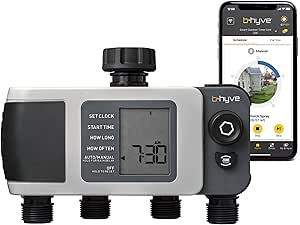
Orbit B-hyve XD 4-Port Smart Hose Watering Timer (24634)
The Orbit B-hyve XD transforms a simple outdoor faucet into a multi-zone irrigation system, with four independently controlled outlets managed via Bluetooth app control. Unlike single-valve timers like the EZAIoT, it offers the flexibility of managing multiple areas with weather-adaptive scheduling, reducing water waste through its WeatherSense technology. The Bluetooth connection limits remote access to nearby, but its two-year warranty provides peace of mind. Its multi-zone capability makes it ideal for complex landscapes, but the Bluetooth-only connectivity means it lacks the convenience of WiFi control over long distances, making it less suitable for large or multi-location properties. This system is best for users prioritizing zone control and weather responsiveness within a manageable Bluetooth range.
Pros:- Four independent zones from one faucet
- WeatherSense technology adjusts for rainfall and temperature
- Bluetooth app control for nearby operation
- Two-year limited warranty
Cons:- Bluetooth only, limited remote control range
- No WiFi compatibility for long-distance control
- No flow monitoring feature
Best for: Homeowners with multiple zones who want smart scheduling and weather adaptation within Bluetooth range.
Not ideal for: Large properties or those requiring remote, WiFi-based control beyond Bluetooth proximity.
- Ports:4
- Connectivity:Bluetooth
- Weather response:WeatherSense
- Warranty:2 years
Our verdict“Great for multi-zone control with weather responsiveness in a Bluetooth environment, but not suited for remote WiFi control needs.”
MOES WiFi Water Timer for Garden Hose with Flow Meter,No Hub Required
The MOES WiFi timer provides a simple, direct WiFi solution that excels for small gardens or single-zone watering, with a built-in flow meter for water usage insights. Its straightforward app control supports up to 10 schedules and weather-based rain delay, similar to EZAIoT but with a more robust design and 2-year battery life. Compared to the Rachio, it lacks scalability but is easier to set up and use. The brass inlet and outlet ensure durability against outdoor conditions. Its main tradeoff is the limited control scope—ideal for small yards but not suitable for large or multi-zone systems. This timer makes the most sense for those seeking reliable, no-hub WiFi control with flow monitoring without extra complexity.
Pros:- No hub or wiring required, connects directly via WiFi
- Durable brass inlet and outlet for outdoor use
- Supports 10 schedules and rain delay
- Flow meter for water usage monitoring
Cons:- Flow Mode requires minimum 0.2 GPM, unsuitable for low-flow systems
- Batteries not included, potential additional cost
- WiFi signal may weaken in metal enclosures
Best for: Small garden owners or renters needing reliable WiFi control and flow monitoring without extra hubs.
Not ideal for: Larger properties or multi-zone irrigation setups that require scalability or advanced ecosystem integrations.
- Connectivity:WiFi 2.4GHz
- Flow meter:Yes
- Material:Brass
- Max pressure:130 PSI
- Schedules:Up to 10
- Rain delay:Yes
Our verdict“Ideal for small gardens needing simple, reliable WiFi control with flow tracking, without the hassle of hubs or complex setup.”
SONOFF Hydro ONE Lite Zigbee Smart Sprinkler Timer (SWV-ZNU)
The SONOFF Hydro ONE Lite stands out for its durable brass inlet and seamless integration with Zigbee ecosystems like Home Assistant. It excels in weather-adaptive scheduling and safety features such as frost alerts and child lock, making it ideal for those already invested in Zigbee-compatible smart home setups. Compared with ECOWITT WittFlow WFC01, it offers more straightforward smart home compatibility but lacks a built-in flow meter, which limits water usage tracking. This makes it less suitable for users prioritizing detailed flow data. Its dependency on a Zigbee hub can be a hurdle for some, and the absence of a flow meter means less granular control over water consumption. This pick makes the most sense for homeowners who want reliable, long-term outdoor control integrated into their Zigbee network.
Pros:- Durable brass inlet ensures long-term outdoor durability
- Weather-adaptive and seasonal scheduling conserves water
- Smart safety features like frost alerts and child lock
- Watering history logs accessible via app
Cons:- Requires a separate Zigbee hub, adding complexity and cost
- No built-in flow meter limits detailed water usage tracking
Best for: Homeowners with existing Zigbee smart home systems seeking reliable, weather-aware irrigation control.
Not ideal for: Users looking for built-in water flow monitoring without additional hubs or complex setups.
- Connectivity:Zigbee 3.0 (hub required)
- Power Source:4 AA batteries
- Inlet Material:Brass
- Max Schedules:6 custom watering plans
- Flow Meter:None
- Warranty:2 years
Our verdict“Best suited for Zigbee-compatible smart home users who prioritize reliable scheduling over detailed flow analytics.”
ECOWITT WittFlow WFC01 Smart Water Timer with Flow Meter & Thermometer, App Remote Control, NPT Threads, 915 MHz
The ECOWITT WittFlow WFC01 offers a distinct advantage with its built-in flow meter and temperature sensor, providing real-time water usage data that many other timers lack. Its all-copper pipelines and IP66 waterproofing ensure durability under tough outdoor conditions, making it ideal for users who want detailed analytics. Compared to the SONOFF Hydro ONE Lite, it adds precise flow monitoring and integrates with soil moisture and weather sensors for smarter automation, but it depends on a separate IoT gateway, which complicates setup and incurs extra costs. Its below-average customer rating suggests potential reliability issues or user interface frustrations, which might deter less tech-savvy buyers. Smart features only operate when connected to ECOWITT’s cloud, adding a reliance on stable internet and service uptime. This option makes the most sense for gardeners who want comprehensive water control and detailed logs, willing to manage additional hardware.
Pros:- Built-in flow meter and temperature sensor enable real-time water monitoring
- All-copper pipelines and connectors ensure durability and corrosion resistance
- Smart Mode automation integrates with soil moisture and weather sensors
- IP66 waterproof rating withstands harsh outdoor environments
Cons:- Requires a separate ECOWITT IoT gateway for app and cloud features, increasing complexity and cost
- Customer reviews indicate mixed reliability and user experience issues
- Smart Mode only functions with active cloud connection, limiting offline use
Best for: Gardeners prioritizing real-time water usage data and automation with soil moisture sensors.
Not ideal for: Users seeking a simple, standalone timer without the need for extra gateways or cloud dependence.
- Frequency:915 MHz
- Water Resistance Rating:IP66
- Max Water Pressure:0.9 MPa
- Thread Standard:NPT
- Connectivity:Requires ECOWITT IoT Gateway (sold separately)
- Warranty:2 years
Our verdict“Best for users who need detailed water flow analytics and are comfortable managing additional hardware and cloud services.”

How We Picked
I evaluated each valve against the criteria that actually determine satisfaction in this category: whether the flow meter is genuinely integrated and accurate (not just marketing), connectivity approach and what happens when the internet drops, build quality of the fittings and housing, power source and realistic battery life, app quality including scheduling flexibility and weather adaptation, and total cost of ownership including any required hub. Because these products span hose-bib timers and semi-permanent valve installations, I also weighed how each one fits a typical yard — single faucet versus multi-zone, drip line versus sprinkler.
The ranking logic is straightforward: models with true flow metering and robust scheduling rank highest, because that combination is the whole point of this category. Hub-free WiFi models rank well on value and ease of setup but lose points for cloud dependence and patchier app support. Non-metered models like the RAINPOINT multi-zone units, Rachio, and Orbit B-hyve XD are still excellent controllers, so they rank on their own strengths — zone capacity, brand polish, ecosystem maturity — but they sit lower here specifically because this comparison prioritizes flow measurement.
| smart sprinkler valves with flow meter | Connectivity | Flow Meter |
|---|---|---|
| RAINPOINT WiFi Water Timer for | — | — |
| RAINPOINT WiFi Water Timer for | — | — |
| meross WiFi Smart Water Timer | WiFi 2.4GHz | — |
| RAINPOINT WiFi Water Timer wit | — | Built-in, measures gallons or liters |
| SONOFF SWV-ZF2U Hydro DUO Zigb | Zigbee 3.0 | Yes |
| Rachio Smart Hose Timer | WiFi (Hub required) | — |
| SONOFF SWV-ZFU Hydro ONE Zigbe | Zigbee 3.0 | Built-in |
| EZAIoT WiFi Water Timer for Ga | WiFi 2.4GHz | Yes |
| Orbit B-hyve XD 4-Port Smart H | Bluetooth | — |
| MOES WiFi Water Timer for Gard | WiFi 2.4GHz | Yes |
| SONOFF Hydro ONE Lite Zigbee S | Zigbee 3.0 (hub required) | None |
| ECOWITT WittFlow WFC01 Smart W | Requires ECOWITT IoT Gateway (sold separately) | — |
Factors to Consider When Choosing Smart Sprinkler Valves With Flow Meters
Before you commit to a specific valve, it helps to understand the structural choices in this market. The twelve products above fall into distinct camps, and picking the right camp matters more than picking between individual models within one.Real Flow Metering vs. Flow-Adjacent Marketing
The single biggest trap in this category is assuming every “smart” timer tracks water usage. Genuine flow meters — like those in the SONOFF Hydro series, EZAIoT, MOES, and ECOWITT models — spin a turbine or sensor in the water path and report gallons used, flow rate, and anomalies. That data is what enables automatic leak alerts and lets the system shut off water when a zone uses more than expected, which is the feature that pays for itself if a drip line cracks while you’re on vacation. Models without meters can still skip watering on rainy days, but they’re blind to everything happening downstream. A common mistake buyers make is paying a premium for a well-known brand name and only later discovering it can’t answer the question “how much water did that zone use?” If leak protection is your motivation, verify the meter exists before anything else.
WiFi vs. Zigbee vs. Proprietary Radios
Connectivity determines both your setup experience and your long-term dependence on a company’s servers. WiFi models (RAINPOINT, EZAIoT, MOES) connect straight to your router with no extra hardware, which is why beginners gravitate toward them — but most route commands through cloud servers, meaning a server shutdown or an internet outage can freeze your schedule. Zigbee models like the SONOFF Hydro lineup require a hub but integrate with Home Assistant for fully local control that keeps working offline, which is why enthusiasts prefer them despite the added cost. Proprietary systems like Rachio’s and ECOWITT’s 915 MHz link sit in between: reliable and purpose-built, but locked to that one ecosystem. My advice: if you already run a smart home hub, lean Zigbee; if you don’t and never plan to, don’t buy a hub-dependent valve just for its specs.
Fittings, Threads, and Physical Durability
Plastic threads on a hose bib that gets direct sun and freezing nights are the number-one failure point reported in this category, and that’s why brass inlets show up on nearly every top-tier pick here. If you plan to leave the valve outdoors year-round, brass inlet and outlet fittings plus an IP65 rating are worth paying extra for — the cost difference is small compared to a flooded foundation from a cracked housing. Thread type also decides what you can even install: standard garden-hose threads (GHT) suit faucet-mounted timers, while the ECOWITT’s NPT threads are made for screwing into rigid pipe on a permanent irrigation manifold. Matching thread type to your plumbing before buying saves a return cycle, since adapters between GHT and NPT introduce leak points of their own.
Power Source and Battery Reality
Nearly every valve here runs on AA batteries, and how many it takes predicts both runtime and cold-weather reliability. Four-AA designs like the SONOFF Hydro models tend to last a full season or more because the motorized valve only draws power briefly at open and close, while models that keep a WiFi radio awake continuously drain faster. A few SONOFF units add Type-C USB power as an option, which is genuinely useful for valves mounted near an outlet or in a shed — you get rock-solid uptime without battery anxiety. Avoid the mistake of mixing old and new batteries; uneven discharge is a frequent cause of mid-season valve failures that get misdiagnosed as app bugs. Whatever you choose, plan to swap batteries at the start of each watering season rather than waiting for a low-battery alert you might miss.
Zone Count and Future Expansion
A single-zone valve is fine for one drip line, but if your faucet serves a lawn, raised beds, and containers, a multi-zone model is far cheaper than buying three separate timers and stacking splitters. The Orbit B-hyve XD covers four zones off one faucet — the most in this lineup — while the RAINPOINT and SONOFF Hydro DUO handle two. The tradeoff is that multi-zone models concentrate all your watering through one flow path, so a single valve failure takes down everything, and flow data (where it exists) covers combined usage rather than per-zone breakdowns. My suggestion: map your yard’s actual hydrozones before shopping. Buyers who under-buy zones end up daisy-chaining timers, which creates pressure drops that weak municipal water supplies can’t afford.
App Quality, Weather Adaptation, and Total Cost
The app is where you’ll live with this product every week, and quality varies more than hardware does. Look for weather-adaptive scheduling that shortens cycles on hot, dry days — the SONOFF Hydro and Rachio ecosystems handle this best among these twelve — plus flexible programs like per-zone start times and seasonal percentage adjustments. When comparing prices, calculate total cost including any required hub: a budget Zigbee timer plus a hub can exceed a mid-range WiFi model that works out of the box. Also check whether the app requires an account and cloud connection for basic scheduling, because that dependency outlives the warranty and can outlive the product line. A slightly pricier valve from a company with a mature app is usually the better five-year bet than the cheapest unit on the shelf.
Frequently Asked Questions
Do I really need a flow meter, or is rain delay enough?
Rain delay and weather-based scheduling decide when to water, but a flow meter verifies what actually happened — gallons delivered, flow rate, and whether a zone used abnormally more water than usual. That last part is the real value: a flow meter can catch a burst drip line, a stuck-open valve, or a clogged sprinkler head within a single cycle and alert you or shut things down automatically. Rain delay alone can’t detect any of that, so you might water on schedule for weeks before noticing a dead patch or a sky-high water bill. If your system is small, above ground, and you check it weekly, rain delay is probably sufficient. If the system is buried, multi-zone, or waters while you travel, the flow meter earns its price the first time something breaks.
Is a Zigbee valve like the SONOFF Hydro worth needing an extra hub?
It depends on whether you already have — or intend to build — a smart home hub. If you own a Home Assistant setup, Home Assistant Yellow, or a compatible Zigbee coordinator, the SONOFF Hydro valves become dramatically more capable: local control that survives internet outages, custom automations, and logging without any cloud subscription. Buying a hub solely for one sprinkler valve, though, adds $30–70 to the project and complicates setup for a benefit you may never use — in that case a hub-free WiFi model like the EZAIoT or MOES delivers flow metering more simply. The honest tradeoff is that WiFi models are easier today but depend on the manufacturer’s servers staying online, while Zigbee models take more effort now and stay yours forever.
Can these timers handle multiple zones from a single faucet?
Several can, but with real limits. The Orbit B-hyve XD offers four ports, the RAINPOINT brass-inlet 2-zone models and the SONOFF Hydro DUO offer two, and each port runs its own independent schedule. The catch is water pressure: a typical residential faucet delivers enough for one or two drip zones or one sprinkler zone at a time, and running multiple zones simultaneously usually drops pressure below what sprinkler heads need. Most multi-zone models water zones sequentially, which handles this automatically, but check that behavior in the app before assuming it. Also note that on the metered multi-zone units, flow data is usually aggregated rather than broken out per zone, so pinpointing which zone leaked takes some deduction.
Will a hose-thread timer work on my underground irrigation pipes?
Not directly, and this is one of the most common mismatched purchases in the category. Hose timers use garden-hose threads (GHT) and expect faucet-level pressure flexibility, while in-ground manifolds use pipe threads (NPT) and often higher pressure. The ECOWITT WittFlow WFC01 is the standout here specifically because it has NPT threads, letting it thread into a rigid irrigation line where a hose-timer body would need adapters and become a leak risk. For everything else in this lineup, mounting on a hose bib or faucet is the intended use. If your goal is automating an existing underground system, you may actually be better served by a multi-zone in-ground controller rather than any hose-faucet timer — different product category entirely.
How accurate are the built-in flow meters, and can I trust the gallon numbers?
Expect reasonably good but not utility-grade accuracy — most turbine-style meters in this price range read within roughly 5–10 percent of actual usage, which is plenty for comparing zones, spotting leaks, and spotting seasonal trends. Accuracy does drift at very low flow rates, so a slow drip line may register less precisely than a full sprinkler zone, and mineral buildup in hard-water areas can degrade readings over a season or two. The practical move is to cross-check once: run a cycle into a bucket or compare against your water bill’s irrigation season delta, then treat the app’s numbers as consistent relative data rather than billing-accurate absolutes. What these meters are genuinely excellent at is anomaly detection — a stuck valve that doubles your usual flow gets flagged regardless of small calibration errors.
Conclusion
If you want the short answer: the SONOFF SWV-ZFU Hydro ONE is my best overall pick because it combines genuine flow metering, weather-adaptive scheduling, brass fittings, and flexible power in one package — provided you have (or will buy) a Zigbee hub. For the best value, the EZAIoT WiFi Water Timer and MOES WiFi Timer deliver real flow measurement with no hub required, which makes them the smartest entry points for anyone who wants leak awareness on a budget. Beginners who value a polished, foolproof app over raw features should start with the Rachio Smart Hose Timer, accepting that it lacks a flow meter. For multi-zone yards, the Orbit B-hyve XD 4-Port wins on capacity while the RAINPOINT 2-Zone brass models split the difference between zones and durability. Smart home enthusiasts get the most from the SONOFF Hydro DUO with its two zones and Home Assistant support, and anyone installing into permanent piping with NPT threads — especially existing ECOWITT weather station owners — should look hard at the WittFlow WFC01. Match the valve to your plumbing, your ecosystem, and whether flow data truly matters to you, and the right pick from this list becomes obvious.
Halloween Picks
halloween
As an affiliate, we earn on qualifying purchases.