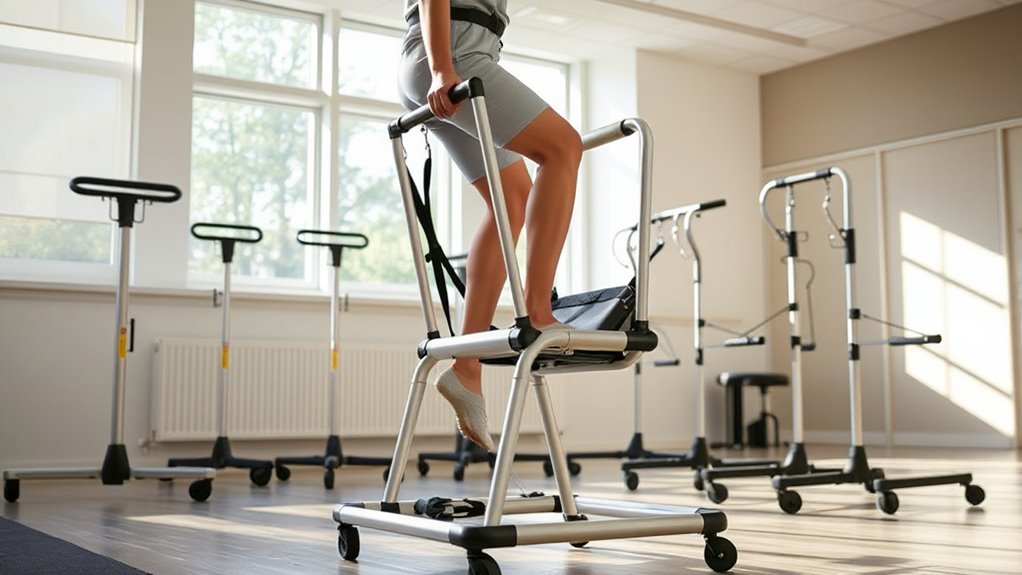

Standing frames for rehabilitation vary in how they support posture, help with sit-to-stand movement, and allow indoor mobility. I would put the CANEVE Rehabilitation Standing Frame with Dining Board first for buyers who want a supported standing position with a useful surface, while the children’s adjustable frame and 330 lb capacity stand-up support walkers address more specific fit and transfer needs. The main tradeoff is between a stable, more fixed standing setup and a wheeled device that offers greater movement but may demand more balance and supervision. Fit, support placement, and intended use matter more than the product name. Read on for the full comparison and guidance on matching a frame to the user’s needs.

Turn the school run and nap time into listening time
- Thousands of audiobooks, podcasts and originals
- Listen on your phone, tablet or Echo — also offline
- Cancel anytime
Complete the kit


Key Takeaways
- The lineup spans distinct support styles: dining-board and floorstanding frames suit supported stationary standing, while wheeled walkers add mobility.
- Adjustability is not the same as a good fit: the children’s frame and the 58–71-inch model signal different height needs, but measurements and support placement still need checking.
- Wheel count alone does not indicate stability: the 4-wheel and 8-wheel options differ in design, so brake access, wheel behavior, and the user’s control are more useful checks.
- Capacity claims are specific to two listed models: the blue and yellow 330 lb versions share a stated limit; buyers should confirm capacity and fit rather than assume similar-looking walkers match.
- CANEVE offers two different setups: one listing names a dining board, while the adjustable standing frame listing does not, making the choice hinge on whether that surface is useful.
| Children’s Adjustable Standing Frame for Rehabilitation |  | Best for Pediatric Posture Practice | Material: Wood board and steel pipe | Dimensions: 80 × 65 × 132 cm | Suitable use: Indoor and outdoor | VIEW ON AMAZON | See Our Full Breakdown |
| CANEVE Rehabilitation Standing Frame with Dining Board |  | Best for Home-Supported Daily Activities | Brand: CANEVE | Product type: Rehabilitation standing frame | Included feature: Dining board | VIEW ON AMAZON | See Our Full Breakdown |
| Adjustable Adult Rehabilitation Walker with Seat and Wheels |  | Best for Supported Mobility with a Rest Seat | Material: Electroplated carbon steel | Height adjustment: 10 levels, 45.67–55.12 in | Width adjustment: 5 levels, 7.87–13.78 in | VIEW ON AMAZON | See Our Full Breakdown |
| Adjustable Floorstanding Adult Walker for Rehabilitation |  | Best for Adjustable Adult Fit | Material: Electroplated carbon steel | Height adjustment: 10 levels, 45.67–55.12 in | Width adjustment: 5 levels, 7.87–13.78 in | VIEW ON AMAZON | See Our Full Breakdown |
| Adjustable Adult Standing Walker with 8 Wheels and Support Pads |  | Best for Exercise and Rest Breaks | User height: 58–71 inches | Weight capacity: 220 lbs | Height adjustment: 10 levels | VIEW ON AMAZON | See Our Full Breakdown |
| Adjustable Height Balance Frame for Indoor and Outdoor Training |  | Best for Balance and Strength Exercises | Height range: 31–37 in | Base width: 34–42 in | Weight capacity: 350 lbs | VIEW ON AMAZON | See Our Full Breakdown |
| Adjustable Rehabilitation Walker with Stand-Up Support, 4 Wheels, 330 lb Capacity, Blue |  | Best for Stand-Up and Walking Practice | Frame material: Carbon steel | Padding: PU foam | Wheel material: PU | VIEW ON AMAZON | See Our Full Breakdown |
| Adjustable Standing Rehabilitation Walker for Adults |  | Best for Adjustable Fit and Anti-Tip Support | Suitable user height: 58–71 in | Height adjustment: 45–55 in, 10 levels | Width adjustment: 13–20 in, 5 levels | VIEW ON AMAZON | See Our Full Breakdown |
| Adjustable Standing Walker for Adults, 58–71 Inches Tall |  | Best for Lower-Capacity Users | Recommended user height: 58–71 in (150–180 cm) | Maximum weight capacity: 220 lbs | Frame material: Carbon steel | VIEW ON AMAZON | See Our Full Breakdown |
| Height-Adjustable Rehabilitation Walker with Stand-Up Support, 4 Wheels, 330 lb Capacity, Yellow |  | Best for Buyers Who Need Listed Dimensions | Frame material: Carbon steel | Padding: PU foam | Wheel material: PU | VIEW ON AMAZON | See Our Full Breakdown |
| 8-Wheel Standing Support Device for Seniors |  | Best for Rest Breaks During Supported Training | Maximum weight capacity: 331 lb (150 kg) | Wheel structure: 8-wheel multi-point support | Width settings: 5 | VIEW ON AMAZON | See Our Full Breakdown |
| CANEVE Adjustable Rehabilitation Standing Frame |  | Best for Buyers Prioritizing Height Adjustment | Product type: Rehabilitation standing frame | Use: Lower-limb rehabilitation training | Height: Adjustable | VIEW ON AMAZON | See Our Full Breakdown |
More Details on Our Top Picks
Children’s Adjustable Standing Frame for Rehabilitation
For a child who needs supported standing practice, this frame offers more adjustment points than the adult walkers in this batch. Its adjustable chest and knee supports and double body straps let caregivers position the child’s torso and legs, while the adjustable tabletop gives the child a place to rest their arms during practice. Four swivel wheels help move it between rooms or suitable outdoor areas. Compared with the Adjustable Adult Rehabilitation Walker with Seat and Wheels, this model is aimed at children and posture positioning rather than adult walking support; the adult walker provides a seat and infusion holder instead. The main limitation is the missing weight capacity and sizing range, so buyers cannot confirm fit from the supplied details alone. Its child-specific use also makes it a poor choice for general adult mobility training.
Pros:- Adjustable chest and knee supports allow positioning for standing practice
- Double body straps help secure the child in the frame
- Adjustable tabletop provides arm support during use
- Four swivel wheels make indoor repositioning easier
Cons:- No user weight capacity or sizing range is provided
- Designed for pediatric rehabilitation needs rather than general adult use
Best for: Caregivers seeking a pediatric standing frame with adjustable chest, knee, and tabletop supports for supervised posture practice
Not ideal for: Families who need a clearly stated user size or weight limit, or an adult mobility walker
- Material:Wood board and steel pipe
- Dimensions:80 × 65 × 132 cm
- Suitable use:Indoor and outdoor
- Wheels:Four swivel wheels
- Body support:Double body straps
- Adjustable supports:Knee baffle, chest support, and tabletop
- Intended use:Standing training for patients with cerebral palsy or hemiplegia
Our verdict“Choose this frame for a child who needs adjustable supported standing, provided a clinician or supplier can confirm fit and capacity.”
CANEVE Rehabilitation Standing Frame with Dining Board
The dining board and correction board give this home rehabilitation frame a practical focus: it is intended to support training alongside seated-height activities such as eating. That makes it a different proposition from the Adjustable Floorstanding Adult Walker for Rehabilitation, whose listed details center on adjustable height, width, and wheeled movement. CANEVE may suit a household looking for a frame with built-in boards, but the supplied product information says little about its adjustment range, materials, stability features, or user capacity. Those gaps make it harder to judge fit and compare its support to the better-specified adult walkers in this batch. I would treat it as a candidate for home use only after confirming dimensions and user limits with the seller or rehabilitation professional.
Pros:- Designed for home rehabilitation training
- Includes a dining board for supported daily activities
- Includes a correction board as part of the frame
Cons:- No user capacity or fit range is provided
- The supplied details do not describe materials, wheels, or brakes
- Limited specifications make stability and setup difficult to compare
Best for: Households supporting an adult with hemiplegia or paralysis who want a home training frame with a dining board
Not ideal for: Buyers who need verified height and width ranges, a stated weight limit, or detailed mobility and brake specifications
- Brand:CANEVE
- Product type:Rehabilitation standing frame
- Included feature:Dining board
- Included feature:Correction board
- Intended use:Home rehabilitation training
- Intended users:People recovering from stroke or living with hemiplegia or paralysis
Our verdict“Consider this for home training when its fit and support limits have been confirmed, especially if the included boards suit the routine.”
Adjustable Adult Rehabilitation Walker with Seat and Wheels
This adult walker combines standing and walking support with a padded seat, which gives users a place to rest during a session. Its height and width adjustments cover a stated user height range of 59.06–70.87 inches, and six of its eight wheels have brakes for controlling movement. The one-button entry latch and infusion holder also make it more equipped for supervised rehabilitation than the simpler Adjustable Floorstanding Adult Walker for Rehabilitation. That added functionality comes with a sizable frame that may be hard to maneuver in tight rooms, and the listed capacity is 220.46 pounds. Buyers should check both dimensions and capacity against the intended user and available space; this is not a compact alternative for narrow home layouts.
Pros:- Ten height settings and five width settings allow fit adjustments
- Padded supports and a seat provide contact points for standing and resting
- Six braked wheels offer movement control
- One-button entry latch and infusion holder support supervised use
Cons:- Listed capacity is limited to 220.46 pounds
- Large frame may need substantial room to turn and maneuver
- Eight-wheel layout may be more equipment than buyers seeking a simple standing frame need
Best for: Adults within the stated height and weight limits who need padded standing support, a rest seat, and controlled wheeled movement
Not ideal for: Users above 220.46 pounds, people outside the stated height range, or households with little maneuvering space
- Material:Electroplated carbon steel
- Height adjustment:10 levels, 45.67–55.12 in
- Width adjustment:5 levels, 7.87–13.78 in
- User height:59.06–70.87 in
- Weight capacity:220.46 lbs
- Wheels:Eight wheels, 3.94 in diameter; six with brakes
- Supports and features:Seat, padded supports, infusion holder, one-button entry latch
Our verdict“Choose this walker when an adult needs adjustable standing support with a seat and the room to maneuver its large wheeled frame.”
Adjustable Floorstanding Adult Walker for Rehabilitation
This floorstanding walker is a straightforward adult option for buyers whose main needs are a fit range and controlled movement. It offers ten height settings, five width settings, and eight wheels, six with brakes, with a stated user height range of 59.06–70.87 inches. Compared with the Adjustable Adult Rehabilitation Walker with Seat and Wheels, it has fewer listed comfort and therapy accessories: there is no seat, padded support set, or infusion holder in the supplied description. That simpler feature set may appeal to buyers who do not need those extras, but the product details also provide no independent support for the stated corrosion- and impact-resistance claims. Its 220.46-pound capacity and broad wheeled base still require a fit check and enough floor space.
Pros:- Ten height and five width settings provide adjustability
- Six braked wheels support controlled positioning
- Stated user height range helps buyers assess fit
- Electroplated carbon steel frame material is specified
Cons:- No seat, padded supports, or infusion holder are listed
- Maximum load capacity is 220.46 pounds
- Safety and durability claims are not independently substantiated in the supplied details
Best for: Adults within the stated height and weight limits who want adjustable standing and walking support with braked wheels
Not ideal for: Users who need a built-in seat or padded supports, exceed the capacity, or cannot accommodate a wheeled floorstanding frame
- Material:Electroplated carbon steel
- Height adjustment:10 levels, 45.67–55.12 in
- Width adjustment:5 levels, 7.87–13.78 in
- Wheel count:Eight
- Wheel diameter:3.94 in
- Brakes:Six wheels have brakes
- Maximum load capacity:220.46 lbs
- User height range:59.06–70.87 in
Our verdict“Pick this for adjustable adult standing support with braked wheels if you do not need the seat and padded accessories of the B0DZ28JN3X walker.”
Adjustable Adult Standing Walker with 8 Wheels and Support Pads
The removable support panel and elastic exercise cords make this walker the most activity-oriented option in this group. Its anti-tilt frame and eight braked wheels are intended for supported movement, while the panel provides a place to sit or rest. Compared with the Adjustable Adult Rehabilitation Walker with Seat and Wheels, this model adds exercise cords and lists indoor and outdoor use, whereas the other adult walker specifies padded supports, a one-button entry latch, and an infusion holder. The fit range is 58–71 inches tall, with a 220-pound capacity, so buyers outside those limits should look elsewhere. Its width adjustment spans 13–20 inches, but the supplied details do not say how the listed width is measured; confirm the fit before choosing it for a narrow space.
Pros:- Ten height settings and five width settings allow adjustments
- Anti-tilt frame and eight wheels with brakes support controlled movement
- Removable panel offers a rest point
- Elastic cords add movement exercises to supported use
Cons:- Weight capacity is limited to 220 pounds
- Stated user height range excludes users below 58 or above 71 inches
- Width range is listed as 13–20 inches without clarifying measurement details
Best for: Adults within the stated height and weight limits who want a wheeled standing walker with a removable rest panel and exercise cords
Not ideal for: Users above 220 pounds or outside the 58–71-inch height range, and buyers who need a clearly documented narrow-width fit
- User height:58–71 inches
- Weight capacity:220 lbs
- Height adjustment:10 levels
- Width adjustment:5 levels, 13–20 inches
- Wheels:Eight
- Features:Anti-tilt frame, brakes, removable support panel, elastic exercise cords
- Suitable use:Indoor and outdoor
Our verdict“Choose this model for supported standing and movement exercises if the user fits its limits and the removable panel suits their rest needs.”
Adjustable Height Balance Frame for Indoor and Outdoor Training
Compact exercise support sets this frame apart from the wheeled walkers in this roundup. Its height adjusts from 31 to 37 inches and its base from 34 to 42 inches, letting a therapist or user tailor the setup for dips, push-ups, and other supported exercises. The 350-pound capacity is higher than the 220-pound limit listed for the Adjustable Standing Walker for Adults, though that walker is designed for supported mobility with wheels and brakes. This frame is better suited to stationary strength and balance work than walking practice. Its iron construction and anti-slip grips offer a straightforward setup, but it requires assembly, and the product details do not specify folding or transport features. I would choose it for exercise sessions where adjustable support matters more than mobility assistance.
Pros:- Height adjusts from 31 to 37 inches
- Base width adjusts from 34 to 42 inches
- Supports up to 350 pounds
- Cushioned anti-slip handles and non-slip foot grips
Cons:- Requires assembly
- Designed for stationary exercises rather than walking support
Best for: Adults and therapists seeking an adjustable stationary frame for supported balance, dips, or push-ups
Not ideal for: People who need a wheeled device for walking practice or a frame that folds for storage
- Height range:31–37 in
- Base width:34–42 in
- Weight capacity:350 lbs
- Material:Iron
- Handle type:Sponge-grip, anti-slip
- Use:Indoor and outdoor
- Assembly:Minimal assembly required
Our verdict“Choose this frame for adjustable, stationary strength and balance exercises; look to a wheeled rehabilitation walker for walking practice.”
Adjustable Rehabilitation Walker with Stand-Up Support, 4 Wheels, 330 lb Capacity, Blue
Stand-up support and walking practice make this four-wheel walker a fit for adults who need help moving between supported standing and mobility exercises. Its height range of 23–51 inches and seat adjustment from 11–36 inches allow a broad setup range, while padded contact points and quiet PU wheels support repeated indoor sessions. Compared with the eight-wheel Adjustable Standing Rehabilitation Walker for Adults, this model has fewer wheels and offers a push-cart training mode; the eight-wheel option instead emphasizes anti-tilt support and width adjustment. The tradeoff is substantial: at 31–34 kg, this walker may be difficult to lift or reposition, and its wide footprint calls for open floor space. I would favor it when multiple training positions matter more than easy portability.
Pros:- Supports standing, walking, and push-cart training
- Height adjusts from 23 to 51 inches
- Padded surfaces and PU wheels support indoor mobility practice
- Folds for storage and transport
Cons:- Heavy at 31–34 kg, making lifting and repositioning difficult
- Wide footprint may be challenging in smaller rooms
Best for: Adults recovering from injury who need a height-adjustable device for supported standing, walking, and push-cart practice
Not ideal for: Caregivers who must frequently lift or move the device, or households with narrow rooms and doorways
- Frame material:Carbon steel
- Padding:PU foam
- Wheel material:PU
- Front wheel size:5 in
- Rear wheel size:8 in
- Height range:23–51 in
- Seat height range:11–36 in
- Load capacity:330 lbs (150 kg)
- Weight:31–34 kg
Our verdict“Pick this walker for varied supported mobility exercises when you have the space and help to manage its heavy frame.”
Adjustable Standing Rehabilitation Walker for Adults
Height and width adjustment give this eight-wheel walker an edge for users who need a closer fit around padded supports. Its width adjusts from 13 to 20 inches, and side anti-tip wheels plus a braking system are intended to limit unwanted movement during standing and mobility practice. The elastic assist rope also adds a lower-limb exercise option that the four-wheel Adjustable Rehabilitation Walker with Stand-Up Support does not list. That other walker provides detailed seat-height and wheel-size ranges, while this model emphasizes fit adjustments and anti-tilt features. The product data has a possible sizing ambiguity: it lists a suitable user height of 58–71 inches alongside a frame height adjustment of 45–55 inches. Assembly is required, so I would confirm the measurements with a clinician before choosing it.
Pros:- Width adjusts from 13 to 20 inches
- Eight-wheel design includes anti-tip side wheels
- Braking system and padded supports
- Folding frame and elastic assist rope
Cons:- Listed user-height and frame-height ranges may be difficult to reconcile
- Requires assembly
- 330-pound capacity may not suit every user
Best for: Adults in the listed 58–71-inch user-height range who need adjustable width, padded support, and anti-tip features
Not ideal for: Buyers who need clearly reconciled frame dimensions before ordering or want a setup that requires no assembly
- Suitable user height:58–71 in
- Height adjustment:45–55 in, 10 levels
- Width adjustment:13–20 in, 5 levels
- Weight capacity:330 lbs
- Wheels:8, with anti-tip side wheels
- Frame material:Stainless steel
- Features:Folding design, braking system, padded supports, elastic assist rope
Our verdict“Consider this walker for adjustable width and anti-tip support if its listed dimensions match the user’s fit needs.”
Adjustable Standing Walker for Adults, 58–71 Inches Tall
Adjustable fit with speed-controlled wheels is the appeal of this standing walker for adults between 58 and 71 inches tall. Its eight wheels, brakes, and removable padded armrest and cushion support a more tailored setup for standing and mobility practice. Compared with the Adjustable Standing Rehabilitation Walker for Adults, this model lists fewer fit details and a lower 220-pound capacity; the other walker supports up to 330 pounds and specifies width adjustment and anti-tip side wheels. That makes this a narrower choice for users whose weight falls within its stated limit and who value removable padding. The product description does not give dimensions or assembly details, which leaves practical questions for caregivers planning storage and setup. I would confirm fit and capacity with a clinician before selecting it.
Pros:- Height and width adjust to fit different users
- Eight wheels with speed adjustment and brakes
- Removable padded armrest and cushion
Cons:- 220-pound maximum capacity is lower than the 330-pound walkers in this group
- Dimensions and assembly requirements are not specified
Best for: Adults 58–71 inches tall and within the 220-pound limit who need adjustable padded support and controlled wheels
Not ideal for: Users above 220 pounds or caregivers who need published dimensions to plan storage and clearance
- Recommended user height:58–71 in (150–180 cm)
- Maximum weight capacity:220 lbs
- Frame material:Carbon steel
- Wheels:8
- Adjustments:Height and width
- Armrest and cushion:Removable, high-density sponge
Our verdict“Choose this walker only when its 220-pound limit fits the user and adjustable wheel control is a priority.”
Height-Adjustable Rehabilitation Walker with Stand-Up Support, 4 Wheels, 330 lb Capacity, Yellow
Published unfolded dimensions help caregivers judge whether this four-wheel walker will fit their therapy space before setup. Like the blue Adjustable Rehabilitation Walker with Stand-Up Support, it supports standing, walking, and push-cart practice, folds for storage, and has adjustable supports with padded surfaces. Both list a 330-pound capacity and a 31–34 kg weight, so this yellow model is not an easier option to lift. Its stated dimensions add useful planning detail, though the height and depth ranges span a wide footprint that may still be awkward in tight rooms. Compared with the eight-wheel Adjustable Standing Rehabilitation Walker for Adults, this model provides explicit wheel sizes and seat-height adjustment rather than listed width adjustment and anti-tip side wheels. I would choose it when space planning is the deciding factor.
Pros:- Supports standing, walking, and push-cart training
- Height and seat position adjust across broad ranges
- Folds for storage and transport
- Unfolded and folded dimensions are listed
Cons:- Heavy at 31–34 kg
- Wide, variable footprint may not suit small rooms
Best for: Caregivers who need published folded and unfolded dimensions to plan a dedicated rehabilitation area
Not ideal for: People who need a lightweight walker, a compact footprint, or eight-wheel anti-tip features
- Frame material:Carbon steel
- Padding:PU foam
- Wheel material:PU
- Front and rear wheel sizes:5 in front; 8 in rear
- Height adjustment:23–51 in
- Seat height adjustment:11–36 in
- Load capacity:330 lbs (150 kg)
- Weight:31–34 kg
- Unfolded dimensions:72 × 80–100 × 58–130 cm (W × D × H)
Our verdict“Choose this model over the blue version when its listed dimensions help you plan the space, provided the heavy frame is manageable.”
8-Wheel Standing Support Device for Seniors
The 8-wheel support layout, anti-tip wheels, and reinforced frame make this a fit for users who need several points of contact during gentle standing and movement practice. Its one-hand brake and cushioned seat add practical support for pausing between efforts. Compared with the Adjustable Rehabilitation Walker with Stand-Up Support, 4 Wheels, 330 lb Capacity, Blue, this device uses more wheels and offers five width settings plus ten height adjustments, giving buyers more stated fit options. The tradeoff is a narrower stated user-height range of 60–69 inches; the other walker may suit users outside that band if its dimensions fit. Terrain guidance is also limited to gentle slopes, so I would not choose it for steeper routes where performance is unspecified.
Pros:- Eight-wheel support with anti-tip wheels provides multiple contact points
- Five width settings and ten height adjustments allow fit changes
- One-hand brake supports controlled stopping
- Cushioned seat offers a place to rest during training
Cons:- Recommended only for users 60–69 inches tall
- Guidance covers gentle slopes; suitability for steeper terrain is unspecified
Best for: Adults 60–69 inches tall who need adjustable support and a seat for breaks during gentle rehabilitation movement
Not ideal for: Users outside the stated height range or anyone whose training route includes steep slopes
- Maximum weight capacity:331 lb (150 kg)
- Wheel structure:8-wheel multi-point support
- Width settings:5
- Height adjustments:10
- Recommended user height:60–69 inches
- Brake:One-hand brake
- Seat:Sponge cushion
- Terrain guidance:Designed for gentle slopes
Our verdict“Choose this device for supported, gentle training with rest breaks if the user’s height falls within its stated range.”
CANEVE Adjustable Rehabilitation Standing Frame
The CANEVE frame is described for lower-limb rehabilitation training, and its adjustable height is the only specific fit feature supplied. That gives it a clearer stated training purpose than the 8-Wheel Standing Support Device for Seniors, whose details emphasize wheeled movement, braking, and a resting seat. I would place CANEVE ahead for buyers seeking a standing frame for rehabilitation, but the sparse description makes it hard to judge how well it supports an individual session. There is no stated adjustment range, capacity, padding, stability feature, or transfer aid. By comparison, the 8-wheel device lists a weight limit and adjustment counts, giving buyers more concrete fit information. CANEVE’s white finish is specified, but its practical value depends on details that are not provided.
Pros:- Designed for lower-limb rehabilitation training
- Height is adjustable
- Standing-frame format is stated
- White color is specified
Cons:- No height adjustment range or user-height guidance is provided
- Weight capacity and stability features are unspecified
- The description gives no details about padding or transfer support
Best for: Rehabilitation buyers who specifically want a height-adjustable frame for lower-limb training and can confirm fit and support details before choosing
Not ideal for: Buyers who need a known height range, weight capacity, padding, or stability features to match a particular rehabilitation plan
- Product type:Rehabilitation standing frame
- Use:Lower-limb rehabilitation training
- Height:Adjustable
- Color:White
- User height range:Not specified
- Maximum weight capacity:Not specified
Our verdict“Consider this frame when adjustable height and lower-limb training are the main requirements, provided its missing fit and support details can be confirmed.”

How We Picked
I ranked these options by how clearly their described design supports rehabilitation standing: the type of body support, adjustability, mobility, and whether the product appears suited to a particular user or setting. Models with a specific use case, such as a children’s frame, a dining board, or a stated 330 lb capacity, are easier to match to a need than listings with few distinguishing details. I also weighed the practical tradeoff between a more stationary support frame and a wheeled walker that may help users move around.
The ranking favors options with a clear role and useful distinguishing details, while closely related listings are grouped as alternatives rather than treated as proven equivalents. Product names alone do not establish clinical suitability, stability, materials, braking performance, or compatibility with a person’s diagnosis. Buyers should verify those details with the supplier and, where relevant, a rehabilitation professional before choosing a device.
Factors to Consider When Choosing Standing Frames For Rehabilitation
Start with the standing task the device needs to support, then check fit and safe use in the actual room. Similar labels can describe different setups, and a walker that supports movement may not provide the same assistance as a stationary frame.
Match the support style to the standing task
Decide whether the main goal is to practice standing in one place, assist a sit-to-stand movement, or support movement once upright. A dining-board frame suggests a surface that may help with activities while standing, but that feature does not establish transfer assistance. Wheeled rehabilitation walkers may offer movement, yet they call for attention to balance and control. A common mistake is choosing by the word “standing” without identifying which task matters most. Ask the clinician or supplier to describe how the device is intended to be used. Match that answer to the user’s current abilities and care plan.
Measure the user and check support placement
Height ranges are only a starting point; arm supports, hand grips, and any torso or pelvic supports must sit in usable positions for the individual. Measure the user in the footwear and posture expected during use, and ask whether adjustments can be made without tools. Avoid assuming that an adult model fits every adult or that a child’s model will accommodate growth. Poorly placed supports can make a device uncomfortable or difficult to control. Request a fitting guide or adjustment instructions before purchase. If the person’s posture changes during therapy, ask how often the fit should be reviewed.
Treat wheels, brakes, and floors as one decision
Wheels can make repositioning easier, but they also change how the device behaves when the user leans or shifts weight. Check whether brakes are present, where they are located, and whether the user or caregiver can operate them reliably. Consider thresholds, rugs, tight turns, and the amount of clear floor space at home. More wheels do not automatically mean safer movement or better control. Ask the supplier which surfaces the device is designed for and what inspection or maintenance the wheels need. A stationary frame may suit a confined therapy area better than a mobile walker.
Check capacity and the complete fit, not just a headline number
A stated weight capacity is a limit, not a guarantee that the frame will fit or support a particular posture. Verify the intended user weight, height range, and any limits on the type of support provided. The two listings here that state a 330 lb capacity give buyers a concrete number to confirm, while other product names provide no capacity figure. Do not infer that a visually similar model shares the same limit. Ask about the frame’s dimensions and the supplier’s definition of supported load. If the listing leaves these points unclear, get written specifications before deciding.
Plan for caregiver help and the room where it will be used
Think through how the user will get into and out of the device, who will assist, and whether that person can reach controls and supports. A frame that works in a clinic may be awkward in a small bedroom or bathroom. Measure doorways, turning areas, and storage space, including the device’s footprint when positioned for use. Ask whether assembly, cleaning, and adjustments require a caregiver or special tools. The easiest device to use is the one the user and caregiver can handle consistently in the intended setting. Confirm a return or fitting policy before buying if an in-person trial is unavailable.
Frequently Asked Questions
Should I choose a stationary standing frame or a wheeled rehabilitation walker?
Choose based on the task and the user’s ability to control the device. A stationary frame is generally the more direct fit when supported standing in one place is the priority. A wheeled walker adds the possibility of moving while upright, but that makes wheel control, brakes, and supervision more relevant. Ask the treating professional which movements the user is cleared to perform. The product title alone cannot establish whether either style fits an individual rehabilitation plan.
Can a standing frame help someone who needs assistance getting upright?
Some designs may offer stand-up support, but the label does not explain how much help they provide or how transfers should be performed. Confirm whether the device is intended for sit-to-stand assistance, supported standing after a transfer, or both. Ask about the user’s ability to bear weight and follow instructions, as these affect safe use. A caregiver should receive clear setup and transfer guidance from a qualified professional. Do not treat a standing frame as a substitute for a prescribed transfer aid.
How do I know whether an adjustable model will fit?
Compare the user’s height and weight with the manufacturer’s full specifications, then check where the hand, arm, and body supports can be positioned. An adjustment range that covers someone’s height does not prove the support points will align comfortably. Ask for measurement instructions and the device’s assembled dimensions. If the user is a child or may grow, find out how much adjustment remains and whether later refitting is possible. A clinician or supplier can help verify fit before use.
Is an 8-wheel model more stable than a 4-wheel model?
Wheel count by itself does not establish stability. Stability depends on the frame geometry, wheel placement, brakes, support points, floor surface, and how the user shifts weight. The 4-wheel models in this roundup include listings with stated 330 lb capacity, while the 8-wheel options emphasize wheel count without that same detail in their names. Ask the seller for brake specifications and instructions for the intended surfaces. If safe control is uncertain, request a supervised trial or professional assessment.
What should I confirm before buying a rehabilitation standing frame online?
Get the full dimensions, weight capacity, adjustment range, support locations, and details about wheels and brakes where applicable. Confirm whether assembly is required, what tools are needed, and whether the product can be returned after a fit check. Ask who can help with initial adjustment and what routine inspection the frame needs. Check that the model is intended for the user’s height, weight, and planned rehabilitation task. If the listing lacks these details, ask the supplier to provide them before placing an order.
Conclusion
For a broadly useful starting point, I rank the CANEVE Rehabilitation Standing Frame with Dining Board as best overall among the listed models because its named surface gives it a clear supported-standing role. The Adjustable Floorstanding Adult Walker is the value-minded pick for buyers who want a straightforward adult setup, though its listing details should be checked carefully. For a more specialized choice, the 330 lb capacity stand-up support walkers are the premium-style options when that stated capacity and wheeled support match the user’s needs. Beginners should start with a professional fitting and compare the CANEVE frame with the simpler floorstanding model before choosing. For children, consider the Children’s Adjustable Standing Frame; for users who need mobility or a particular height range, compare the 4-wheel and 8-wheel designs and the 58–71-inch listing against verified specifications and clinical guidance.