Choosing the right whole house water filtration systems determines whether your family drinks clean water and avoids plumbing damage from sediment or hardness. The iSpring WGB21B Two-Stage System stands out as the best overall pick for its balance of high capacity and straightforward installation, while the Aquasana Rhino offers superior premium features for those needing UV protection and salt-free conditioning. Buyers often face a tradeoff between simple sediment-and-carbon setups versus complex multi-stage systems that handle chlorine, heavy metals, and bacteria simultaneously. Understanding your specific water contaminants is the first step to avoiding underpowered or over-engineered solutions. Continue reading to see how these fifteen models compare on maintenance, flow rate, and filtration depth to help you make a confident decision.

Turn the school run and nap time into listening time
- Thousands of audiobooks, podcasts and originals
- Listen on your phone, tablet or Echo — also offline
- Cancel anytime
Complete the kit


Key Takeaways
- The iSpring WGB21B wins on simplicity and capacity, making it the ideal choice for households primarily concerned with sediment and chlorine taste rather than complex chemical removal.
- Premium models like the Aquasana Rhino justify their higher cost by integrating UV sterilization and salt-free conditioning, addressing biological contaminants and scale without the environmental impact of salt softeners.
- Budget-friendly 3-stage kits often lack the flow rate necessary for larger homes, leading to pressure drops when multiple fixtures are used simultaneously, a critical flaw not always obvious in marketing materials.
- UV integration is the key differentiator for well water users; standard carbon filters cannot remove bacteria or viruses, meaning non-UV systems leave rural homeowners vulnerable to invisible pathogens.
- Maintenance costs vary wildly; some systems use proprietary cartridges that are expensive and hard to source, while others use standard 20-inch big blue housings that offer cheaper, easier replacements.
| iSpring WGB21B Two-Stage Whole House Water Filtration System, 50,000 Gallons | 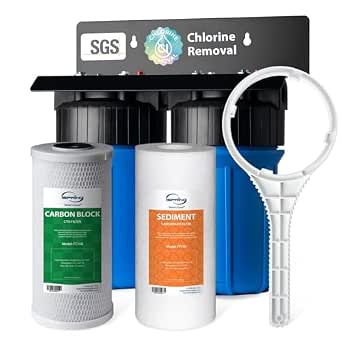 | Best for Straightforward Chlorine and Sediment Reduction | Filtration stages: 2 | Sediment filter: 5-micron polypropylene | Carbon filter: CTO carbon block | VIEW ON AMAZON | See Our Full Breakdown |
| Waterdrop WHF3E-SKH 3-Stage Whole House Water Filter System |  | Best for High Stated Filter Capacity | Filtration stages: 3 | Maximum flow rate: 15 GPM | Capacity: Up to 250,000 gallons | VIEW ON AMAZON | See Our Full Breakdown |
| iSpring WGB32B 3-Stage Whole House Water Filter System |  | Best for Extra Carbon Filtration | Filtration stages: 3 | Filter types: 5-micron sediment filter and two CTO carbon block filters | Maximum flow rate: 15 GPM | VIEW ON AMAZON | See Our Full Breakdown |
| HQUA WF3-01 3-Stage Whole House Water Filtration System | 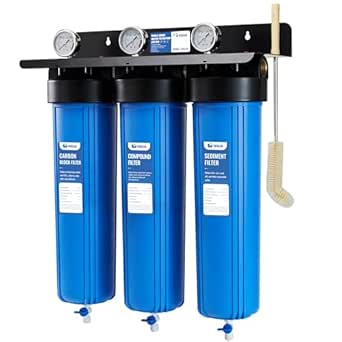 | Best for Maintenance Monitoring | Filtration stages: 3 | Filter size: 20 × 5.5 inches | Maximum flow rate: 15 GPM | VIEW ON AMAZON | See Our Full Breakdown |
| Coospider-repta 55W Whole House UV Water Purifier, 12 GPM |  | Best UV Add-On for Pre-Filtered Water | Model: HSTUV-55 | Power: 55W | Maximum flow rate: 12 GPM | VIEW ON AMAZON | See Our Full Breakdown |
| Whole House Water Filter System with 9 Filters, 0.5-Micron, 3-Stage Filtration |  | Best for a Ready-to-Replace Filter Supply | Filtration stages: 3 | Included filters: 9 total: 3 PP sediment, 3 GAC carbon, and 3 CTO carbon-block filters | Maximum flow rate: 15 GPM | VIEW ON AMAZON | See Our Full Breakdown |
| iSpring WGB32BM 3-Stage Whole-House Water Filter System |  | Best for Well Water with Iron and Manganese | Model: WGB32BM | Filtration stages: 3 | Maximum iron reduction: 3.0 ppm | VIEW ON AMAZON | See Our Full Breakdown |
| Kind Water Systems E-3000UV Whole-House Salt-Free Water Softener and Filter Combo with UV |  | Best Multi-Treatment Option for City Water | Model: E-3000UV | Filtration: Sediment and carbon block | Water treatment: Salt-free scale reduction and UV treatment | VIEW ON AMAZON | See Our Full Breakdown |
| Aquasana Rhino Whole House Water Filter System with UV, Salt-Free Conditioner, and Pro Kit |  | Best Long-Life Premium System | Model: WH-1000-CS-UVS-B | Capacity: Up to 1,000,000 gallons | Maximum flow rate: 14.6 GPM | VIEW ON AMAZON | See Our Full Breakdown |
| Brio Whole House Water Filter System with Gauges, 2-Stage Filtration |  | Best for Straightforward, Serviceable Filtration | Model: FSWH220STD | Filtration stages: 2 | Filter types: 5-micron sediment and CTO carbon block | VIEW ON AMAZON | See Our Full Breakdown |
| 3-Stage Whole House Water Filter System with 2-Year Filter Supply |  | Best for Budget-Conscious Well Owners | Filtration Stages: 3 | Filter Supply: 3 sets (9 filters total) | Maximum Flow Rate: 15 gpm | VIEW ON AMAZON | See Our Full Breakdown |
| Express Water Ultimate Protection 3-Stage Whole House Water Filter System |  | Best for Hard Water Areas | Filtration Stages: 3 | Purification Method: Activated carbon, KDF, polyphosphate | Maximum Flow Rate: 17 gpm | VIEW ON AMAZON | See Our Full Breakdown |
| HQUA WF3-03 3-Stage Whole House Water Filtration System with UV Filter | 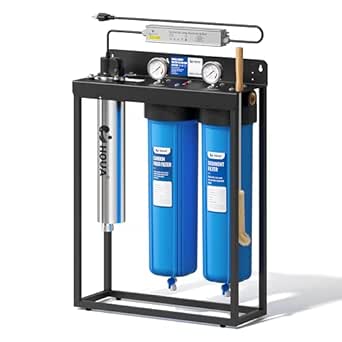 | Best for Microbiological Safety | Filtration Stages: 3 | Purification Methods: Carbon block, ion exchange, UV | Maximum Flow Rate: 15 GPM | VIEW ON AMAZON | See Our Full Breakdown |
| Express Water Ultimate Protection 3-Stage Whole House Water Filter System |  | Best for High-Sediment Water | Filtration Stages: 3 | Sediment Filter: Reusable 50-micron spin-down | Maximum Flow Rate: 17 gpm | VIEW ON AMAZON | See Our Full Breakdown |
| Waterdrop WHF2E-PC Whole House Water Filter System |  | Best for Municipal Water Users | Filtration Stages: 4 | Maximum Flow Rate: 15 gpm | Filter Life: 50,000 gallons or 6 months | VIEW ON AMAZON | See Our Full Breakdown |
| whole house water filtration system | Maximum flow rate | Filtration stages | Capacity |
|---|---|---|---|
| iSpring WGB21B Two-Stage Whole | 15 GPM | 2 | — |
| Waterdrop WHF3E-SKH 3-Stage Wh | 15 GPM | 3 | Up to 250,000 gallons |
| iSpring WGB32B 3-Stage Whole H | 15 GPM | 3 | Up to 100,000 gallons |
| HQUA WF3-01 3-Stage Whole Hous | 15 GPM | 3 | 100,000 gallons |
| Coospider-repta 55W Whole Hous | 12 GPM | — | — |
| Whole House Water Filter Syste | 15 GPM | 3 | 10,000 gallons |
| iSpring WGB32BM 3-Stage Whole- | 15 GPM | 3 | 100,000 gallons |
| Kind Water Systems E-3000UV Wh | — | — | 15 gallons |
| Aquasana Rhino Whole House Wat | 14.6 GPM | — | Up to 1,000,000 gallons |
| Brio Whole House Water Filter | — | 2 | 900 gallons |
| 3-Stage Whole House Water Filt | 15 gpm | 3 | 10,000 gallons |
| Express Water Ultimate Protect | 17 gpm | 3 | 100,000 gallons |
| HQUA WF3-03 3-Stage Whole Hous | 15 GPM | 3 | 100,000 gallons |
| Express Water Ultimate Protect | 17 gpm | 3 | 100,000 gallons |
| Waterdrop WHF2E-PC Whole House | 15 gpm | 4 | — |
More Details on Our Top Picks
iSpring WGB21B Two-Stage Whole House Water Filtration System, 50,000 Gallons
The iSpring WGB21B keeps whole-house treatment focused: a 5-micron sediment filter catches particles, while a carbon block filter targets chlorine, cloudiness, taste, and odor. Its 15 GPM maximum flow and 1-inch ports suit homes that want treated water at multiple fixtures without adding a powered system. Compared with the iSpring WGB32B, it uses two stages instead of three and has half the stated capacity, so it is the simpler fit when basic sediment and chlorine concerns lead the decision. The tradeoff is narrower treatment: it does not reduce total dissolved solids, and the cartridge set needs periodic replacement. I’d choose it for routine municipal-water improvement, not as a fix for a specific dissolved contaminant or a substitute for water testing.
Pros:- Two-stage sediment and carbon-block filtration addresses common particles, chlorine, taste, and odor concerns.
- Maximum flow rate of 15 GPM and 1-inch connections support whole-house use.
- Stated capacity of up to 50,000 gallons.
- Retains dissolved minerals and operates without electricity.
Cons:- Does not reduce total dissolved solids.
- Stated capacity is lower than the iSpring WGB32B’s 100,000 gallons.
- Filters require periodic replacement, up to about once a year.
Best for: Homeowners seeking a relatively simple, no-power system to reduce sediment, chlorine, and unpleasant taste or odor throughout the house.
Not ideal for: Households needing total dissolved solids reduction or targeted treatment for contaminants beyond the system’s stated sediment and carbon filtration.
- Filtration stages:2
- Sediment filter:5-micron polypropylene
- Carbon filter:CTO carbon block
- Filter capacity:Up to 50,000 gallons
- Maximum flow rate:15 GPM
- Inlet/outlet size:1 inch
- Operating pressure:Up to 80 psi
- Dimensions:26 × 19 × 11 inches
Our verdict“Choose the WGB21B for straightforward whole-house sediment and chlorine filtration, but pick the WGB32B if you want an added carbon stage and greater stated capacity.”
Waterdrop WHF3E-SKH 3-Stage Whole House Water Filter System
The Waterdrop WHF3E-SKH is the capacity-led choice in this group, with a 250,000-gallon stated capacity alongside three filtration stages aimed at scale, chlorine, lead, sediment, taste, and odor. Its 15 GPM flow rating and 1-inch connections match the iSpring systems, while the larger stated capacity may appeal to households hoping to avoid more frequent cartridge changes. The iSpring WGB32B is a simpler alternative with a 100,000-gallon capacity and a clearly described sediment-plus-carbon configuration; Waterdrop claims broader reduction targets, but performance can vary with source water and use. Its NSF/ANSI 372 certification concerns lead content in plumbing components, while testing is referenced to NSF/ANSI 42 and 53. I’d verify the specific claims against your water test before buying, and budget for annual filter replacement.
Pros:- Three filtration stages target scale, chlorine, lead, sediment, taste, and odor.
- Stated capacity reaches up to 250,000 gallons.
- 15 GPM maximum flow rate with 1-inch inlet and outlet connections.
- External lifespan trackers can help monitor filter replacement timing.
Cons:- Actual filter performance depends on source-water quality and household use.
- Filters may still require replacement as often as once per year.
- Certification and testing details should not be mistaken for proof of every stated contaminant-reduction claim.
Best for: Households prioritizing a high stated filtration capacity and seeking a multi-stage system with reduction targets that include scale and lead.
Not ideal for: Buyers who need a treatment choice based on independently verified performance for a specific contaminant or who prefer a simpler, more explicitly described filter setup.
- Filtration stages:3
- Maximum flow rate:15 GPM
- Capacity:Up to 250,000 gallons
- Filter life:Up to 1 year
- Filtration method:Activated carbon and sedimentation
- Operating pressure range:20–90 psi
- Inlet/outlet:1 inch
- Certifications and testing:NSF/ANSI 372 certified; tested with reference to NSF/ANSI 42 and 53
Our verdict“Choose Waterdrop for its unusually high stated capacity and broad reduction targets, provided you confirm its claims match your water and accept annual maintenance.”
iSpring WGB32B 3-Stage Whole House Water Filter System
With a 5-micron sediment filter followed by two coconut-shell carbon block filters, the iSpring WGB32B gives chlorine, sediment, rust, taste, and odor reduction more emphasis than the two-stage WGB21B. That extra carbon stage is the main reason to choose it: the stated capacity rises to 100,000 gallons, while maximum flow remains 15 GPM. It also retains dissolved minerals, so this is filtration rather than water softening or TDS removal. Compared with the Waterdrop WHF3E-SKH, the WGB32B offers a more plainly specified filter arrangement but a lower stated capacity and fewer listed reduction targets. The tradeoff is a sizable 45-pound assembly and recurring filter changes. I’d shortlist it for homes wanting a familiar sediment-and-carbon approach and enough room for a substantial DIY installation.
Pros:- Three-stage layout combines a 5-micron sediment filter with two carbon block filters.
- Stated capacity of up to 100,000 gallons and maximum flow of 15 GPM.
- Targets chlorine, sediment, rust, tastes, and odors while retaining dissolved minerals.
- Designed for DIY installation and includes a manual and housing wrench.
Cons:- Does not reduce total dissolved solids.
- The 45-pound system requires adequate mounting space and support.
- Filters need periodic replacement.
Best for: Homeowners with space for a full-size DIY system who want three stages focused on sediment and carbon filtration, including chlorine and taste reduction.
Not ideal for: Buyers who need TDS reduction, a compact installation, or a system selected for a specific contaminant not covered by the stated claims.
- Filtration stages:3
- Filter types:5-micron sediment filter and two CTO carbon block filters
- Maximum flow rate:15 GPM
- Capacity:Up to 100,000 gallons
- Filter life:1 year
- Inlet/outlet:1-inch NPT
- Operating pressure:25–80 psi
- Dimensions and weight:24.5 × 8 × 28 inches; 45 pounds
Our verdict“Pick the WGB32B over the WGB21B if you want an additional carbon stage and higher stated capacity, and have room for its full-size housing.”
HQUA WF3-01 3-Stage Whole House Water Filtration System
The HQUA WF3-01 is the maintenance-conscious pick: pressure gauges help reveal changing pressure across the system, while 180-day timers provide a reminder to check filter life. Its sediment, carbon block, and GAC+KDF stages target sediment, chlorine, odors, heavy metals, and other chemicals, with a stated capacity of 100,000 gallons and a 15 GPM maximum flow. Compared with the iSpring WGB32B, HQUA adds visible monitoring hardware and adapters for either 3/4-inch or 1-inch NPT fittings; the iSpring has a simpler stated filter combination. HQUA’s wider operating-pressure range is useful for some plumbing setups, but it does not remove the need to confirm contaminant claims against your water. At 44 pounds and 22 inches long, it also calls for a dedicated installation area.
Pros:- Pressure gauges provide a way to monitor system pressure and possible filter restriction.
- 180-day filter-life timers help prompt routine maintenance checks.
- Three stages target sediment, chlorine, odors, heavy metals, and other chemicals.
- Adapters accommodate 3/4-inch and 1-inch NPT fittings.
Cons:- The 44-pound, 22 × 9.5 × 28-inch assembly needs substantial installation space.
- Cartridges require periodic replacement.
- Stated contaminant-reduction targets should be checked against independent performance information and the household’s water test.
Best for: Homeowners who want gauges and timed reminders to help track filter maintenance, especially those matching either 3/4-inch or 1-inch NPT plumbing.
Not ideal for: Small utility areas or buyers who want a compact system, minimal installation hardware, or treatment verified for a specific water issue.
- Filtration stages:3
- Filter size:20 × 5.5 inches
- Maximum flow rate:15 GPM
- Capacity:100,000 gallons
- Operating pressure:25–116 psi
- Temperature range:40–125 °F
- Maximum supported TDS:500 ppm
- Filter timer:180 days
Our verdict“Choose the HQUA WF3-01 if visible maintenance cues and flexible pipe adapters matter more than a smaller installation footprint.”
Coospider-repta 55W Whole House UV Water Purifier, 12 GPM
Unlike the cartridge systems here, the Coospider-repta is a UV treatment stage, not a stand-alone sediment or carbon filter. Its 55W lamp sits in a stainless steel chamber, and a flow sensor switches the lamp on when water moves, then keeps it on for five minutes after flow stops. That design makes it a potential final stage for a whole-house setup, including some well-water applications, when paired with suitable pre-filtration. By contrast, the HQUA WF3-01 uses three physical filtration stages aimed at sediment, chlorine, and other reduction targets; it does not serve the same role as a UV unit. Coospider-repta’s 12 GPM maximum is also below the 15 GPM ratings of the cartridge systems. It needs 120V power, pre-filtered water, and periodic lamp replacement.
Pros:- UV treatment can serve as a final stage in a pre-filtered whole-house setup.
- Flow sensor activates the lamp with water flow and keeps it on for five minutes afterward.
- Stainless steel chamber is designed for inline plumbing installation.
- Includes the UV lamp, quartz sleeve, ballast, and mounting hardware.
Cons:- Designed for pre-filtered water and does not replace sediment or carbon filtration.
- Maximum flow rate of 12 GPM is lower than the 15 GPM cartridge systems in this lineup.
- Requires 120V power and regular UV lamp replacement.
Best for: Well-water households or other buyers adding UV treatment after sediment and other suitable pre-filtration, with plumbing flow within the 12 GPM limit.
Not ideal for: Anyone seeking a complete whole-house filtration system in one unit, households without a suitable pre-filter, or installations that need more than 12 GPM.
- Model:HSTUV-55
- Power:55W
- Maximum flow rate:12 GPM
- Purification method:Ultraviolet
- Chamber material:Stainless steel
- Connection:3/4-inch MNPT inlet and outlet
- Voltage:120V
- Lamp shutoff delay:5 minutes
Our verdict“Choose this unit as a UV add-on for an already pre-filtered whole-house system, not as your only treatment stage.”
Whole House Water Filter System with 9 Filters, 0.5-Micron, 3-Stage Filtration
This system’s clearest advantage over the iSpring WGB32BM is what comes in the box: three complete sets of sediment, GAC, and carbon-block filters, giving owners replacements on hand rather than a single initial set. Its clear housings also make trapped debris visible, which can help when judging how quickly source water is loading the sediment stage. At 15 GPM, it is specified to support simultaneous household use, and its 3/4-inch connections suit homes with that plumbing size. The tradeoff is ongoing maintenance: filters are listed for replacement every six months, and the stated 10,000-gallon capacity is far below the iSpring’s 100,000-gallon rating. Like both systems, it preserves minerals and does not reduce TDS, so it is not a solution for dissolved salts.
Pros:- Includes three full sets of sediment and carbon filters
- 15 GPM maximum flow rate is suited to multiple taps
- Clear housings allow visual checks for sediment buildup
- Targets chlorine, rust, sediment, and odors while retaining minerals
Cons:- Listed filter replacement interval is only six months
- 10,000-gallon capacity is much lower than the iSpring WGB32BM’s listed capacity
- Does not reduce TDS
Best for: Homeowners with 3/4-inch main-line plumbing who want replacement filters included and need chlorine, odor, rust, and sediment reduction.
Not ideal for: Households seeking lower-maintenance filtration, TDS reduction, or a system sized for 1-inch connections.
- Filtration stages:3
- Included filters:9 total: 3 PP sediment, 3 GAC carbon, and 3 CTO carbon-block filters
- Maximum flow rate:15 GPM
- Connection size:3/4 inch
- Filter life:6 months
- Capacity:10,000 gallons
- Dimensions:14 × 13 × 10 inches
- TDS reduction:Does not reduce TDS
Our verdict“Choose this if having several replacement sets ready matters more than longer filter life or dissolved-solids reduction.”
iSpring WGB32BM 3-Stage Whole-House Water Filter System
Among these options, the iSpring WGB32BM is the more targeted pick for households dealing with iron and manganese: its listed reduction limits are 3.0 ppm iron and 1.0 ppm manganese, alongside sediment, chlorine, and rust filtration. That gives it a different purpose from the included-filter-focused 9-filter system, which does not list iron or manganese treatment. A 100,000-gallon capacity and filter life of up to one year also mean fewer planned changes than that system’s six-month schedule. The compromise is installation and scope. This is a 55-pound permanent main-line unit with 1-inch NPT connections, not a compact, quick-fit option, and it does not reduce TDS. Buyers should check their water test results against its stated reduction limits rather than assume it handles every well-water issue.
Pros:- Specifies reduction limits for iron and manganese
- 100,000-gallon listed capacity and up to one-year filter life
- 15 GPM maximum flow rate
- 1-inch NPT connections suit compatible main-line plumbing
Cons:- Requires permanent installation on the main water line
- At 55 pounds, it is heavier and less compact than the 9-filter system
- Does not reduce TDS
Best for: Well-water households whose test results show iron or manganese within the system’s stated reduction limits and whose main line uses 1-inch connections.
Not ideal for: Renters, owners who need a portable or under-sink unit, or households seeking TDS reduction or treatment beyond the listed iron and manganese limits.
- Model:WGB32BM
- Filtration stages:3
- Maximum iron reduction:3.0 ppm
- Maximum manganese reduction:1.0 ppm
- Maximum flow rate:15 GPM
- Capacity:100,000 gallons
- Inlet/outlet:1-inch NPT
- Sediment filtration:Down to 5 microns
- Operating pressure:25–80 psi
Our verdict“Pick the WGB32BM when iron and manganese are the main concerns and your plumbing and water test match its specifications.”
Kind Water Systems E-3000UV Whole-House Salt-Free Water Softener and Filter Combo with UV
The Kind E-3000UV combines sediment and carbon-block filtration with salt-free scale reduction and UV treatment, making it a broader treatment package than the Brio’s two-stage sediment-and-carbon setup. It is designed for city water and lists reduction of over 155 chemical contaminants, plus up to 99.9% microorganism reduction. The salt-free approach avoids salt and brine discharge, but it should not be mistaken for conventional ion-exchange softening; buyers looking to reduce water hardness itself should check whether scale control meets their needs. Its 29 × 23.25 × 29-inch footprint also calls for more installation room than the Brio. The product data lists a 15-gallon capacity, so I would not assume a long service interval without clarification from the manufacturer. This makes most sense when several treatment functions matter more than a compact setup.
Pros:- Combines sediment and carbon-block filtration with salt-free scale control and UV
- Lists reduction of over 155 chemical contaminants
- Lists up to 99.9% microorganism reduction
- Salt-free scale treatment uses no brine discharge
Cons:- Designed for city water rather than well-water applications
- Large dimensions may complicate installation in confined utility areas
- Listed capacity is 15 gallons, with no longer service interval specified in the supplied data
Best for: City-water households seeking sediment and chemical filtration, salt-free scale control, and UV treatment in one installed system.
Not ideal for: Homes with well water, tight utility spaces, or buyers who need conventional salt-based softening or a clearly stated large treatment capacity.
- Model:E-3000UV
- Filtration:Sediment and carbon block
- Water treatment:Salt-free scale reduction and UV treatment
- Chemical contaminant reduction:Over 155 chemical contaminants
- Microorganism reduction:Up to 99.9%
- Maximum supported TDS:1,282 ppm
- Capacity:15 gallons
- Dimensions:29 × 23.25 × 29 inches
Our verdict“Choose the E-3000UV if you have city water and want several treatment methods together, provided you can accommodate its footprint.”
Aquasana Rhino Whole House Water Filter System with UV, Salt-Free Conditioner, and Pro Kit
The Aquasana Rhino is the longest-horizon system in this group: its 1,000,000-gallon or 10-year rating sets it apart from the Kind E-3000UV, whose supplied data lists a 15-gallon capacity without a comparable lifespan. The Rhino also layers sediment pre-filtration, carbon and KDF media, salt-free scale control, post-filtration, and UV treatment, with UV certification to NSF/ANSI Standard 55, Class B. That breadth suits buyers who want a built-in treatment train rather than the Brio’s simpler two-stage filtration. There are limits: the system is specified for hardness under 15 gpg and TDS up to 500 ppm, and its UV stage needs corded power. Its 46 × 9 × 69-inch dimensions demand a tall installation area, so the long rated life comes with a substantial space commitment.
Pros:- Rated for up to 1,000,000 gallons or 10 years
- Combines sediment, carbon, KDF, post-filtration, scale control, and UV
- UV is certified to NSF/ANSI Standard 55, Class B
- Salt-free scale control requires no salt bags or backwashing
Cons:- Recommended for water hardness under 15 gpg
- UV treatment requires corded electrical power
- 69-inch height can be difficult to fit in some utility spaces
Best for: Homeowners planning a long-term whole-house installation who want multi-stage filtration, salt-free scale control, and UV treatment for water under 15 gpg hardness.
Not ideal for: Homes with harder water, TDS above the stated limit, little vertical utility space, or no convenient electrical outlet near the installation.
- Model:WH-1000-CS-UVS-B
- Capacity:Up to 1,000,000 gallons
- Maximum flow rate:14.6 GPM
- Treatment stages:Sediment pre-filter, carbon, KDF, salt-free scale control, post-filter, and UV
- Chlorine reduction:Up to 97%
- UV certification:NSF/ANSI Standard 55, Class B
- Recommended water hardness:Under 15 gpg
- Maximum supported TDS:500 ppm
- Dimensions:46 × 9 × 69 inches
Our verdict“Choose the Rhino for a long-term, multi-stage installation if your water hardness and available space fit its stated limits.”
Brio Whole House Water Filter System with Gauges, 2-Stage Filtration
The Brio is the simpler choice here: its 5-micron sediment filter catches particles before the CTO carbon block targets taste and odor concerns, while gauges give owners a way to monitor the system. Its reversible bracket and standard 1-inch connections add installation flexibility, and it accepts universal-fit 4.5 × 20-inch filters. Compared with the Aquasana Rhino, Brio has no UV, scale-control, or KDF stages; that narrower setup can be easier to match to a household that wants basic filtration without a multi-treatment system. The tradeoff is that the listed 900-gallon capacity is limited compared with the iSpring WGB32BM’s 100,000 gallons, while filter life varies with source water. At 36.5 pounds, it also needs secure mounting. It is not a TDS-reduction system.
Pros:- Pairs 5-micron sediment filtration with a CTO carbon-block filter
- Gauges support monitoring of system conditions
- Reversible mounting bracket offers installation flexibility
- Accepts universal-fit 4.5 × 20-inch filters
Cons:- Listed capacity is 900 gallons, well below the iSpring WGB32BM’s 100,000 gallons
- Filter life varies with source-water quality
- Weighs 36.5 pounds and requires secure mounting
Best for: Homeowners with 1-inch plumbing who want basic sediment and carbon filtration, gauges, and the flexibility to use universal-fit cartridges.
Not ideal for: Households needing UV treatment, scale control, a high listed capacity, or a lighter system for mounting on a less robust surface.
- Model:FSWH220STD
- Filtration stages:2
- Filter types:5-micron sediment and CTO carbon block
- Filter size:4.5 × 20 inches
- Connections:1 inch
- Filter life:Up to 12 months, depending on water quality
- Capacity:900 gallons
- Weight:36.5 pounds
Our verdict“Pick the Brio for basic, serviceable whole-house sediment and carbon filtration if its limited listed capacity suits your maintenance plan.”
3-Stage Whole House Water Filter System with 2-Year Filter Supply
This system stands out primarily for its included filter inventory, which covers approximately two years of maintenance. Unlike the Express Water Ultimate Protection models that require frequent cartridge purchases, this unit bundles three sets of PP, GAC, and CTO filters, lowering the initial long-term cost barrier. It is designed to preserve natural minerals while reducing sediment and chlorine, making it suitable for well water where TDS reduction is not a priority. However, the 15 gpm flow rate is modest compared to competitors, which may impact simultaneous shower and laundry usage. The under-sink installation type listed in specs is unusual for a whole-house unit, but the 3/4-inch plumbing fit suggests it integrates into standard main lines. If you need TDS reduction, this is the wrong choice; if you want basic protection with minimal upfront maintenance hassle, it offers strong value.
Pros:- Includes three full sets of replacement filters for ~2 years of service
- Built-in shut-off and bypass valves simplify cartridge changes
- Preserves beneficial minerals while reducing chlorine and sediment
Cons:- Does not lower Total Dissolved Solids (TDS) or remove heavy metals
- Moderate 15 gpm flow rate may restrict simultaneous high-volume usage
Best for: Homeowners on well water seeking low upfront maintenance costs who do not need TDS reduction.
Not ideal for: Large households with high simultaneous water demand or those needing heavy metal removal.
- Filtration Stages:3
- Filter Supply:3 sets (9 filters total)
- Maximum Flow Rate:15 gpm
- Plumbing Fit:3/4 inch
- Capacity:10,000 gallons
- TDS Reduction:No
- Filter Life Cycle:6 months
Our verdict“This unit is the smart pick for budget-focused well owners who prioritize included consumables over advanced contaminant removal.”
Express Water Ultimate Protection 3-Stage Whole House Water Filter System
This model differentiates itself by targeting hard water issues alongside standard filtration. The inclusion of polyphosphate filtration helps prevent scale buildup in pipes and appliances, a feature missing from basic sediment-and-carbon setups like the Waterdrop WHF2E-PC. It effectively reduces chlorine and specific heavy metals such as lead and arsenic, offering broader protection than simple carbon blocks. The stainless steel construction and pressure gauges provide durability and monitoring capabilities that plastic housings lack. However, the tradeoff is significant physical bulk; at 63 pounds and nearly 3 feet wide, it requires substantial installation space. While the 17 gpm flow rate supports larger homes, the six-month filter life means higher ongoing maintenance frequency compared to systems with longer-lasting cartridges.
Pros:- Polyphosphate media actively reduces scale buildup in plumbing
- Reduces lead, arsenic, and other heavy metals effectively
- Includes pressure gauges for easy system monitoring
Cons:- Heavy stainless steel housing requires considerable installation space
- Filters require replacement every six months, increasing upkeep
Best for: Households in hard water regions needing scale prevention and heavy metal reduction.
Not ideal for: Homeowners with limited utility room space or those seeking low-maintenance filters.
- Filtration Stages:3
- Purification Method:Activated carbon, KDF, polyphosphate
- Maximum Flow Rate:17 gpm
- Capacity:100,000 gallons
- Weight:63 lb
- Material:Stainless steel
- Operating Pressure:20–80 psi
Our verdict“Choose this system if scale buildup and heavy metals are your primary water quality concerns.”
HQUA WF3-03 3-Stage Whole House Water Filtration System with UV Filter
The HQUA WF3-03 earns its place by addressing a critical gap in standard filtration: microbiological contamination. By integrating a 55W UV filter alongside carbon and ion exchange stages, it targets bacteria, viruses, and PFAS, which mechanical filters like the Express Water Ultimate Protection cannot fully eliminate. This makes it a stronger choice for homes with private wells at risk of bacterial intrusion. The system offers flexible freestanding or wall-mounted installation, adapting to various utility layouts better than the fixed-freestanding Express Water units. However, the complexity of maintaining a UV bulb and multiple filter types demands more attention. The 15 gpm flow rate is adequate but not exceptional, and the 44-pound weight still requires sturdy mounting. This is not a set-and-forget solution; it requires regular UV lamp checks.
Pros:- UV stage disinfects water, reducing bacteria and viruses
- Reduces PFAS and heavy metals alongside standard contaminants
- Flexible installation options (wall or freestanding)
Cons:- Requires maintenance of UV lamp and multiple filter types
- Large footprint necessitates significant installation space
Best for: Well water users concerned about bacteria, viruses, and PFAS contamination.
Not ideal for: Buyers seeking a simple, low-maintenance system without electrical components.
- Filtration Stages:3
- Purification Methods:Carbon block, ion exchange, UV
- Maximum Flow Rate:15 GPM
- UV Filter Power:55 W
- Capacity:100,000 gallons
- Weight:44 lb
- Installation:Freestanding or wall-mounted
Our verdict“This is the definitive choice for well owners prioritizing disinfection and PFAS reduction over simplicity.”
Express Water Ultimate Protection 3-Stage Whole House Water Filter System
This variant of the Express Water line distinguishes itself with a reusable 50-micron spin-down sediment filter. Unlike the standard PP sediment filters in the 3-Stage Whole House Water Filter System with 2-Year Filter Supply, this prefilter can be flushed and reused, extending the life of the downstream carbon and anti-scale cartridges. This design is particularly advantageous for homes with high sediment loads, such as those on well water or in areas with aging municipal pipes. The 17 gpm flow rate and 100,000-gallon capacity match its siblings, ensuring robust performance for larger households. The quick-change cartridge design simplifies swaps, though the 66-pound weight and large dimensions remain a challenge for tight utility spaces. It is a robust, maintenance-friendly option for sediment-heavy environments.
Pros:- Reusable spin-down prefilter extends life of main cartridges
- High 17 gpm flow rate supports multiple simultaneous uses
- Quick-change cartridges simplify routine maintenance
Cons:- Heavy and bulky unit requires substantial installation space
- Main cartridges still require replacement every six months
Best for: Homes with high sediment levels needing extended main filter life.
Not ideal for: Small apartments or homes with very clean municipal water.
- Filtration Stages:3
- Sediment Filter:Reusable 50-micron spin-down
- Maximum Flow Rate:17 gpm
- Capacity:100,000 gallons
- Connections:1 inch
- Weight:66 pounds
- Materials:ABS and stainless steel
Our verdict“This model is the most practical choice for households battling heavy sediment in their water supply.”
Waterdrop WHF2E-PC Whole House Water Filter System
Designed specifically for municipal water systems, the Waterdrop WHF2E-PC excels at reducing chlorine, odors, and VOCs without over-engineering for well water issues. Its four-stage process includes a scale inhibitor, making it a compact alternative to the bulky Express Water Ultimate Protection for city dwellers concerned about mineral buildup. The insert-fit cartridge design and included replacement timer streamline maintenance, addressing the common pain point of forgetting filter changes. At 15 gpm, it handles typical household demands efficiently. However, its 50,000-gallon capacity is lower than the 100,000-gallon rivals, potentially requiring more frequent replacements for large families. It lacks the heavy metal and UV capabilities of the HQUA WF3-03, making it unsuitable for private wells but a streamlined, effective solution for treated city water.
Pros:- Specifically optimized for municipal water chlorine and VOC removal
- Scale inhibitor protects plumbing from mineral buildup
- Replacement timer prevents missed filter changes
Cons:- Lower 50,000-gallon capacity compared to competitors
- Lacks advanced heavy metal or UV disinfection capabilities
Best for: City water users focused on chlorine, taste, and odor improvement.
Not ideal for: Well water owners or those needing heavy metal and bacterial removal.
- Filtration Stages:4
- Maximum Flow Rate:15 gpm
- Filter Life:50,000 gallons or 6 months
- Inlet/Outlet:1-inch FNPT
- Certification:NSF/ANSI 372
- Dimensions:15.19 x 8.39 x 16.44 inches
- Power Source:None required
Our verdict“This compact system is the ideal fit for municipal water customers seeking taste and odor improvement with minimal fuss.”

How We Picked
I evaluated these fifteen systems based on filtration capacity, flow rate consistency, and long-term maintenance burden. A system might claim to filter 100,000 gallons, but if the flow rate drops below 10 gallons per minute (GPM) under typical household load, it becomes impractical for families with multiple bathrooms. I prioritized models that maintain steady pressure while removing a broad spectrum of contaminants, including sediment, chlorine, and volatile organic compounds (VOCs).
Build quality and housing durability were also critical factors. I favored systems with brass or heavy-duty composite fittings over plastic-only connections, which are prone to cracking under high pressure or thermal expansion. Finally, I assessed the availability of replacement filters. A great filter is useless if you cannot source the cartridges locally or online without a six-week wait, so I ranked systems higher if they utilized standard, widely available filter sizes or had robust manufacturer support networks.
Factors to Consider When Choosing Whole House Water Filtration Systems
Selecting a whole house system requires looking beyond the marketing claims to understand how the unit interacts with your home’s specific plumbing and water chemistry.Matching Filtration Stages to Contaminant Types
Many buyers mistakenly assume all filters remove all contaminants. A 2-stage system typically handles sediment and chlorine, which improves taste and protects appliances, but it will not remove heavy metals like lead or bacteria. If your water test reveals high levels of dissolved solids or pathogens, you need a 3-stage system or one with specialized media like KDF (Kinetic Degradation Fluxion) or catalytic carbon. Skipping this step leads to buying a system that does nothing for your actual problem, wasting money on ineffective protection.
Understanding Flow Rate and Pressure Drop
Flow rate is often the most overlooked specification. A filter rated for 15 GPM might sound sufficient, but if your household has three bathrooms and a washing machine, peak demand can exceed this, causing a noticeable pressure drop. I recommend calculating your peak usage by adding the GPM of your showerheads, faucets, and appliances. If your total exceeds the filter’s rated capacity, you must either install a larger housing, use parallel filters, or accept reduced water pressure during high-demand times.
The Hidden Cost of Proprietary vs. Standard Housings
Some manufacturers lock you into their ecosystem with proprietary filter cartridges that are expensive and difficult to find in local hardware stores. In contrast, systems using standard 20-inch Big Blue housings allow you to buy generic or third-party filters at a fraction of the cost. Over ten years, this difference can amount to thousands of dollars. Unless a proprietary system offers a unique, patented filtration technology that standard filters cannot match, I strongly advise choosing a model with universal housing compatibility for long-term affordability.
UV Systems for Well Water vs. Municipal Supply
If you rely on private well water, a UV (ultraviolet) light component is not optional—it is necessary. Municipal water is already chlorinated to kill bacteria, so UV is often redundant for city dwellers. However, wells are susceptible to bacterial intrusion from runoff or surface water. A system without UV leaves you vulnerable to E. coli and other pathogens. Conversely, city water users might find UV maintenance an unnecessary hassle and expense, making non-UV models a smarter, lower-maintenance choice for them.
Salt-Free Conditioning vs. Traditional Softening
Hard water causes scale buildup that destroys water heaters and reduces soap efficiency. Traditional salt-based softeners exchange calcium for sodium, requiring large amounts of salt and producing brine waste that can harm septic systems and local waterways. Salt-free conditioners, like those in the Aquasana Rhino, use template-assisted crystallization (TAC) to change the structure of minerals so they don’t stick to pipes. While they don’t ‘soften’ water in the traditional sense (the water still feels hard), they prevent scale without the environmental and maintenance drawbacks of salt systems.
Installation Location and Space Requirements
Whole house systems are bulky. A 3-stage system with UV and conditioning tanks can require significant floor space in a garage, basement, or utility room. Measure your available space and check for clearance requirements for filter changes. Some systems are designed for horizontal mounting or have compact footprints, which is vital for homes with tight mechanical rooms. Ignoring physical dimensions can lead to a unit that technically fits but is impossible to service, rendering the filters inaccessible for replacement.
Frequently Asked Questions
Do I need a whole house system if I already have a reverse osmosis (RO) filter at my kitchen sink?
Yes, they serve completely different purposes. An RO filter cleans drinking water at one tap, protecting you from ingestion of contaminants, but it does not protect your skin, hair, or plumbing appliances from chlorine, sediment, or scale. Whole house systems filter all water entering the home, extending the life of your water heater, washing machine, and showerheads while improving the quality of water used for bathing and laundry. Using both provides the best protection: RO for drinking/cooking and whole house for bathing/appliance protection.
How often do I need to replace the filters in a whole house system?
This varies by water quality and usage, but generally, sediment pre-filters need replacement every 3 to 6 months, while carbon blocks last 6 to 12 months. Systems with UV lights require bulb changes annually. High sediment loads in well water will clog pre-filters much faster. I recommend checking pressure gauges monthly; a significant drop indicates a clogged filter. Ignoring this can lead to bypassed filtration or pump strain, so establish a maintenance schedule based on your specific water test results rather than generic timelines.
Can whole house filtration systems remove iron from water?
Standard carbon filters are poor at removing dissolved iron and can become clogged or fouled by it, leading to rapid failure. For iron, you need a system with specific iron-removal media, such as Birm, Pyrolox, or greensand, or a system that injects air/oxygen to oxidize the iron before filtration. Many standard 2-stage or 3-stage carbon kits will not handle iron effectively. If your water has an orange tint or metallic taste, ensure the system you choose explicitly lists iron removal capacity in its specifications.
Is it difficult to install a whole house water filtration system myself?
For a handy homeowner, installing a 2-stage system with standard plumbing connections is manageable, often taking a few hours. However, 3-stage systems with UV lights, bypass valves, and conditioning tanks involve more complex plumbing, including cutting into main lines and managing electrical connections for UV units. Mistakes can lead to leaks or cross-contamination. If you are not comfortable working with copper, PEX, or PVC mains and ensuring proper pressure testing, hiring a licensed plumber is a safer investment to guarantee a leak-free, code-compliant installation.
Do these systems affect water pressure in my home?
All filters create some resistance, which can cause a slight pressure drop. The extent depends on the system’s flow rate rating and the condition of the filters. A new, high-flow system (15+ GPM) might have a negligible impact, but as filters clog, pressure will decrease. If you already have low water pressure, adding a restrictive filter will make it worse. In such cases, consider installing the system after a booster pump or choosing a model with oversized housings and high-flow media specifically designed to minimize pressure loss.
Conclusion
Choosing among these whole house water filtration systems depends entirely on your water source and household needs. For most municipal water users, the iSpring WGB21B offers the best value and simplicity, effectively tackling chlorine and sediment without breaking the bank. If you rely on well water, the Aquasana Rhino is the premium choice, combining UV sterilization with salt-free conditioning to address both biological risks and hard water scale. Beginners should stick with the HQUA WF3-01 for its straightforward 3-stage setup and easy filter access. Those concerned with long-term maintenance costs should prioritize systems with standard 20-inch housings like the Express Water Ultimate Protection line. Ultimately, match the system’s capabilities to your water test results: don’t buy UV if you don’t need it, and don’t buy basic carbon if you have iron or bacteria.
Halloween Picks
halloween
As an affiliate, we earn on qualifying purchases.